
Picture credit
"Murex brandaris" by Wenceslaus Hollar — https://commons.wikimedia.org/wiki/File:Wenceslas_Hollar_-_Murex_brabdaris.jpg — Public domain (Wenceslaus Hollar d. 1677, PD in US and EU)
By Tailor, Weaver, Jeweler, Dyer Published
Build card
This card as data: arsenic-green-build-card.csv (CSV) · file notes (JSON): where the values come from, version and license
Data: The Lancet, 1 December 1860, pp. 535 and 554, and 30 November 1861, p. 530; British Medical Journal, 30 November 1861, pp. 584 and 598; Punch, or the London Charivari, 8 February 1862, p. 54 (all public domain; facts restated); Wellcome Collection catalogue data (CC0): 36772i; Evidence status compiled for this page
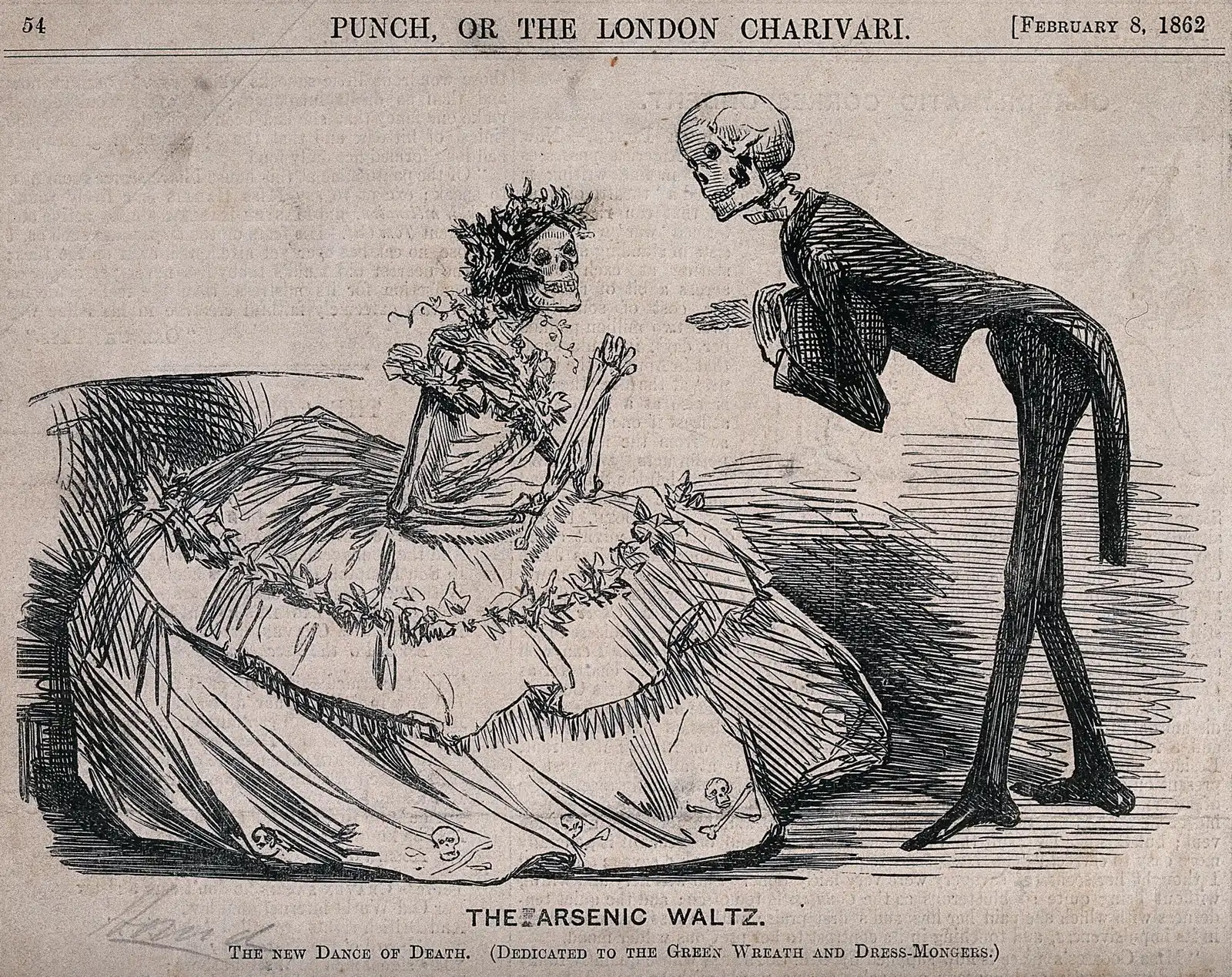
"The Arsenic Waltz," Punch, 8 February 1862, possibly by John Leech, as the Wellcome Collection catalogue records. A skeleton in a leaf wreath and a garlanded ball gown meets a skeleton in evening dress. The engraving is black and white, with no green in it.
"The Arsenic Waltz" by Wellcome Collection — https://commons.wikimedia.org/wiki/File:Two_skeletons_dressed_as_lady_and_gentleman._Etching,_1862._Wellcome_V0042226.jpg — CC BY 4.0 (https://creativecommons.org/licenses/by/4.0/)
In 1861 a young flower maker made leaves colored green with arsenite of copper. An inquest jury blamed Matilda Scheurer's death on that pigment [1]. A year earlier a physician had written that the same green colored leaves worn on bonnets, head-dresses and wreaths [2]. His analysis also found it in the stars on a white evening dress [3].
A dress's color cannot show arsenic, but a test can. A university lab found arsenic in an 1860s silk dress in 2014, while a kit test on another dress in 2019 settled nothing [4][5].
The people who wore these greens are harder to trace. Writers in 1860 and 1861 said wearers suffered too, or probably did, but none named a wearer who did [1][2]. This page therefore marks harm to wearers as evidence insufficient, which is not the same as calling the greens harmless. It covers history only and gives no advice on handling, cleaning, storing or testing old clothes.
Wider than a phone screen: swipe sideways along the diagram, or open it full size.
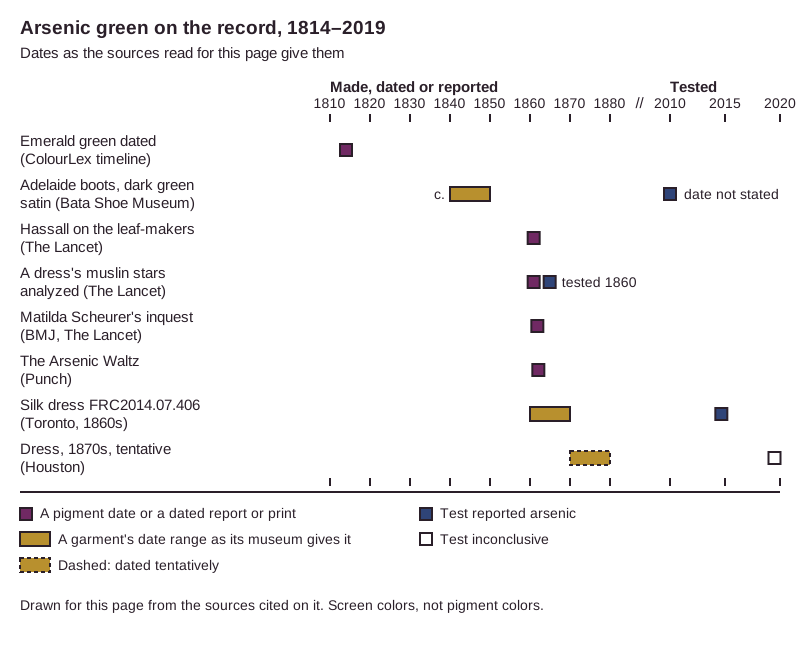
Arsenic green on the record, drawn for this page from the sources it cites: dates of making or reporting in the middle band, dates of testing on the right. Screen colors, not pigment colors.
Diagram: Tailor, Weaver, Jeweler, Dyer, CC BY 4.0
"Arsenic green on the record, 1814–2019" by Tailor, Weaver, Jeweler, Dyer, from https://tailorweaverjewelerdyer.com/color/arsenic-green/. Licensed under CC BY 4.0: https://creativecommons.org/licenses/by/4.0/
Data: The Lancet (1860, 1861), British Medical Journal (1861), Punch (1862), public domain; Dates and test results restated from ColourLex, Toronto Metropolitan University Fashion Research Collection, Houston Museum of Natural Science and Bata Shoe Museum web pages (facts restated, not copied); Drawn for this page
In December 1860 the physician Arthur Hill Hassall gave one green three names: "arsenite of copper, Scheele's green, or emerald green" [2]. He wrote that it colored the green leaves and flowers worn "on bonnets, head-dresses, wreaths, and other similar ornaments" in the past year or two [2]. The reports of the 1861 inquest call it arsenite of copper [1][6].
Later references keep the names apart. ColourLex, a pigment reference, describes emerald green as copper(II) acetoarsenite, also called Paris green and Schweinfurt green, and dates it to 1814 [7][8]. The Wellcome Collection's catalogue pairs Scheele's green with copper arsenite and Paris green with copper acetoarsenite [9]. No source read for this page gives a date or a formula for Scheele's green itself.
A 2024 study in Heritage Science, read here only in its abstract, finds Scheele's green hard to identify in old objects [10]. It says the pigment was often a mixture of uncertain makeup [10]. Making emerald green, it proposes, may have yielded a little Scheele's green [10]. Any account of how these greens were made is historical process, described for history only — these materials are toxic or caustic.
So a test that finds arsenic in an old green does not, on its own, say which green it found. The band above, row by row:
| Date | What happened | Kind of record |
|---|---|---|
| 1814 | Emerald green, as ColourLex dates it | Pigment reference |
| c. 1840s | Adelaide boots in dark green satin (Bata Shoe Museum's date) | Museum page |
| 1 Dec 1860 | Hassall on the leaf-makers | Medical journal |
| 1 Dec 1860 | A white evening dress's stars analyzed: arsenite of copper | Medical journal |
| 30 Nov 1861 | Matilda Scheurer's inquest reported | Two medical journals |
| 8 Feb 1862 | The Arsenic Waltz in Punch | Satirical print |
| 1860s; tested 5 Sep 2014 | Silk dress FRC2014.07.406 A+B+C: arsenic found in a university physics lab | University collection |
| 1870s, tentative; tested 2019 | Dress in Houston, soil test kit: inconclusive | Museum blog |
| Date not stated | Adelaide boots tested: arsenic-based dye found | Museum page |
Wider than a phone screen: swipe sideways along the diagram, or open it full size.
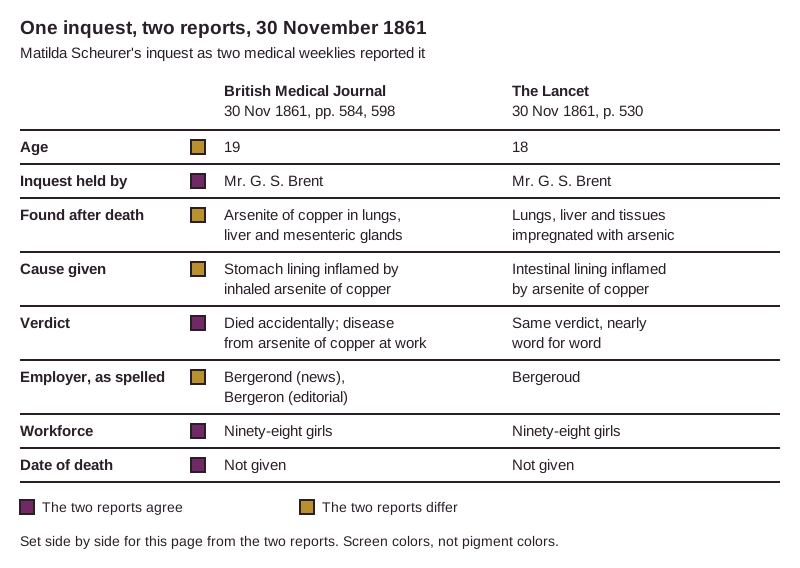
The same inquest in two medical weeklies of 30 November 1861, compared for this page. Screen colors, not pigment colors.
Diagram: Tailor, Weaver, Jeweler, Dyer, CC BY 4.0
"One inquest, two reports, 30 November 1861" by Tailor, Weaver, Jeweler, Dyer, from https://tailorweaverjewelerdyer.com/color/arsenic-green/. Licensed under CC BY 4.0: https://creativecommons.org/licenses/by/4.0/
Data: British Medical Journal, 30 November 1861, pp. 584 and 598, and The Lancet, 30 November 1861, p. 530 (public domain; facts restated); Compared for this page
Matilda Scheurer made leaves in the artificial-flower warehouse of Mr. Bergerond, of Judd Street, Brunswick Square [1]. Her mother told the inquest that she had been ill several times over a year and a half [1]. The surgeon, Mr. Paul, said he had treated her four times in eighteen months [1]. After her death he found arsenite of copper in her lungs, with her liver "highly impregnated" and the mesenteric glands as well [1].
The British Medical Journal gave the cause of death as inflammation of the stomach lining "produced by the inhalation of the arsenite of copper" [1]. The jury found that she "died accidentally, from the effects of mortal disease in her stomach and other organs, occasioned by arsenite of copper used in her employment" [1]. The Lancet printed nearly the same verdict on the same day but gave her age as eighteen, not nineteen [1][6]. Neither report gives the date she died.
A sister of hers "had died under similar circumstances," the British Medical Journal adds [1]. Her employer told the inquest that ninety-eight girls worked for him. They had objected to the masks he suggested as too hot and wore muslin over their mouths instead [1].
The Lancet called masks or muslin "a precaution of the most imperfect and inefficient character" [6]. It wanted the pigment's use made a crime, as it lately had been in France [6]. Hassall had been told there were "from two to three hundred" leaf-makers using it, mostly young women and girls but also some men and boys, all with symptoms of arsenical poisoning [2]. All of this is historical process, described for history only — these materials are toxic or caustic.
The two reports, point by point:
| British Medical Journal, 30 Nov 1861, pp. 584, 598 | The Lancet, 30 Nov 1861, p. 530 | |
|---|---|---|
| Age | 19 | 18 |
| Inquest held by | Mr. G. S. Brent | Mr. G. S. Brent |
| Found after death | Arsenite of copper in lungs, liver and mesenteric glands | Lungs, liver and tissues impregnated with arsenic |
| Cause given | Stomach lining inflamed by inhaled arsenite of copper | Intestinal lining inflamed by arsenite of copper |
| Verdict | Died accidentally; disease from arsenite of copper at work | Same verdict, nearly word for word |
| Employer, as spelled | Bergerond (news), Bergeron (editorial) | Bergeroud |
| Workforce | Ninety-eight girls | Ninety-eight girls |
| Date of death | Not given | Not given |
Wider than a phone screen: swipe sideways along the diagram, or open it full size.
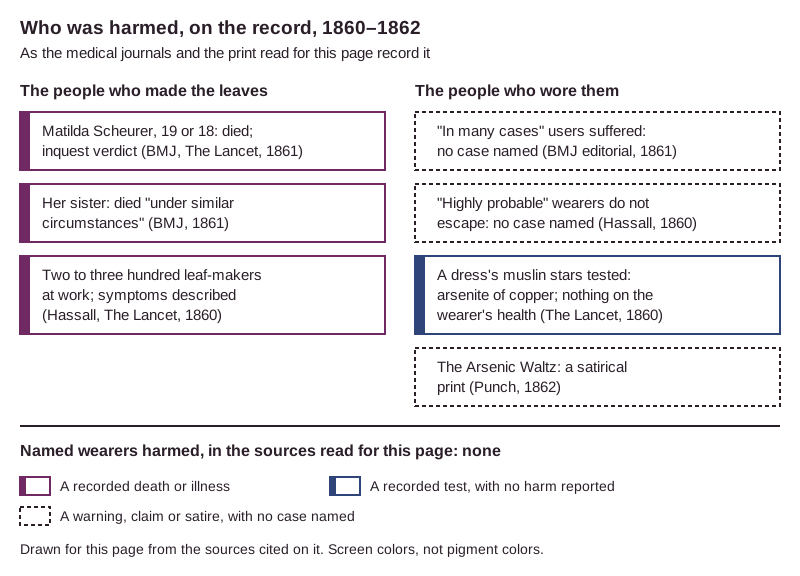
Who was harmed, as the 1860–1862 sources read for this page record it; each entry is described in the text. Screen colors, not pigment colors.
Diagram: Tailor, Weaver, Jeweler, Dyer, CC BY 4.0
"Who was harmed, on the record, 1860–1862" by Tailor, Weaver, Jeweler, Dyer, from https://tailorweaverjewelerdyer.com/color/arsenic-green/. Licensed under CC BY 4.0: https://creativecommons.org/licenses/by/4.0/
Data: The Lancet (1860, 1861), British Medical Journal (1861), Punch (1862), public domain (facts restated); Sorted for this page
Writers of the time said it did, or probably did, but they named no one. After describing the leaf-makers, Hassall wrote: "It is highly probable, however, that the wearers of these ornaments do not altogether escape" [2]. A British Medical Journal editorial of 30 November 1861 was titled "A Word of Caution to the Wearers of Artificial Flowers" [1]. It opened by saying that "in many cases" users of the finished articles had suffered arsenical poisoning, yet the only death it described was the flower maker's [1].
The rest of the editorial pleaded for the makers. It said the journal could "safely assume" that the leaves "giving an artificial verdant splendour to the locks of some of our countrywomen" were the ones whose making had killed the girl [1].
In 1860 a reader sent The Lancet a few stars from a daughter's newly bought white evening dress [3]. Hassall reported that they were "undoubtedly coloured with arsenite of copper" and that slight friction rubbed much of it off [3]. The note says nothing about the daughter's health [3].
Punch made the fear a joke on 8 February 1862 with "The Arsenic Waltz," a dance of skeletons dedicated "to the Green Wreath and Dress-Mongers" [11]. Alison Matthews David's 2015 book Fashion Victims has a chapter titled "Poisonous Pigments: Arsenical Greens" [12]. It could not be read for this page, so nothing here rests on it.
Set side by side, the record holds deaths and illness among the people who made the leaves and only warnings about the people who wore them. Harm to wearers is therefore marked evidence insufficient, in the sense the site's method page gives the term. The corset entry sorts another claim about dress and harm the same way.
Wider than a phone screen: swipe sideways along the diagram, or open it full size.
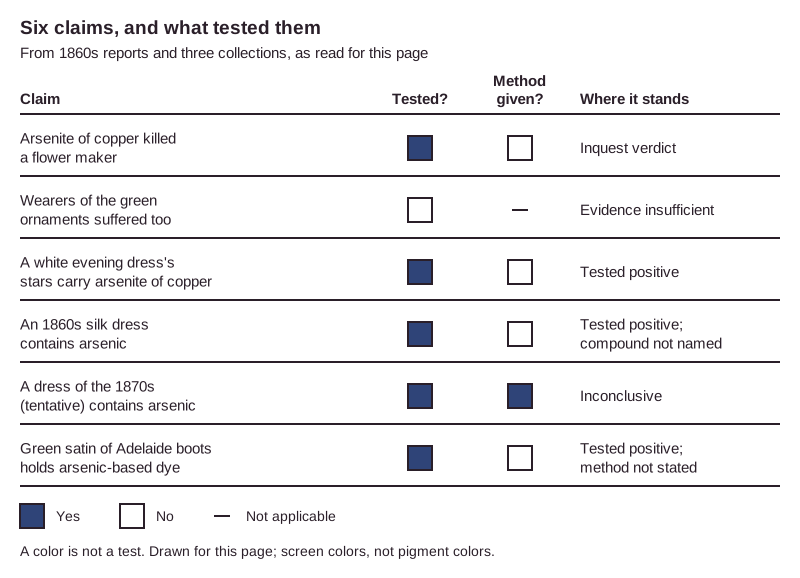
Six claims, whether each was tested and how, and where each stands. Drawn for this page; screen colors, not pigment colors.
Diagram: Tailor, Weaver, Jeweler, Dyer, CC BY 4.0
"Six arsenic green claims, and what tested them" by Tailor, Weaver, Jeweler, Dyer, from https://tailorweaverjewelerdyer.com/color/arsenic-green/. Licensed under CC BY 4.0: https://creativecommons.org/licenses/by/4.0/
Data: The Lancet (1860, 1861) and British Medical Journal (1861), public domain (facts restated); Test reports restated from Toronto Metropolitan University Fashion Research Collection, Houston Museum of Natural Science and Bata Shoe Museum web pages (facts restated, not copied); Claims and their status compiled for this page
A test turns a suspicion into a record. In August 2014 Ingrid Mida, unpacking a donation for Toronto Metropolitan University's Fashion Research Collection, recognized the green of an 1860s silk dress and suspected arsenic [4]. On 5 September 2014 the dress, FRC2014.07.406 A+B+C, was tested in the university's physics lab and did contain arsenic, the collection reported [4]. The report names no method and no compound; it calls the color Scheele's green, but the test as reported found arsenic only.
In 2019 the Houston Museum of Natural Science tested a dress tentatively dated to the 1870s with a kit made for soil samples [5]. The result was negative, yet the museum said the test may have been too brief, so it could not be sure whether the dress held arsenic [5].
The Bata Shoe Museum says the dark green satin of a pair of Adelaide boots, from about the 1840s, tested positive for an arsenic-based dye [13]. It does not say how.
This site calls that kind of record the fade record: an object's documented color history, holding only recorded storage, tests and treatment, with everything else marked not verified. For a green dress, arsenic enters the fade record only when a test puts it there. Other colors here are settled the same way: wool from Timna counts as Tyrian purple because analysis found snail dye in it [14]. The Glen Affric tartan's green counts as indigo or woad because dye analysis found it, as the indigo dye entry explains [15].
The chart as a table:
| Claim | Made by, and when | Tested? | Method given? | Where it stands |
|---|---|---|---|---|
| Arsenite of copper killed a flower maker | Inquest jury; BMJ and The Lancet, 30 Nov 1861 | Post-mortem by a surgeon | No | Inquest verdict |
| Wearers of the green ornaments suffered too | Hassall, 1860, "highly probable"; BMJ editorial, 1861, "in many cases" | No | Not applicable | Evidence insufficient |
| A white evening dress's muslin stars carry arsenite of copper | Hassall's analysis; The Lancet, 1 Dec 1860 | Yes, 1860 | No | Tested positive |
| An 1860s silk dress, FRC2014.07.406 A+B+C, contains arsenic | Toronto Metropolitan University, reported 2015 | Yes, 2014, university physics lab | No | Tested positive; compound not named |
| A dress tentatively dated to the 1870s contains arsenic | Houston Museum of Natural Science, 2019 | Yes, soil test kit | Yes: a kit, a short soak | Inconclusive |
| The green satin of Adelaide boots, c. 1840s, holds arsenic-based dye | Bata Shoe Museum, exhibition page | Yes | No | Tested positive; method not stated |
Tailor, Weaver, Jeweler, Dyer. “Arsenic Green: Only a Test Shows Which Dresses Held It.” Published 27 October 2026. https://tailorweaverjewelerdyer.com/color/arsenic-green/. Accessed: add the date you read it.
Facts here carry numbered links to the sources listed above. How entries are checked: Weighing the Evidence: How This Site Checks Facts. Every substantive change is dated on Corrections. Spotted a mistake or have a better source? Contact and Correspondence.
"Murex brandaris" by Wenceslaus Hollar — https://commons.wikimedia.org/wiki/File:Wenceslas_Hollar_-_Murex_brabdaris.jpg — Public domain (Wenceslaus Hollar d. 1677, PD in US and EU)
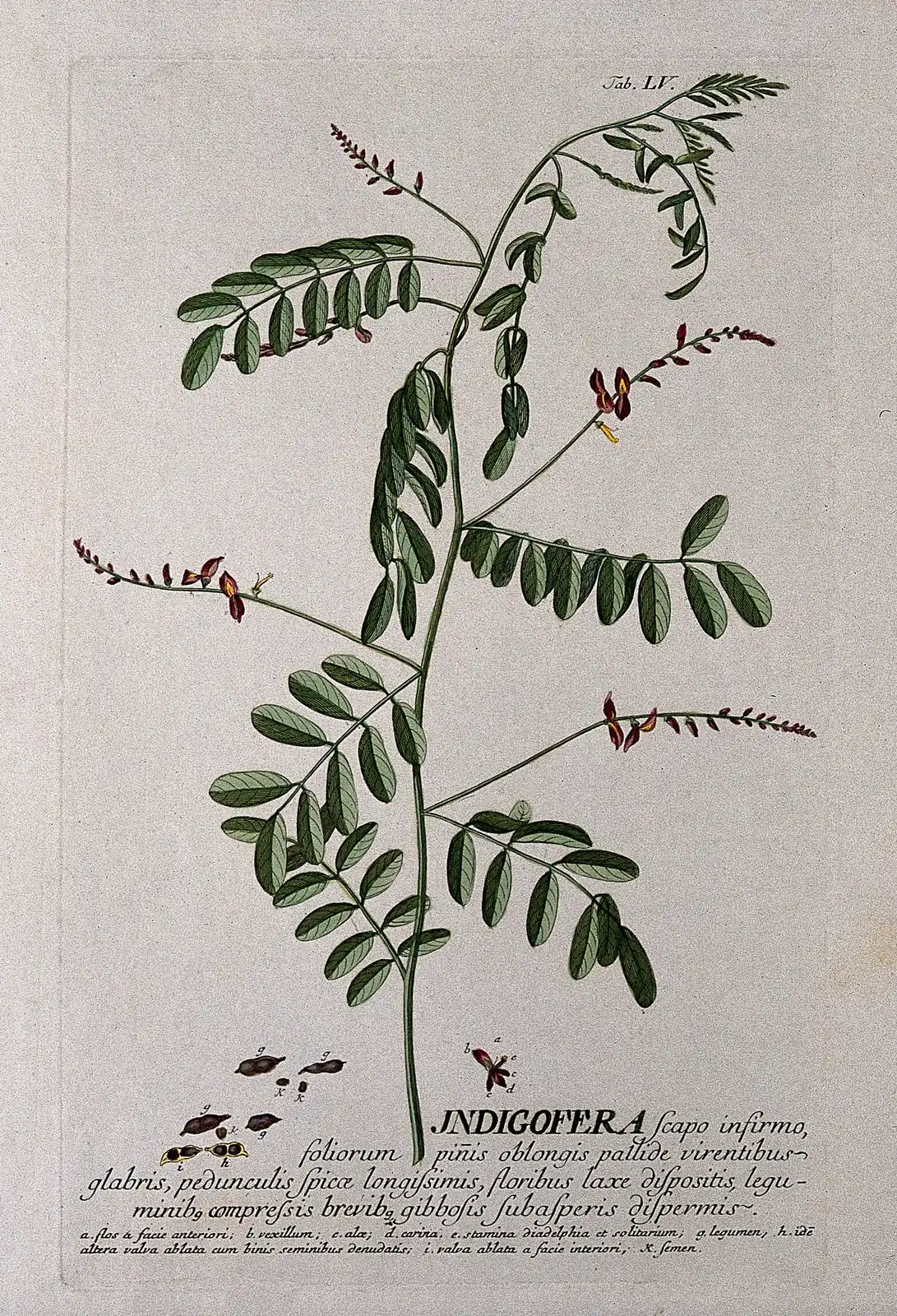
"Indigo plant (Indigofera tinctoria L.): flowering stem with separate flower and fruit segments" by Wellcome Collection — https://commons.wikimedia.org/wiki/File:Indigo_plant_(Indigofera_tinctoria_L.);_flowering_stem_with_Wellcome_V0042997EL.jpg — CC BY 4.0 (https://creativecommons.org/licenses/by/4.0/)

