Tyrian Purple: Most Species Tested Give a Brominated Indigo
By Tailor, Weaver, Jeweler, DyerPublished
Build card
Key construction point
Tyrian purple came from a gland in Mediterranean sea snails. In dye from Bolinus brandaris and Stramonita haemastoma, its main colorant is usually 6,6′-dibromoindigo: indigo carrying two bromine atoms [2][4][5]
Name, category, period, materials, surviving examples and screen swatch
Name
Tyrian purple; in Pliny's Latin, purpura names one of the dye snails and dibapha Tyria the twice-dyed Tyrian cloth [6][7]
Category
Dyes & Pigments
Period
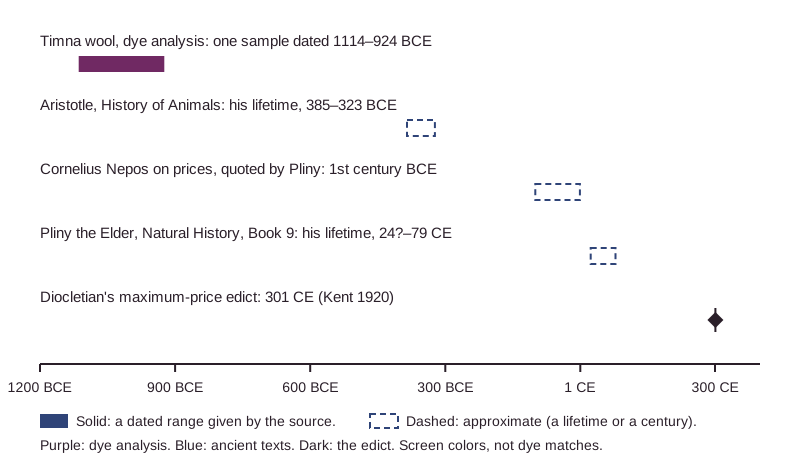
Documentary: described from Aristotle (4th century BCE) to Pliny the Elder (died 79 CE) [1][6]. Dye analysis and radiocarbon: wool from Timna dated to the late 11th to early 10th century BCE, the earliest true-purple fibers known in the southern Levant, as its analysts put it in 2021 [2]
Materials
Secretion of the hypobranchial gland of Hexaplex trunculus, Bolinus brandaris and Stramonita haemastoma, the three Mediterranean species Sukenik and colleagues name; dyed onto wool in Pliny's account and in the Timna samples [2][6]
Surviving examples
Three wool samples from Site 34 (Slaves' Hill), Timna Valley, Israel Antiquities Authority nos. 004, 017 and 018, identified by HPLC dye analysis [2]
Screen swatch
Not applicable. No object on this page has a measured color, and the purple in the site's own design is a brand color, not a historical swatch
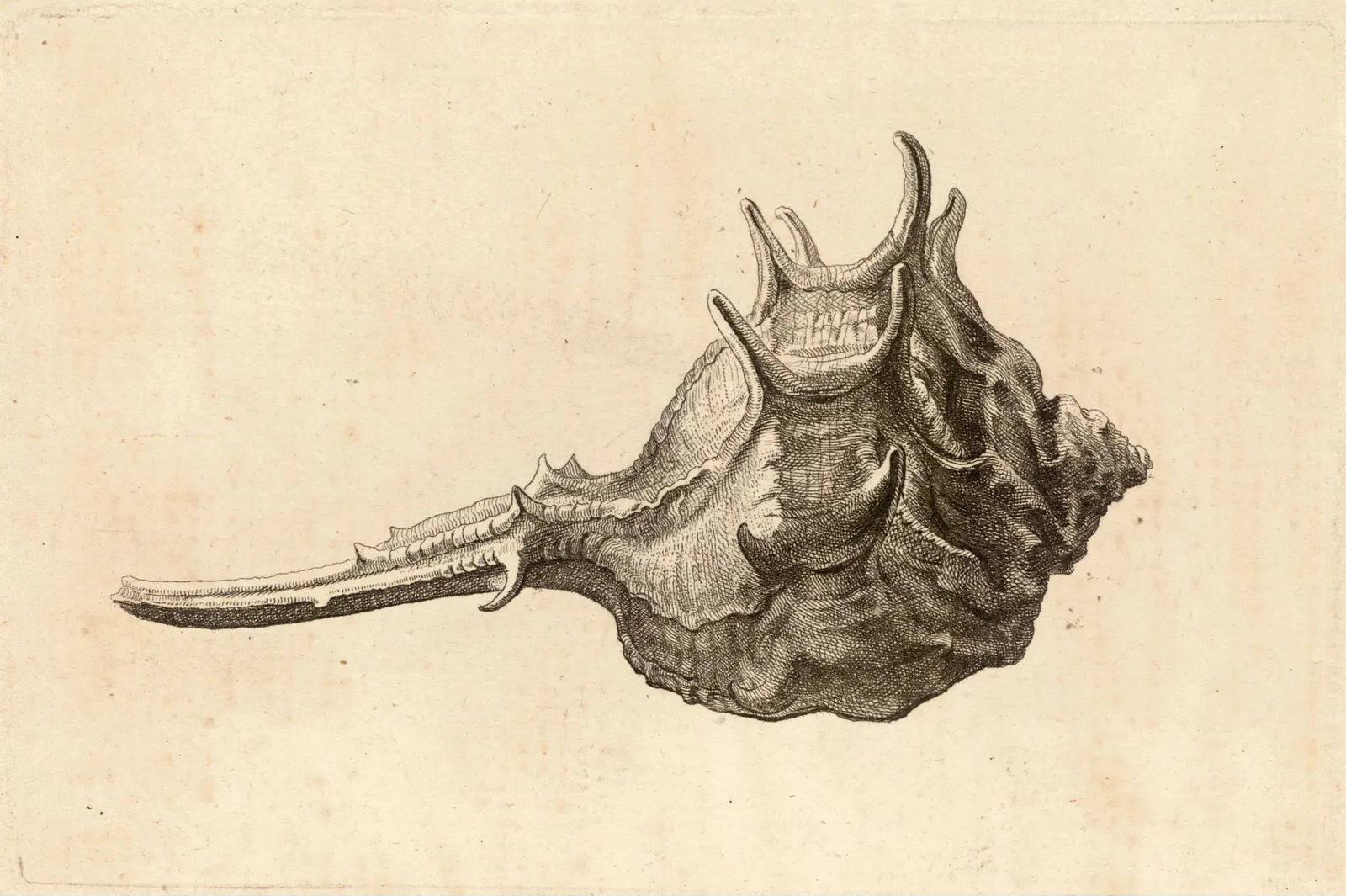
A spiny sea-snail shell etched by Wenceslaus Hollar, who died in 1677. The Commons file page gives the print's title as "Murex brabdaris," evidently for Murex brandaris, one of the purple-dye snails, and records it as plate P2206 in the University of Toronto's Thomas Fisher Rare Book Library, a number not checked with the library.
"Murex brandaris" by Wenceslaus Hollar, Public domain
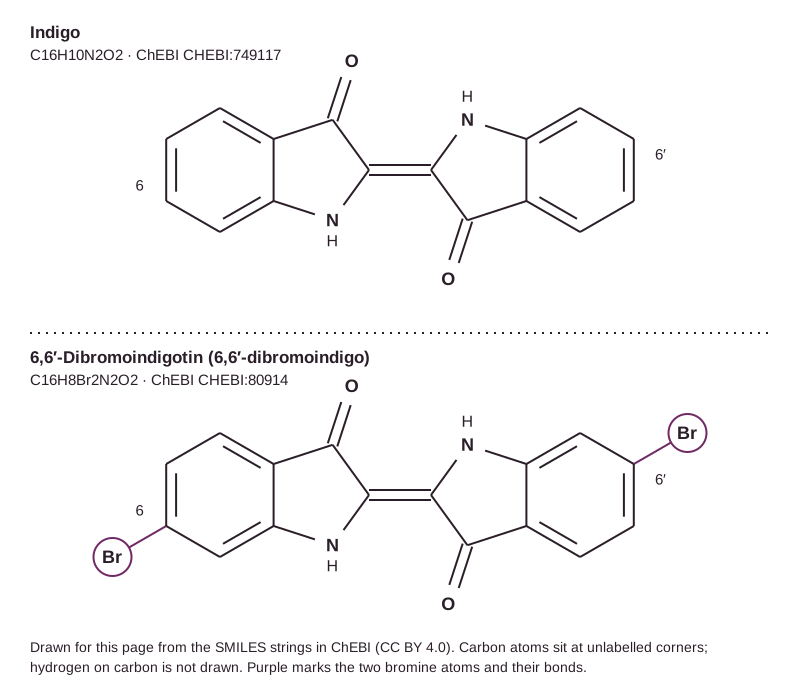
Small purple snails were pounded up, shells and all, but the larger ones were shelled first, Aristotle wrote [1]. What they yielded was Tyrian purple, a dye made from a gland in several Mediterranean sea snails [2]. In most snail species analyzed, its main pigment is 6,6′-dibromoindigo [3]. The name means indigo with two bromine atoms in place of two of its hydrogen atoms, at the positions numbered 6 and 6′, as the ChEBI chemical database records the two molecules [4][5].
The snail holds no purple ready-made. Its gland holds colorless chemicals that turn green, then blue, then purple once they meet air and light [3]. The bromine went unnoticed until 1909, when a chemist extracted the pigment and found it there [3].
Ancient writers describe the dye works but not this chemistry. The only purple prices on this page come from one writer's memory. Here Aristotle and Pliny sit beside a modern dye test on 3,000-year-old wool from Timna, in southern Israel, which its analysts in 2021 called the earliest dyed fiber of true purple known from the southern Levant [2].
From snail to dye
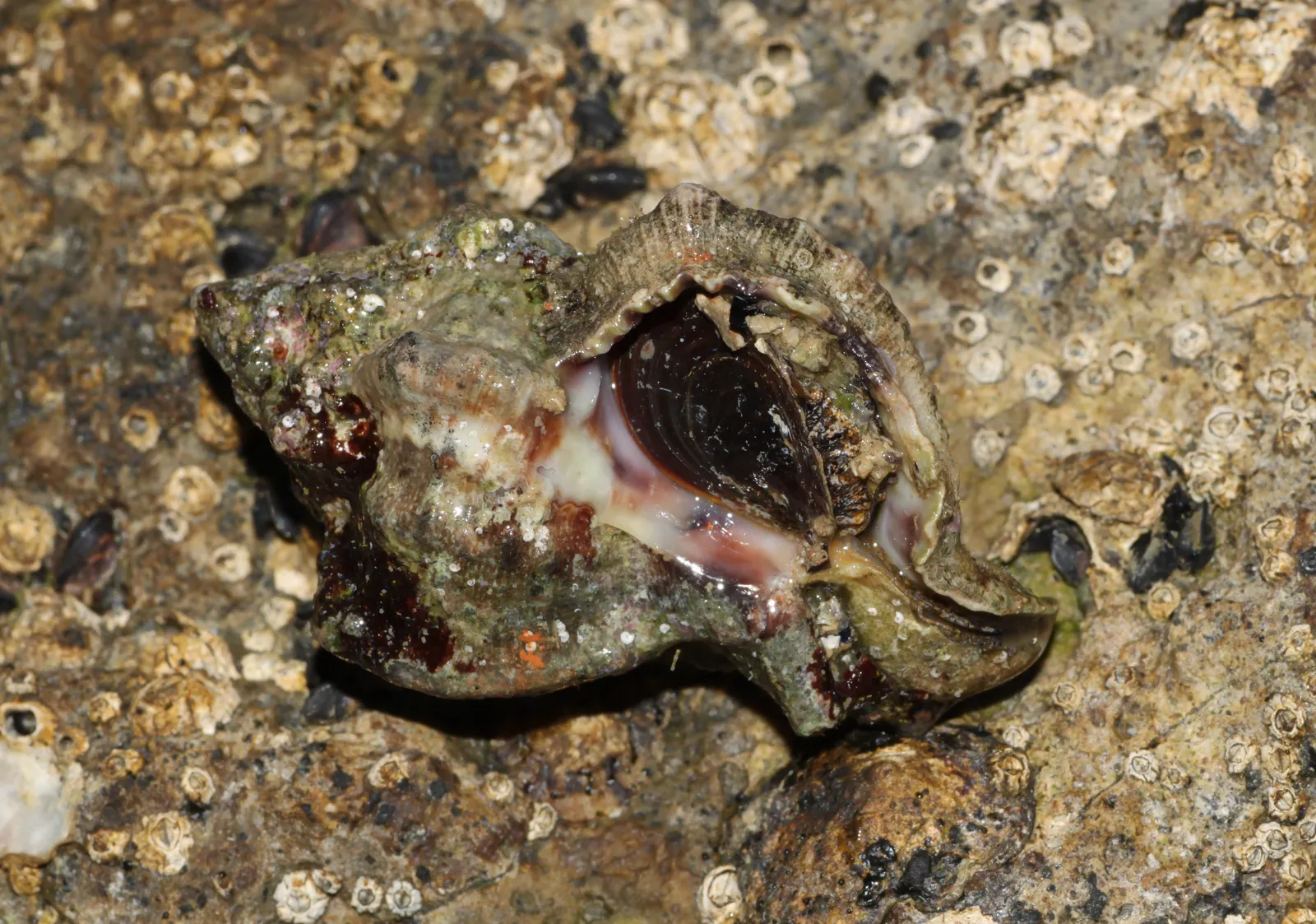
A banded dye-murex, Hexaplex trunculus, on a rock among barnacles in Istria, Croatia, in 2011; the species is as the photographer identified it. Sukenik and colleagues find that, in most cases, this snail's dye carries more plain indigo than the dye of the other two Mediterranean purple snails.
"Banded Dye-Murex, Hexaplex trunculus" by Holger Krisp, CC BY 3.0
Three snails did most of the work, according to Sukenik and colleagues: Hexaplex trunculus, Bolinus brandaris and Stramonita haemastoma, all murex snails common in the Mediterranean [2]. The paper also gives their other names: Murex trunculus, Murex brandaris and Thais haemastoma [2]. The dye comes from the hypobranchial gland, which in the authors' dyeing trials averaged 0.2 grams in B. brandaris and 0.6 grams in S. haemastoma [2]. To explain why purple cloth became so prized, Sukenik and colleagues point to the small amount of dye in each snail and to a long, many-stage process that had to run near where the snails were caught, because their freshness strongly affected the result [2].
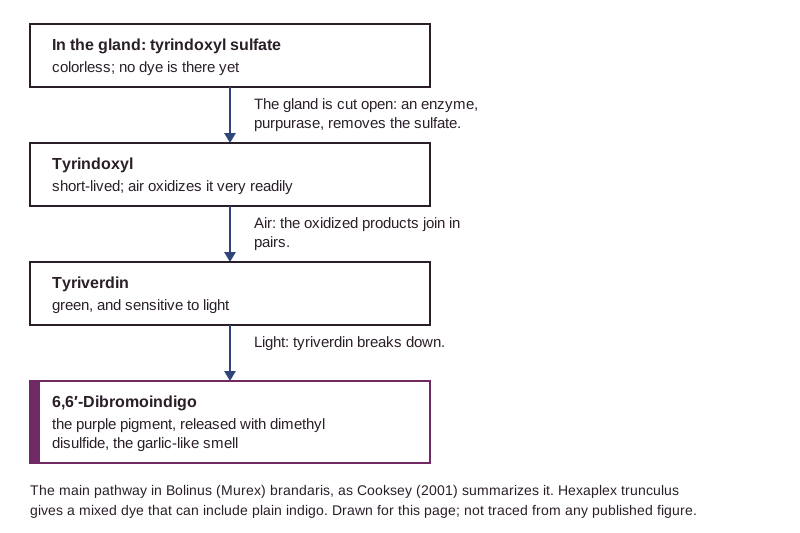
That gland does not contain purple. Cooksey's review of the chemistry explains that it holds colorless precursors, and the color forms only after the gland is opened [3]. When it is cut, an enzyme called purpurase strips a sulfate group from the main precursor, tyrindoxyl sulfate; air oxidizes what is left, the products pair up into a green compound called tyriverdin, and light breaks that down into 6,6′-dibromoindigo [3]. The same step gives off dimethyl disulfide, the garlic-like smell that accounts of purple-making mention [3].
Wider than a phone screen: swipe sideways along the diagram, or open it full size.
The chain from precursor to pigment in Bolinus brandaris, drawn for this page from Cooksey's 2001 summary. Boxes give each compound and arrows what acts on it; Hexaplex trunculus makes a more mixed dye. Screen colors, not dye matches.
Data: C. J. Cooksey, Tyrian Purple: 6,6′-Dibromoindigo and Related Compounds, Molecules 6(9): 736–769, 2001, https://doi.org/10.3390/60900736 (facts restated, not copied)
William Cole watched the chain run in 1685. At Minehead in the UK he spread the contents of the gland of the snail Nucella lapillus on linen in the sun and saw it pass from light green to deep green, sea green, blue, purplish red and at last a deep purple red, as Cooksey quotes him [3]. In Mediterranean sunshine, Cooksey adds, the change takes less than ten minutes [3].
Bromine, and the exceptions
Bromine was the surprise. In 1909 P. Friedländer processed the glands of 12,000 Murex brandaris, obtained 1.4 grams of pigment, and found by elemental analysis that it contained bromine; two syntheses then confirmed it as 6,6′-dibromoindigo [3]. That figure is one laboratory extraction from one species. It says nothing about the yield of an ancient dye works, and this page does not turn it into a cost.
Later analyses found the same main pigment in most species. In the results Cooksey collects, 6,6′-dibromoindigo makes up 77–91% of the purple from every species listed except Hexaplex trunculus, with smaller amounts of 6-bromoindigo and 6,6′-dibromoindirubin [3]. Hexaplex trunculus varies: one analysis in the same table found its dye was 55% plain indigo and only 3% dibromoindigo, while another found 76% dibromoindigo [3]. Sukenik and colleagues report the same pattern: in most cases 6,6′-dibromoindigo is over 60% of the dye from Bolinus brandaris and Stramonita haemastoma, while Hexaplex trunculus dye holds much more plain indigo [2].
How the dye was made, as ancient writers tell it
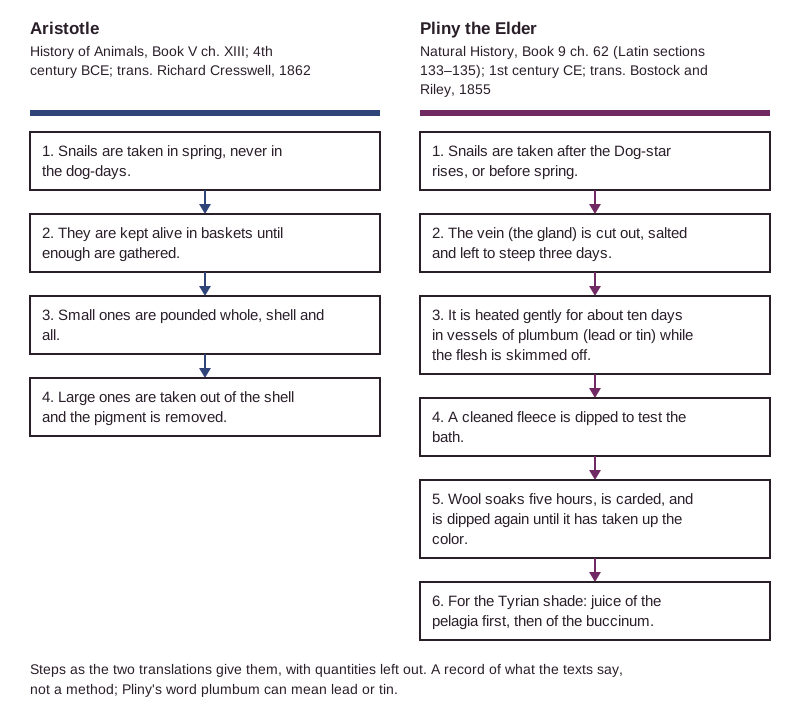
Aristotle starts with the catch. In Book V of his History of Animals, the snails were taken in spring and never in the dog-days, and their pigment lay in a part that looked like a white membrane, which stained the hand when it was bruised [1]. Small ones were pounded whole and large ones shelled, and all were kept alive in baskets until enough were gathered, because a snail that dies first will "vomit up the pigment" [1].
Wider than a phone screen: swipe sideways along the diagram, or open it full size.
What Aristotle and Pliny say was done, step by step, drawn for this page from the Cresswell (1862) and Bostock and Riley (1855) translations. Quantities are left out; the boxes record the texts, not a method. Screen colors, not dye matches.
Pliny the Elder, who died in 79 CE, describes the dye bath step by step in Book 9 of his Natural History [6]. In the 1855 translation by John Bostock and H. T. Riley, the steps run like this [6]:
The snails were best taken after the rising of the Dog-star, or before spring.
The "vein," which is the gland, was cut out, salted and left to steep for three days.
The liquid was heated gently for about ten days in vessels of plumbum, set at the end of a long flue from the furnace, while the flesh was skimmed off.
A cleaned fleece was dipped as a test, and the heating went on until the color satisfied.
The wool soaked for five hours, was carded, and was dipped again until it had taken up the color.
For the Tyrian shade, the wool was first saturated in the juice of one kind of snail, the pelagia, and then dipped in another, the buccinum.
In the Latin text of Karl Mayhoff's Teubner edition (1875–1906), the passage is Book 9, sections 133 to 135 [7].
The vessel is a puzzle. Pliny's word is plumbum, which can mean lead or tin; Bostock and Riley chose tin, their own footnote reports that the translator Littré chose lead, and Cooksey notes that without an adjective the word could be either [6][3]. This is a historical process, described for history only — these materials are toxic or caustic.
What the ten days of heating did, Pliny does not say. Cooksey writes that the surviving details are not enough to explain the chemistry, and that the general belief is that it worked like a vat dye: the pigment was reduced to a dissolved form and turned colored again on the wool in air [3]. Sukenik and colleagues reported in 2021 that the only successful modern reconstruction relied on bacteria in the snails' own flesh, with the bath kept warm for days until it turned yellow [2].
Illustration
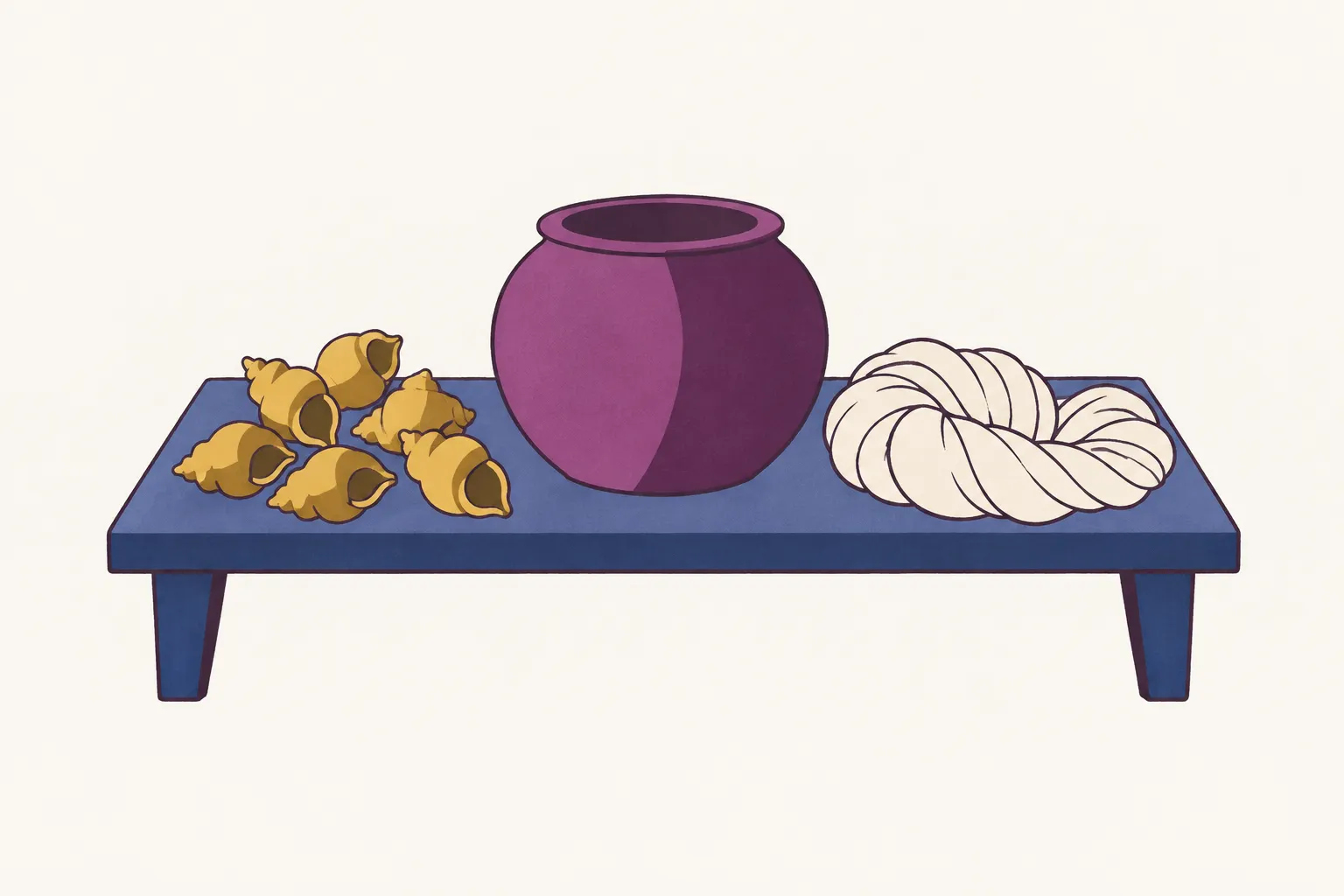
A work table with a heap of sea-snail shells, a dye vat and a hank of undyed wool.
Illustration: Tailor, Weaver, Jeweler, Dyer. Generated schematic image — not a photograph or historical record. Reuse terms: may be shared with this full caption and a link to the source page; not licensed under CC BY.
What ancient writers recorded
Wider than a phone screen: swipe sideways along the diagram, or open it full size.
The sources on this page on one time axis, drawn for this page from tyrian-ancient-sources.csv. Solid bands are dated ranges given by a source; dashed bands stand for a lifetime or a century. Screen colors, not dye matches.
Dye holding the brominated markers of sea-snail purple
Dye analysis and radiocarbon
4th century BCE
Aristotle, History of Animals, Book V
How the snails were caught and the pigment taken
Ancient text
1st century BCE
Cornelius Nepos, quoted by Pliny
What purple cost in his youth
Ancient text, quoted
1st century CE
Pliny the Elder, Natural History, Book 9
The dye bath, the Tyrian double dye, fading
Ancient text
301 CE
Diocletian's edict, in Kent's 1920 translation
Maximum prices for goods and services
Edict
Pliny also records what the color meant in Rome. For purple, the fasces carried before the consuls made way in the crowd; purple set a senator apart from a man of equestrian rank, and in the triumphal robe it was mixed with gold [6].
The price evidence on this page is thin. Pliny quotes Cornelius Nepos, who died under Augustus, recalling that in his youth violet purple sold at 100 denarii a pound, and that the Tyrian dibapha which followed "could not be bought for even one thousand denarii per pound" [6]. Dibapha meant cloth dyed twice [6]. That is one first-century-BCE writer's memory, passed on by another writer, not a price list.
Diocletian's edict of 301 is a different kind of record. Roland G. Kent, introducing his 1920 partial translation, describes it as fixing "maximum prices for practically all articles and services," a legal cap rather than a record of what anyone paid [8]. By then, Kent notes, the denarius was no longer a silver coin but a copper one [8]. Kent gives only "a few of the more interesting items," none of them a purple-dyed cloth, so this page quotes no edict price for purple [8].
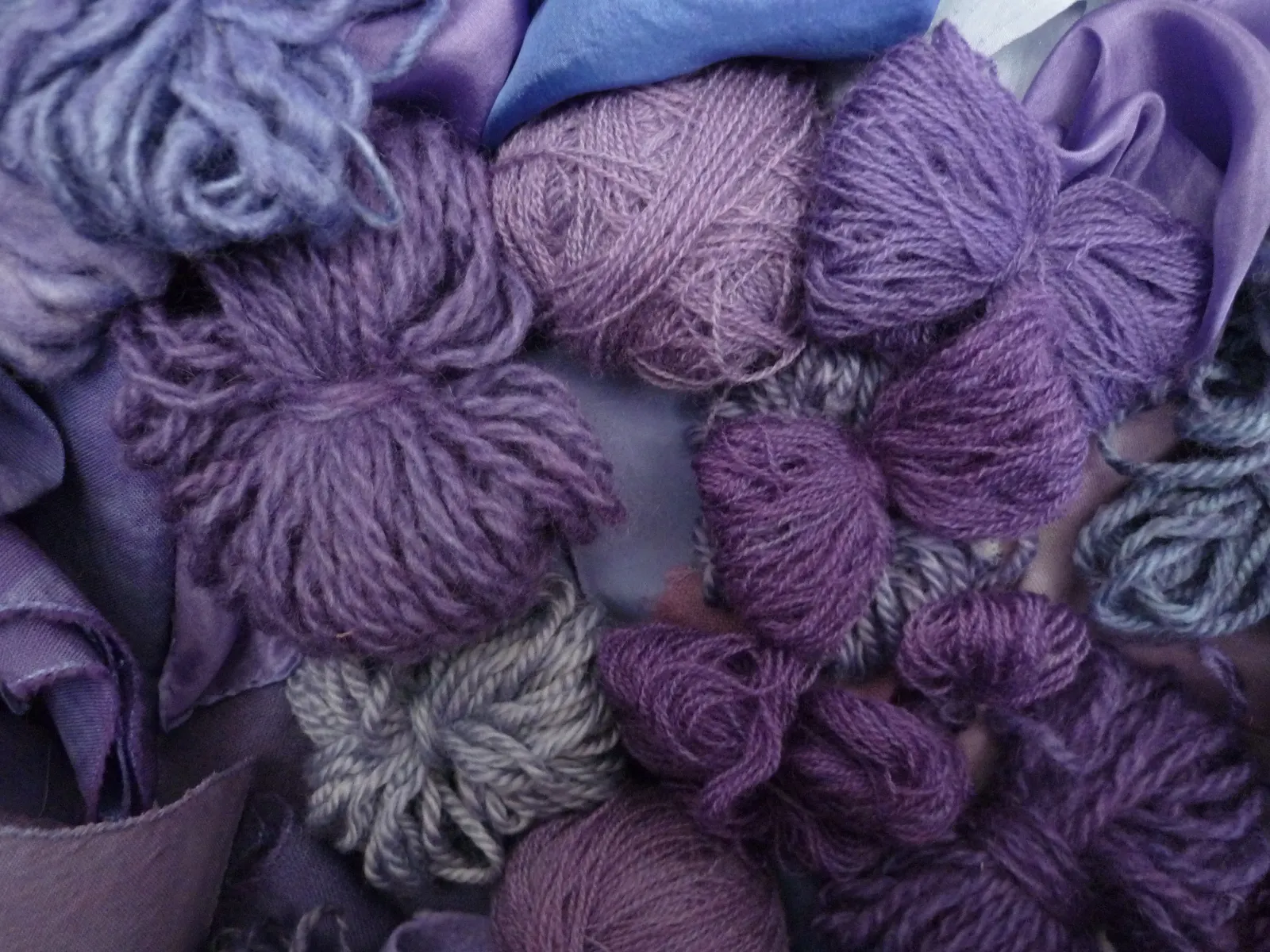
Modern wool yarn and folded cloth in shades from reddish purple to blue-violet, which the photographer describes as dyed in a vat of real purple. The dye in these skeins has not been tested, so the photograph shows a range of shades, not proof of Tyrian purple.
"Wool spun into yarn, dyed in a dye-bath with real purple" by Inge Boesken Kanold, CC BY-SA 3.0
Ancient buyers had reason to wonder. Sukenik and colleagues note that "imitation purple" was made by various methods from much cheaper materials [2]. Chemistry can tell the two apart. Indigo and indirubin also come from plants such as woad and the indigo plant, but the brominated compounds, including 6-monobromoindigotin and 6,6-dibromoindigotin, occur only in dyes from mollusks [2].
That test is what makes the Timna finds count. At Slaves' Hill (Site 34), a copper-smelting camp in the Timna Valley, excavators recovered three wool samples whose dye, analyzed by HPLC (a lab method that separates a dye into its parts), held both brominated markers [2]. The site is dated by radiocarbon to the late 11th to early 10th century BCE, and one sample, a two-ply string, was itself radiocarbon-dated to 1114–924 BCE [2]. The authors, writing in 2021, call these the earliest dyed fibers of true purple known from the southern Levant; older purple textiles are reported from Syria [2].
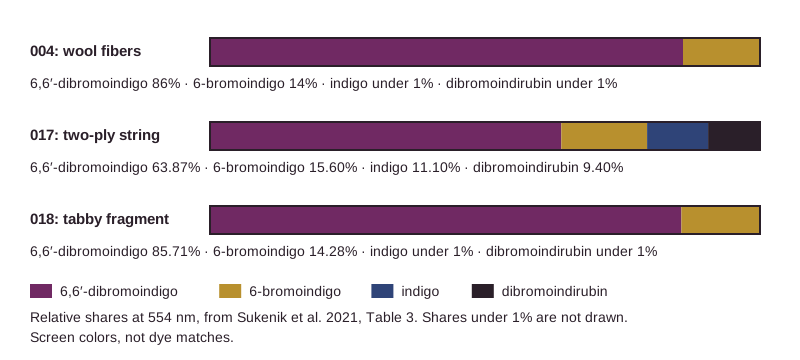
The chart and table give the relative amounts measured at 554 nm, from the paper's Table 3 [2].
Wider than a phone screen: swipe sideways along the diagram, or open it full size.
The share of each compound in the three Timna samples, drawn for this page from timna-purple-analysis.csv (Sukenik et al. 2021, Table 3). Shares under 1% are not drawn. Screen colors, not dye matches.
Data: Sukenik, Iluz, Amar, Varvak, Shamir and Ben-Yosef, Early evidence of royal purple dyed textile from Timna Valley (Israel), PLOS ONE 16(1): e0245897, 2021, CC BY 4.0, https://doi.org/10.1371/journal.pone.0245897
Sample (IAA no.)
What it is
6,6′-dibromoindigo
6-bromoindigo
Indigo
Dibromoindirubin
The authors' reading
004
Pink-purple wool fibers
86%
14%
under 1%
under 1%
Bolinus brandaris or Stramonita haemastoma
017
Two-ply wool string with a pink-purple edge
63.87%
15.60%
11.10%
9.40%
Most probably double-dyed, with Hexaplex trunculus added
018
Tabby fragment with pink-purple weft threads
85.71%
14.28%
under 1%
under 1%
Bolinus brandaris or Stramonita haemastoma
The ratios point to the snails. Samples 004 and 018 match Bolinus brandaris or Stramonita haemastoma, which the analysis cannot tell apart [2]. Sample 017 fits none of the usual species profiles. The authors note that another researcher would explain it by a Hexaplex trunculus poor in indigo and rich in dibromoindigo, but they think it was most probably double-dyed with Hexaplex trunculus as well, the kind of two-bath dyeing Pliny describes for the Tyrian shade [2][6].
No single color. True purple ranges from purplish red to violet blue, Sukenik and colleagues write, depending on the snail's chemistry, the dyeing process, and the oxygen and light the dye meets [2]. In their dyeing trials, Hexaplex trunculus gave more violet-blue wool and the other two species a pinker purple [2]. Pliny's best Tyrian had the color of clotted blood, blackish at a glance but shining when held up to the light [6].
Even a tested fiber has a color history that is only partly on record. This site calls the recorded part the fade record: an object's documented color history, holding only recorded storage, tests and treatment, with everything else marked not verified. Pliny wrote that the colors from the murex and the purple "fade from hour to hour," while Sukenik and colleagues cite Plutarch for the opposite view, that true purple does not fade easily [6][2]. Neither remark is a test of a surviving cloth.
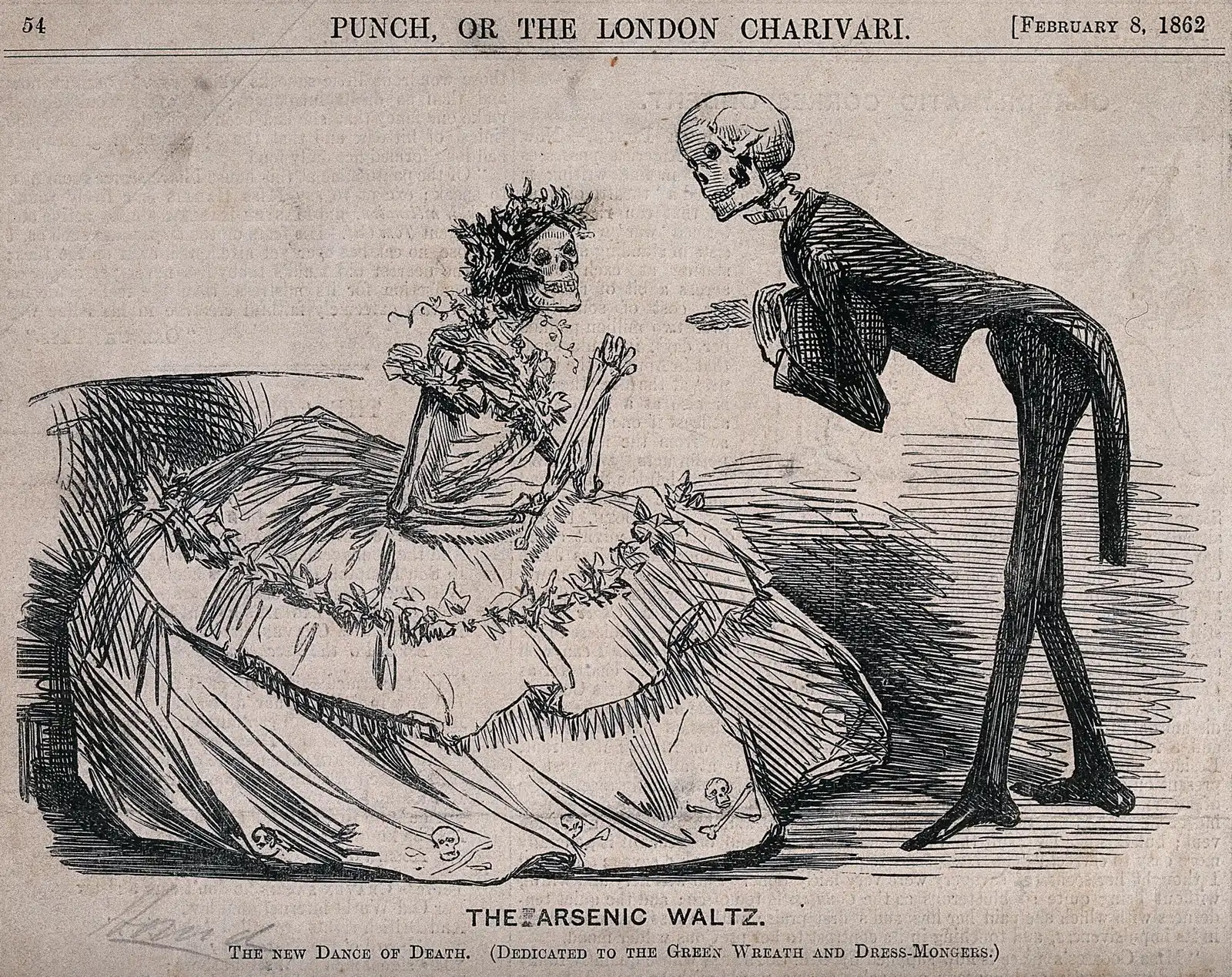
The yarn in the photograph above has no dye test on record, and the purple in this site's own design is a brand color, not a swatch of the dye. The rule is the one behind arsenic green: only a test shows what a color is made of.
A cousin of indigo
Wider than a phone screen: swipe sideways along the diagram, or open it full size.
Indigo (top) and 6,6′-dibromoindigo (bottom), drawn for this page from the SMILES strings in ChEBI records CHEBI:749117 and CHEBI:80914. The frames match atom for atom; purple marks the two bromine atoms at positions 6 and 6′. Screen colors, not dye matches.
Data: ChEBI (Chemical Entities of Biological Interest), EMBL-EBI, records CHEBI:749117 and CHEBI:80914, CC BY 4.0, https://www.ebi.ac.uk/chebi/
Set the two molecules side by side and the family likeness is plain. ChEBI gives indigo the formula C16H10N2O2 and 6,6′-dibromoindigotin, another name for 6,6′-dibromoindigo, the formula C16H8Br2N2O2 [5][4]. Matching the two ChEBI structures atom by atom, computed for this page, shows one change only: a bromine atom takes the place of a hydrogen atom at position 6 on each of the two six-carbon rings [4][5].
Molecule
ChEBI record
Formula
Difference from indigo
Indigo
CHEBI:749117
C16H10N2O2
None: the parent compound
6,6′-Dibromoindigo
CHEBI:80914
C16H8Br2N2O2
Bromine in place of hydrogen at positions 6 and 6′
On cloth, the bromines change the color. Dissolved, both compounds are blue, but cloth dyed with dibromoindigo is purple [3]. Cooksey reports that the wavelength indigo absorbs most strongly moves from 605 nanometers in solution to about 680 on cloth, while dibromoindigo's moves the other way, from 590 to 520, and he traces the difference to the way pairs of dibromoindigo molecules interact [3].
The two dyes share a practical problem too. The murex dye is a vat dye that will not dissolve in water, Sukenik and colleagues note, so it has to be reduced to a soluble form before it can enter the fiber [2].
1Aristotle. History of Animals, Book V, ch. XIII. Translated by Richard Cresswell. London: George Bell & Sons, 1887 (translation dated 1862). Project Gutenberg #59058. https://www.gutenberg.org/ebooks/59058(full text, public-domain translation)
6Pliny the Elder. The Natural History of Pliny, vol. 2, Book IX, chs. 60–65. Translated by John Bostock and H. T. Riley. London: Henry G. Bohn, 1855. Project Gutenberg #60230. https://www.gutenberg.org/ebooks/60230(full text, public-domain translation)