


Picture credit
"Murex brandaris" by Wenceslaus Hollar — https://commons.wikimedia.org/wiki/File:Wenceslas_Hollar_-_Murex_brabdaris.jpg — Public domain (Wenceslaus Hollar d. 1677, PD in US and EU)
By Tailor, Weaver, Jeweler, Dyer Published
Build card
This card as data: indigo-dye-build-card.csv (CSV) · file notes (JSON): where the values come from, version and license
Data: Li, Cunningham, Fan and Wang, Identity blues: the ethnobotany of the indigo dyeing by Landian Yao (Iu Mien) in Yunnan, Southwest China, Journal of Ethnobiology and Ethnomedicine 15: 13, 2019, CC BY 4.0, https://doi.org/10.1186/s13002-019-0289-0; Li, Shi, Huang, Tong, Wu and Wang, Fermentation Blues: Analyzing the Microbiota of Traditional Indigo Vat Dyeing in Hunan, China, Microbiology Spectrum 10(4): e01663-22, 2022, CC BY 4.0, https://doi.org/10.1128/spectrum.01663-22; US Patent 5,378,246, Indigo dye process, Sally Gurley, filed 1993, granted 1995, https://patents.google.com/patent/US5378246A/en; Encyclopédie, Recueil de planches, vol. 1 (Paris, 1762), Agriculture et économie rustique: Indigoterie et Manioc, explanation of the plate, public domain, https://artflsrv04.uchicago.edu/philologic5/encyclopedie0226/navigate/18/22; Encyclopédie, vol. 8 (Paris, 1765), Indigo, public domain, https://artflsrv04.uchicago.edu/philologic5/encyclopedie0226/navigate/8/3019; The Metropolitan Museum of Art, Ceremonial cloth, 2003.177, catalogue data CC0, https://commons.wikimedia.org/wiki/File:MET_DP156678.jpg
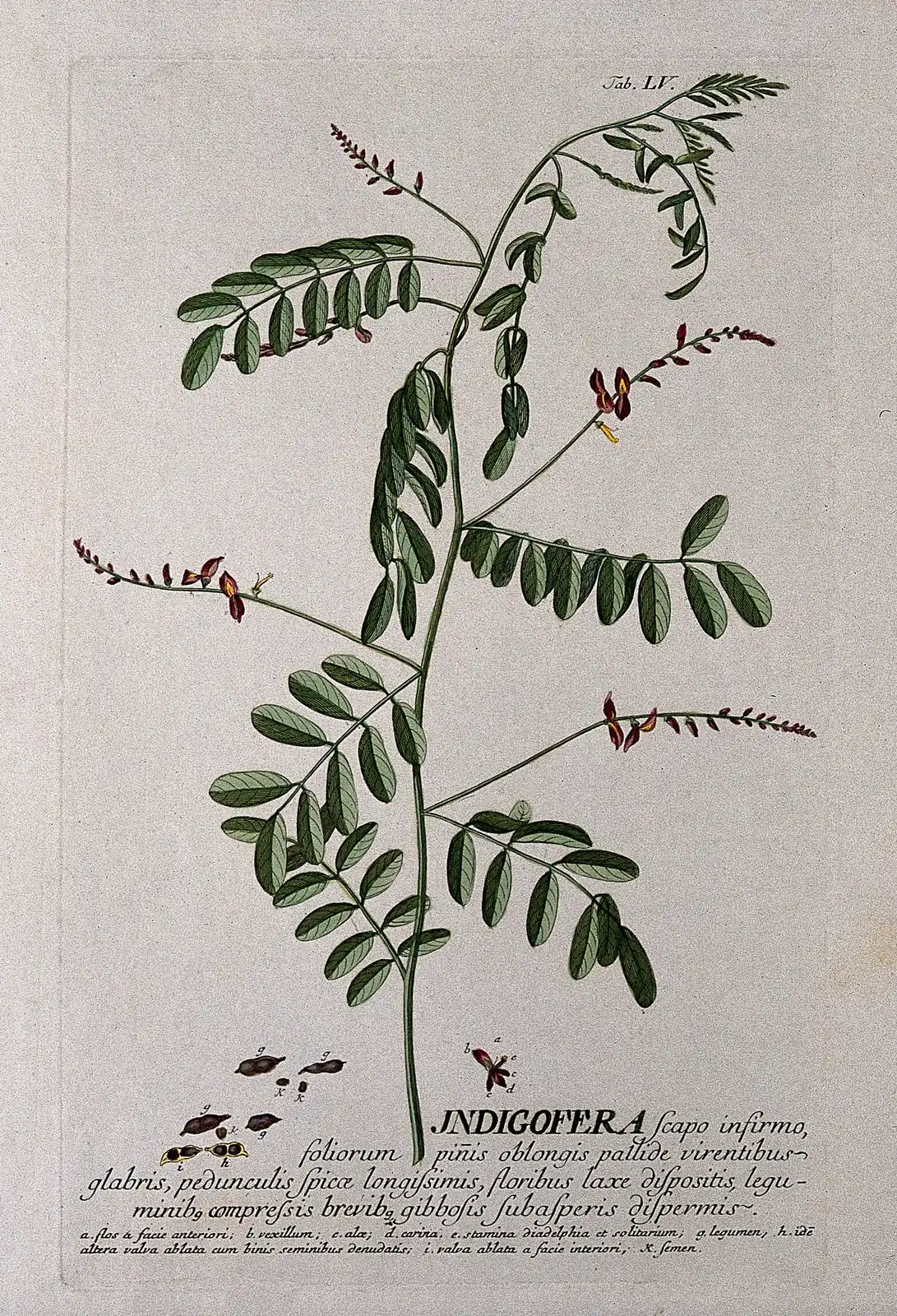
The indigo plant, Indigofera tinctoria, engraved by Johann Jakob or Johann Elias Haid after Georg Dionysius Ehret, Nuremberg, about 1750–53, as the Wellcome Collection catalogue records it. The leaves show no blue; the dye has to be made from them.
"Indigo plant (Indigofera tinctoria L.): flowering stem with separate flower and fruit segments" by Wellcome Collection, CC BY 4.0
"Indigo plant (Indigofera tinctoria L.): flowering stem with separate flower and fruit segments" by Wellcome Collection — https://commons.wikimedia.org/wiki/File:Indigo_plant_(Indigofera_tinctoria_L.);_flowering_stem_with_Wellcome_V0042997EL.jpg — CC BY 4.0 (https://creativecommons.org/licenses/by/4.0/)
Cloth lifted from a Yunnan indigo vat looks green at first, then turns blue in the air [1]. That happens because indigo will not dissolve in water, so it cannot soak into a fiber as blue [1]. The vat changes it first, into a pale leuco form that dissolves there [2]. In the air, oxygen turns that form back into blue indigo, now inside the fiber [2].
A 1995 US patent calls the dissolved leuco form yellow [2]. In the two traditional fermentation vats that Li and colleagues studied in Yunnan and Hunan, the liquid turned yellow-green once it was ready to dye [1][3].
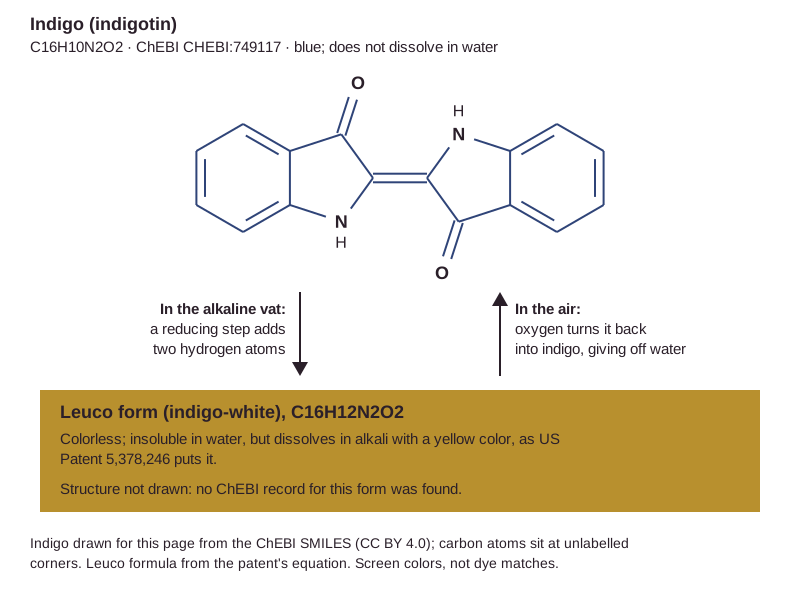
The patent, US 5,378,246, calls indigotin "the true coloring matter of indigo" [2]. It describes a dark blue powder or bronze-blue crystals with the formula C16H10N2O2, and the ChEBI chemical database gives indigo the same formula [2][4]. Li and colleagues put the problem plainly. Indigo is a water-insoluble pigment, so it must be reduced to leuco-indigo before it can get into the fibers [1].
Wider than a phone screen: swipe sideways along the diagram, or open it full size.
Indigo, drawn for this page from the SMILES string in ChEBI record CHEBI:749117. The leuco form below it is given only as the formula C16H12N2O2 from US Patent 5,378,246, since no ChEBI record for it was found. Screen colors, not dye matches.
Diagram: Tailor, Weaver, Jeweler, Dyer, CC BY 4.0
"Indigo and its reduced leuco form" by Tailor, Weaver, Jeweler, Dyer, from https://tailorweaverjewelerdyer.com/color/indigo-dye/. Licensed under CC BY 4.0: https://creativecommons.org/licenses/by/4.0/
Data: ChEBI (Chemical Entities of Biological Interest), EMBL-EBI, record CHEBI:749117, CC BY 4.0, https://www.ebi.ac.uk/chebi/; US Patent 5,378,246, Indigo dye process, Sally Gurley, filed 1993, granted 1995, https://patents.google.com/patent/US5378246A/en
The change is a reduction: in the patent's words, indigotin "combines with two atoms of hydrogen" and becomes "a colorless body, known as indigo-white or the leuco form" [2]. That form "is insoluble in water, but dissolves in alkali, with a yellow color" [2]. In commercial vats an alkali and a reducing chemical do this work [2]. This is a historical process, described for history only — these materials are toxic or caustic.
Oxygen undoes the change "with great ease," and water is given off as indigotin forms again [2]. Both Li papers describe leuco-indigo as dissolving in water [3][1]. Li and colleagues place that dissolving in the warm liquid of the vat, and the patent says the leuco form will not dissolve in plain water [1][2].
| Form | Also called | In plain water | In alkali | Color as described |
|---|---|---|---|---|
| Indigo | indigotin | insoluble [1] | insoluble until reduced [1] | dark blue [2] |
| Leuco form | indigo-white, leuco-indigo | insoluble [2] | dissolves [2] | colorless, yellow in alkali [2]; yellowish-green in practice [1] |
A fermentation vat leaves the reducing to microbes [3]. Modern dyeing uses reducing chemicals instead, which Li and colleagues say can be harmful [3]. The Dong vat they followed in Gaobu Village, Hunan, held indigo paste, rice wine, a mix of plants and a lye of rice-straw ash [3]. This is a historical process, described for history only — these materials are toxic or caustic.
That vat fermented for about 27 days before its liquid turned yellow-green and could dye cloth [3]; a Landian Yao vat in Guangming Village, Yunnan, took about a week [1]. The color matches the dissolved dye, which the patent calls yellow and Li and colleagues call "yellowish-green in reality" [2][1].
Japan's sukumo vat starts from sukumo, which Li and colleagues list as one form of the dye [3]. The abstract of a 2022 study by Nakagawa and colleagues describes sukumo as composted indigo leaves, and says microbes reduce its insoluble indigo to leuco-indigo [5].
Before any dyeing, the indigo had to be made from leaves. The Encyclopédie of Diderot and d'Alembert shows such a works, an indigoterie, in its first volume of plates, published in Paris in 1762 [6]. Its 1765 article on indigo says the plant was very common in the Antilles and Saint-Domingue [7].
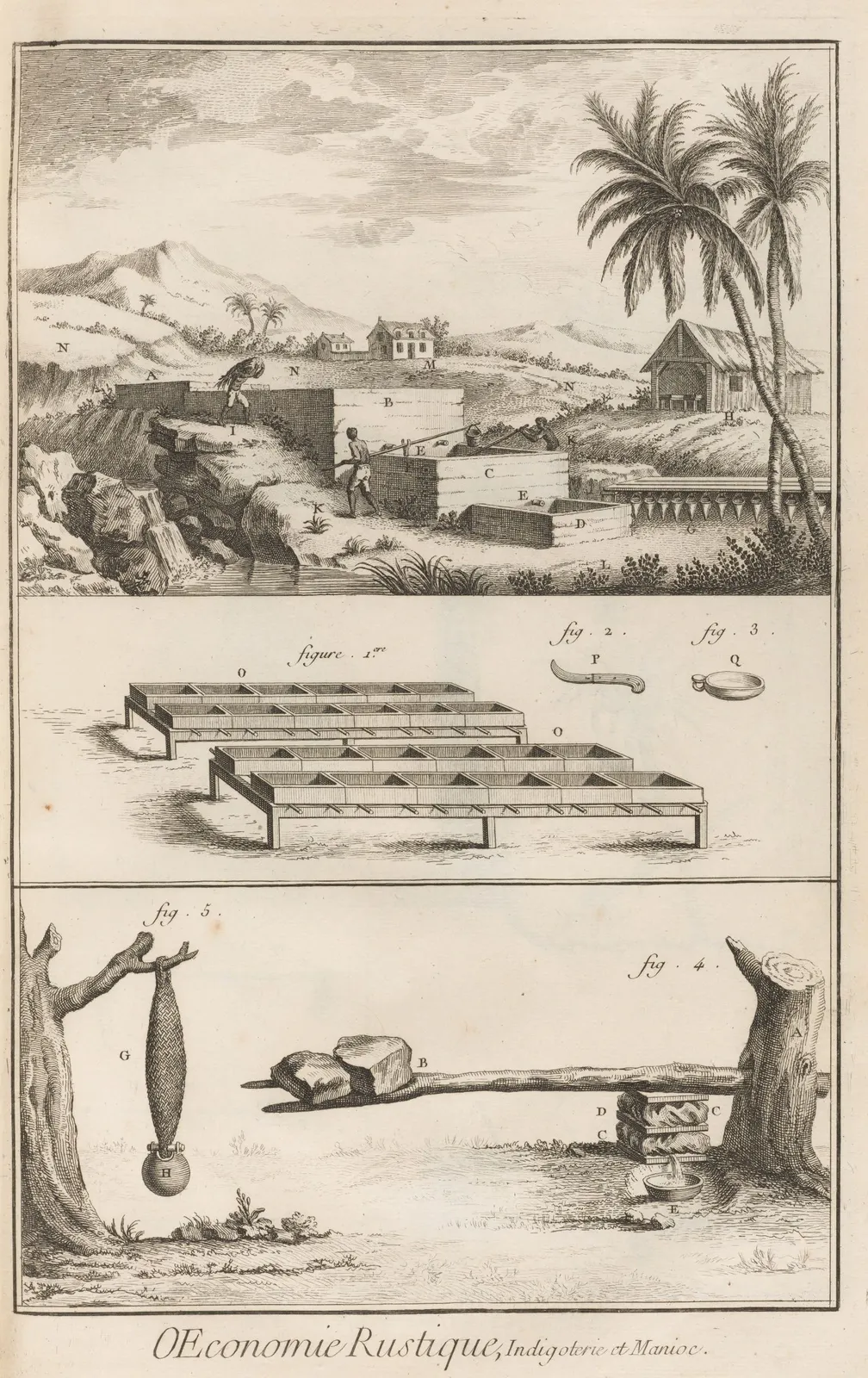
The plate "Œconomie rustique, Indigoterie et Manioc," Encyclopédie, Paris, 1762, Houghton Library copy. The top scene is an indigo works run on slave labor, where indigo was made from the plant, not a vat for dyeing cloth. Below, cassava (manioc) is pressed.
"Œconomie rustique, Indigoterie et Manioc (FP7 En190, Houghton Library, Harvard University)" by Unknown maker, Public domain
"Œconomie rustique, Indigoterie et Manioc (FP7 En190, Houghton Library, Harvard University)" by Unknown maker — https://commons.wikimedia.org/wiki/File:Houghton_FP7_En190_-_Oeconomie_Rustique_Indigoterie_et_Manioc.jpg — Public domain (Encyclopédie plate published in Paris in 1762 (Recueil de planches, vol. 1); draftsman and engraver not named on the file page; US: published before 1931; EU: published in 1762, so no contributor can have lived past 1955; file page tags Public domain and PDM)
The plate's key names three stepped tanks [6][7]. The cut plant steeped in the trempoire, the liquid was beaten in the batterie, and the settled blue was left to rest in the reposoir [6][7]. From their Yunnan fieldwork, Li and colleagues explain such beating: it lets in the oxygen that turns indoxyl, released from the soaking leaves, into indigo [1].
The key calls the man carrying the plant, and the men beating the tank with buckets on long poles, "negres" [6]. The house behind them belongs to the "maître de l'habitation," the plantation's master [6]. Another 1765 article in the Encyclopédie, by Le Romain, is about Black people "considérés comme esclaves" (considered as slaves) in the American colonies [8]. It says land growing sugar cane, cotton, indigo and other crops needed "un nombre d'esclaves proportionné à leur étendue," slaves in proportion to its size [8].
The patent calls the next step in commercial vat dyeing "skying" [2]. After each dip the yarn goes into the open air, where "the leuco dye is oxidized to the insoluble indigotin form in the fibers" [2]. In the Yunnan village, Li and colleagues report, cloth looked green when first taken out and slowly turned blue [1].
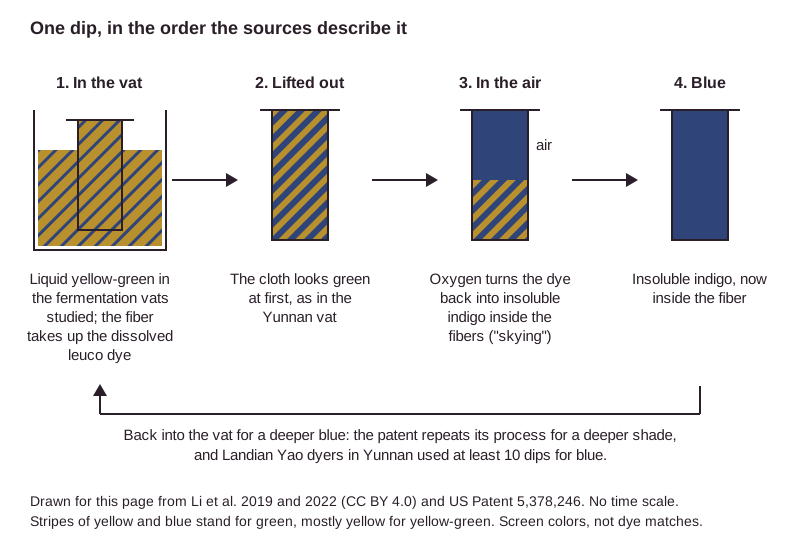
Wider than a phone screen: swipe sideways along the diagram, or open it full size.
One dip, drawn for this page from Li and colleagues (2019, 2022) and US Patent 5,378,246, with no time scale. Yellow and blue stripes stand for green and yellow-green. Screen colors, not dye matches.
Diagram: Tailor, Weaver, Jeweler, Dyer, CC BY 4.0
"One dip in an indigo vat, in the order the sources describe it" by Tailor, Weaver, Jeweler, Dyer, from https://tailorweaverjewelerdyer.com/color/indigo-dye/. Licensed under CC BY 4.0: https://creativecommons.org/licenses/by/4.0/
Data: Li, Cunningham, Fan and Wang, Identity blues: the ethnobotany of the indigo dyeing by Landian Yao (Iu Mien) in Yunnan, Southwest China, Journal of Ethnobiology and Ethnomedicine 15: 13, 2019, CC BY 4.0, https://doi.org/10.1186/s13002-019-0289-0; Li, Shi, Huang, Tong, Wu and Wang, Fermentation Blues: Analyzing the Microbiota of Traditional Indigo Vat Dyeing in Hunan, China, Microbiology Spectrum 10(4): e01663-22, 2022, CC BY 4.0, https://doi.org/10.1128/spectrum.01663-22; US Patent 5,378,246, Indigo dye process, Sally Gurley, filed 1993, granted 1995, https://patents.google.com/patent/US5378246A/en
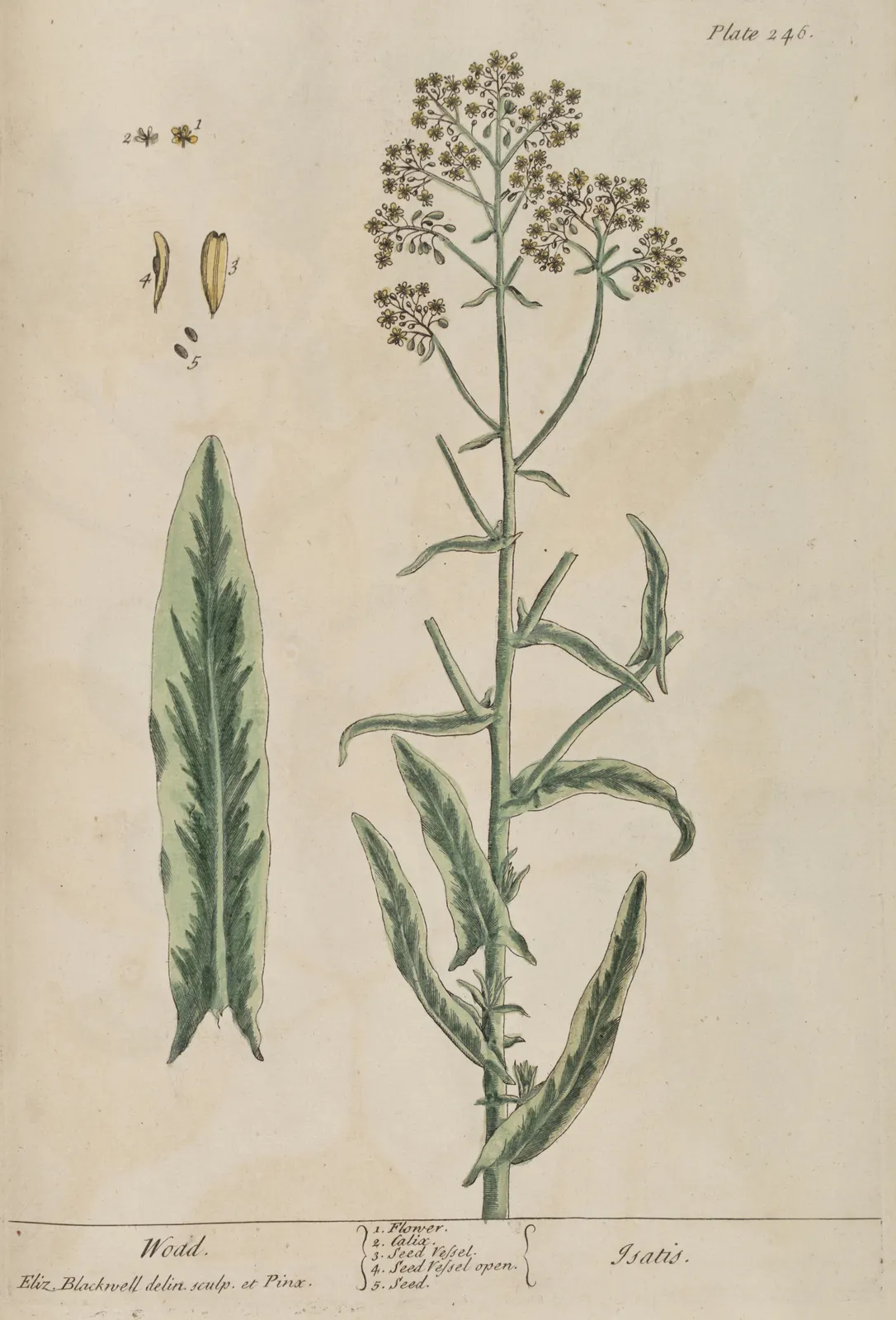
Woad, labelled "Wodd" and "Isatis" on plate 246 of Elizabeth Blackwell's "A Curious Herbal," dated 1737 in the scan's record; she drew, engraved and colored it.
"A curious herbal (Plate 246): Wodd. Isatis." by Elizabeth Blackwell, Public domain
"A curious herbal (Plate 246): Wodd. Isatis." by Elizabeth Blackwell — https://commons.wikimedia.org/wiki/File:A_curious_herbal_(Plate_246)_BHL296739.jpg — Public domain (Elizabeth Blackwell, plate engraved and colored by her, published 1737 per the scan record; US: published before 1931; EU: an artist publishing in 1737 cannot have lived past 1955; file page tags PD-scan and PDM); modified: cropped from the full-page scan to the printed plate (box 530, 583, 3481, 4930 in the 3962 × 5651 original), removing the book gutter, facing page and binding; colours not altered
The pigment is the same; the plant differs. ColourLex, a reference on pigments, lists woad among indigo's other names [9]. It says indigo can be made from many plants, among them woad (Isatis tinctoria) in Europe, and that all of them hold the same starting compound, indican [9].
The Landian Yao used three plants, chiefly Strobilanthes cusia with two Indigofera species [1]. The Hunan vat's paste came from Strobilanthes cusia and Polygonum tinctorium [3]. Li and colleagues also list the medieval woad vat of Europe and the sweet indigo vat of India among traditional fermentation recipes [3]. In commercial dyeing, plants had given way by the 1990s: "synthetic indigo has essentially replaced natural indigo," the 1995 patent says [2].
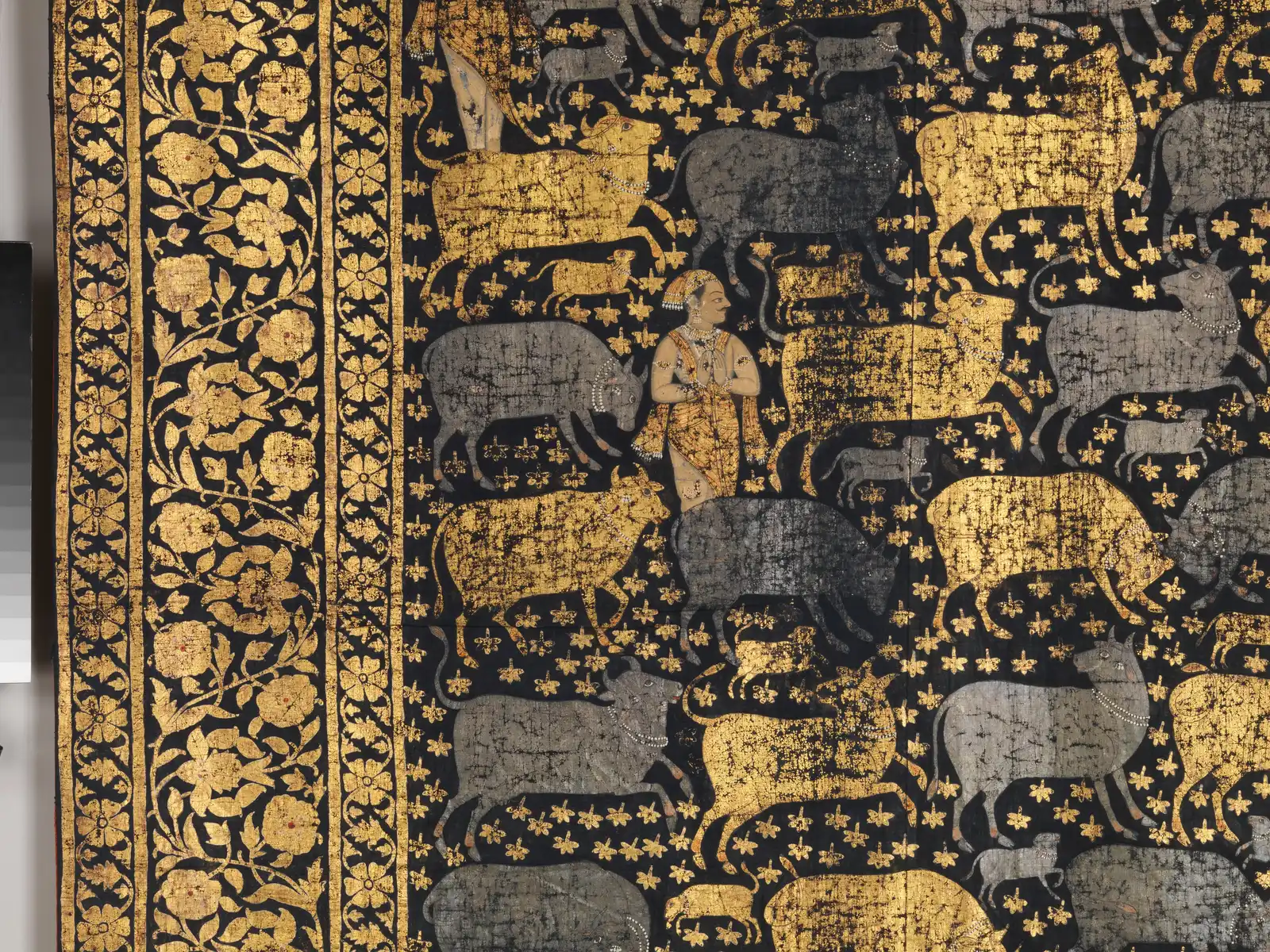
Detail of a ceremonial cloth from the Deccan, India, possibly Aurangabad, late 18th century, catalogued by The Metropolitan Museum of Art (2003.177) as painted and printed gold and silver leaf and opaque watercolor on indigo-dyed cotton.
"Ceremonial cloth" by Unknown maker — https://commons.wikimedia.org/wiki/File:MET_DP156678.jpg — CC0 1.0 (https://creativecommons.org/publicdomain/zero/1.0/)
A dyed cloth rarely says how it was dyed. The Met catalogues this ceremonial cloth as gold and silver on indigo-dyed cotton [10]. The catalogue data read here do not say whether a dye analysis found the indigo, and in the photograph the ground looks almost black [10].
This site calls the checkable part the fade record: an object's documented color history. It holds only recorded storage, tests and treatment, and marks everything else not verified. For this cloth, the records read here hold no dye test, so the indigo rests on the catalogue's word.
The Glen Affric tartan shows what a test adds. V&A Dundee reported in 2023 that dye analysis confirmed indigo or woad in its green; the other colors stayed inconclusive [11]. The tartan entry reads that record in full, and a shade alone cannot settle arsenic green either.
Tailor, Weaver, Jeweler, Dyer. “Indigo Dye: Water Won't Dissolve It, So the Vat Changes It.” Published 27 October 2026. https://tailorweaverjewelerdyer.com/color/indigo-dye/. Accessed: add the date you read it.
Facts here carry numbered links to the sources listed above. How entries are checked: Weighing the Evidence: How This Site Checks Facts. Every substantive change is dated on Corrections. Spotted a mistake or have a better source? Contact and Correspondence.
"Murex brandaris" by Wenceslaus Hollar — https://commons.wikimedia.org/wiki/File:Wenceslas_Hollar_-_Murex_brabdaris.jpg — Public domain (Wenceslaus Hollar d. 1677, PD in US and EU)
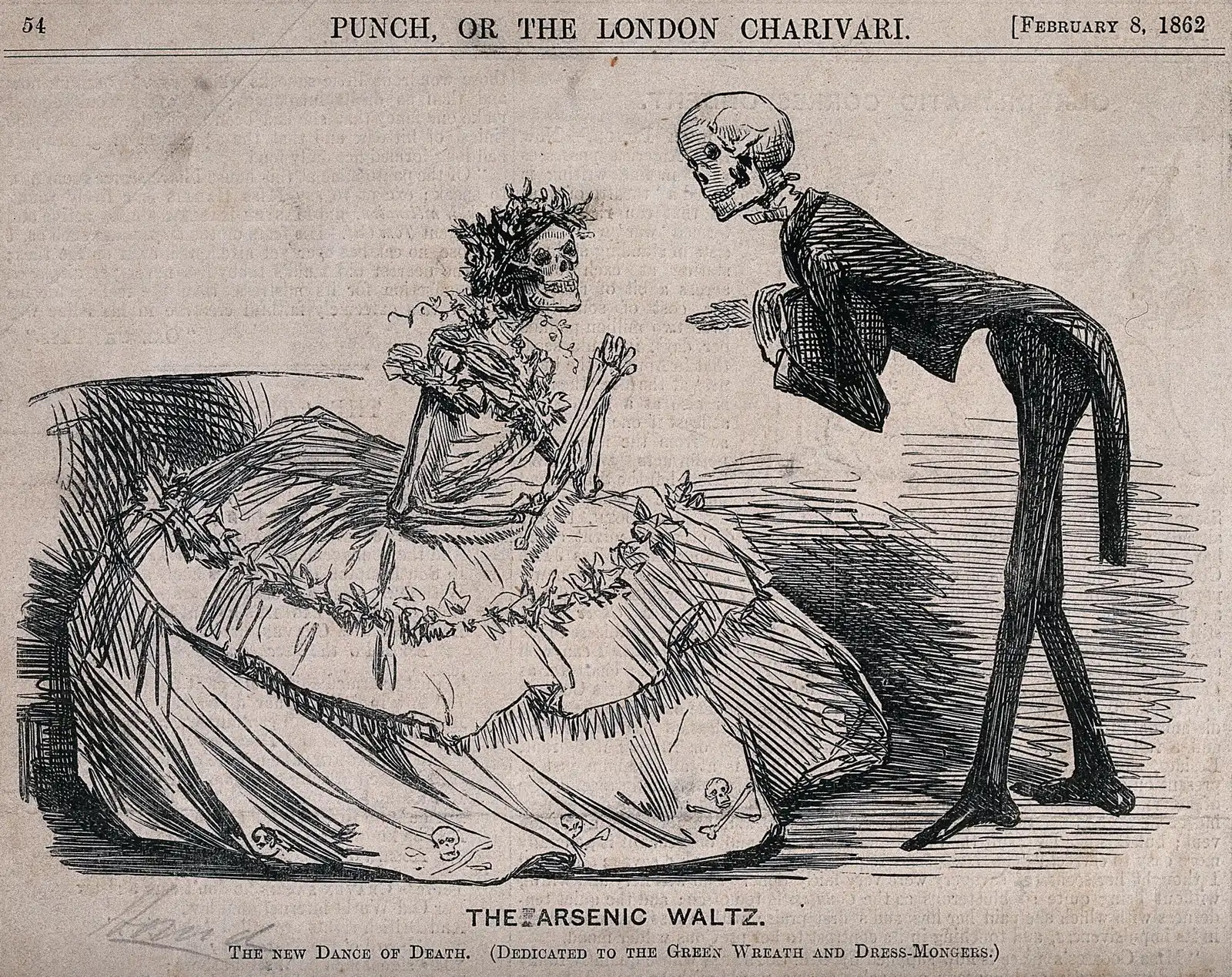
"The Arsenic Waltz" by Wellcome Collection — https://commons.wikimedia.org/wiki/File:Two_skeletons_dressed_as_lady_and_gentleman._Etching,_1862._Wellcome_V0042226.jpg — CC BY 4.0 (https://creativecommons.org/licenses/by/4.0/)

