


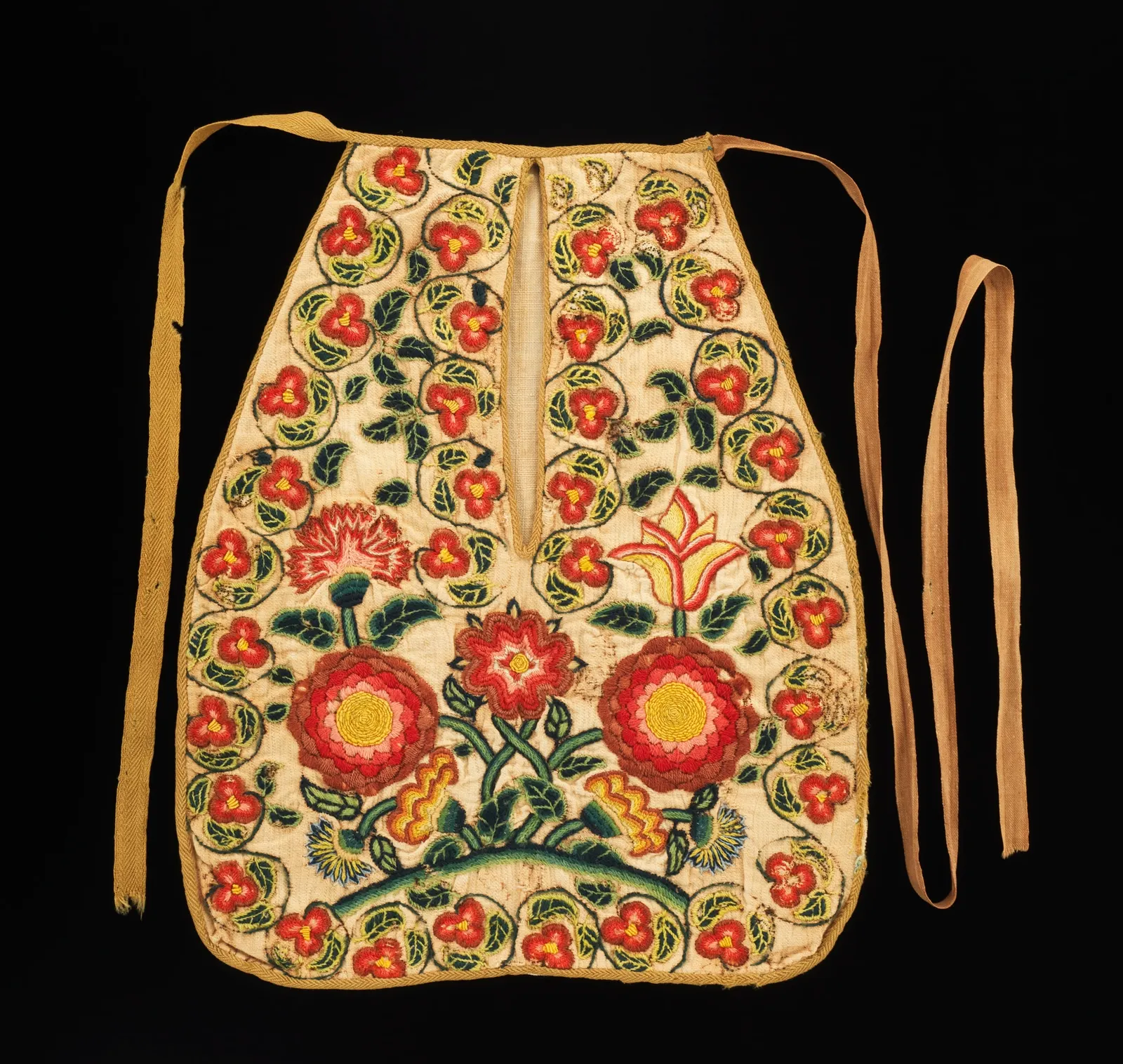
Picture credit
"Pocket" by Unknown maker — https://commons.wikimedia.org/wiki/File:Pocket_MET_1996.2_CP4.jpg — CC0 1.0 (https://creativecommons.org/publicdomain/zero/1.0/)
By Tailor, Weaver, Jeweler, Dyer Published
Build card
This card as data: corset-claims-build-card.csv (CSV) · file notes (JSON): where the values come from, version and license
Data: The Metropolitan Museum of Art Open Access data (CC0): C.I.39.18.1, 2013.515; Rijksmuseum, Amsterdam, collection data (CC0): BK-1978-295; S. Th. Sömmerring, Über die Wirkungen der Schnürbrüste (Berlin, 1793), public domain (facts restated); Comparison and evidence status compiled for this page
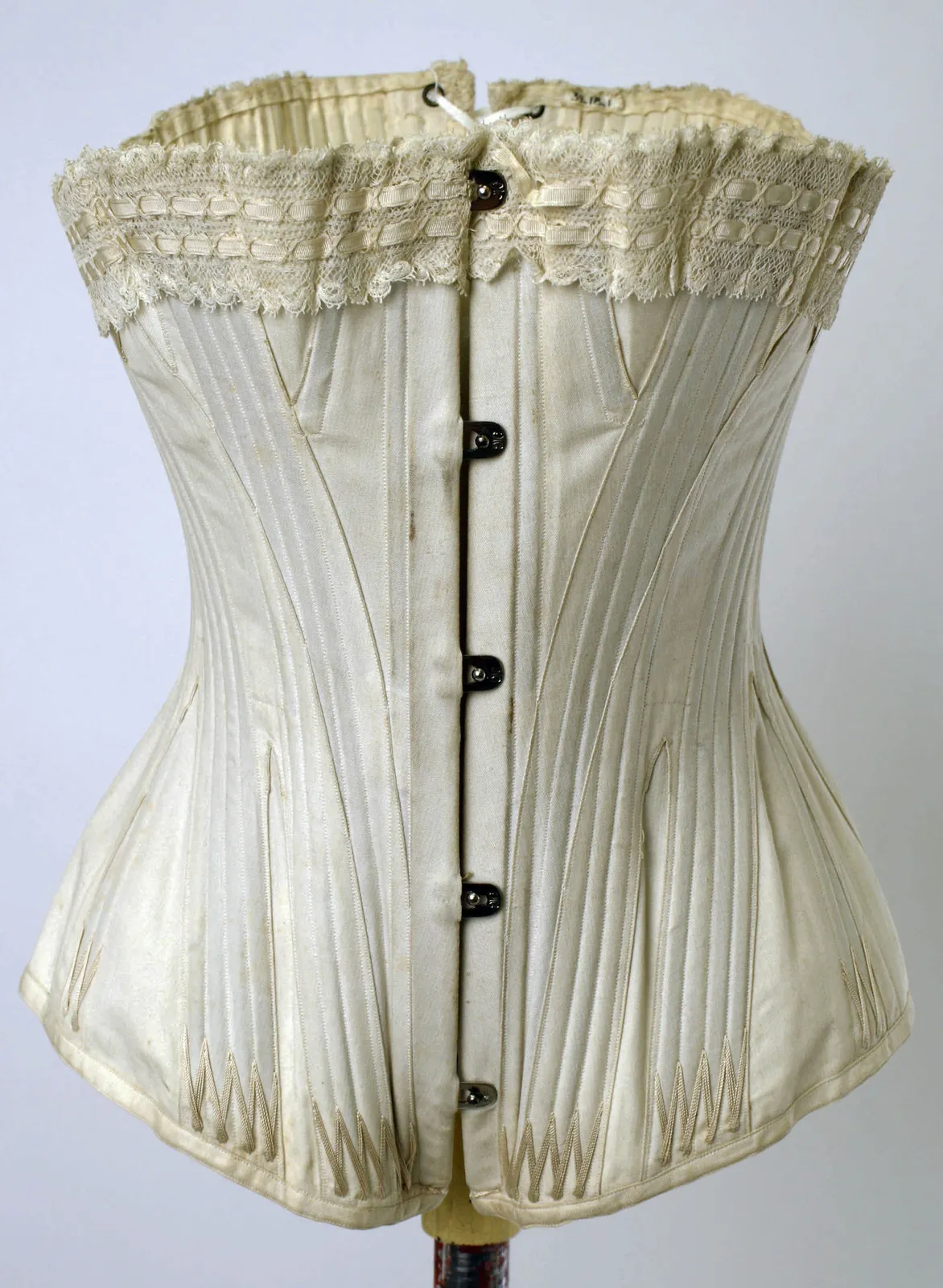
An American corset of the 1880s (Met C.I.39.18.1), seen from the front: lace along the top edge, curved rows of stitching, and five metal studs passing through loops down the center.
"Corset" by Unknown maker — https://commons.wikimedia.org/wiki/File:Corset_MET_CI39.18.1_F.jpg — CC0 1.0 (https://creativecommons.org/publicdomain/zero/1.0/)
On The Met's 1880s corset, the front closes with five metal studs, each pushed through a loop [1]. In 1793 the physician Samuel Thomas von Sömmerring argued that lacing the body into stays reshaped the ribs and pushed organs out of place [2]. In 2015 Rebecca Gibson reported bent ribs and spinal bones in seven women's skeletons in Paris, in a study she called preliminary [3]. For broken ribs and moved organs, no study read for this page measured either, so both are marked evidence insufficient.
This page compares those sources and gives no advice on wearing, lacing or health. Nor does it argue that corsets were harmless, which one small study could not show.
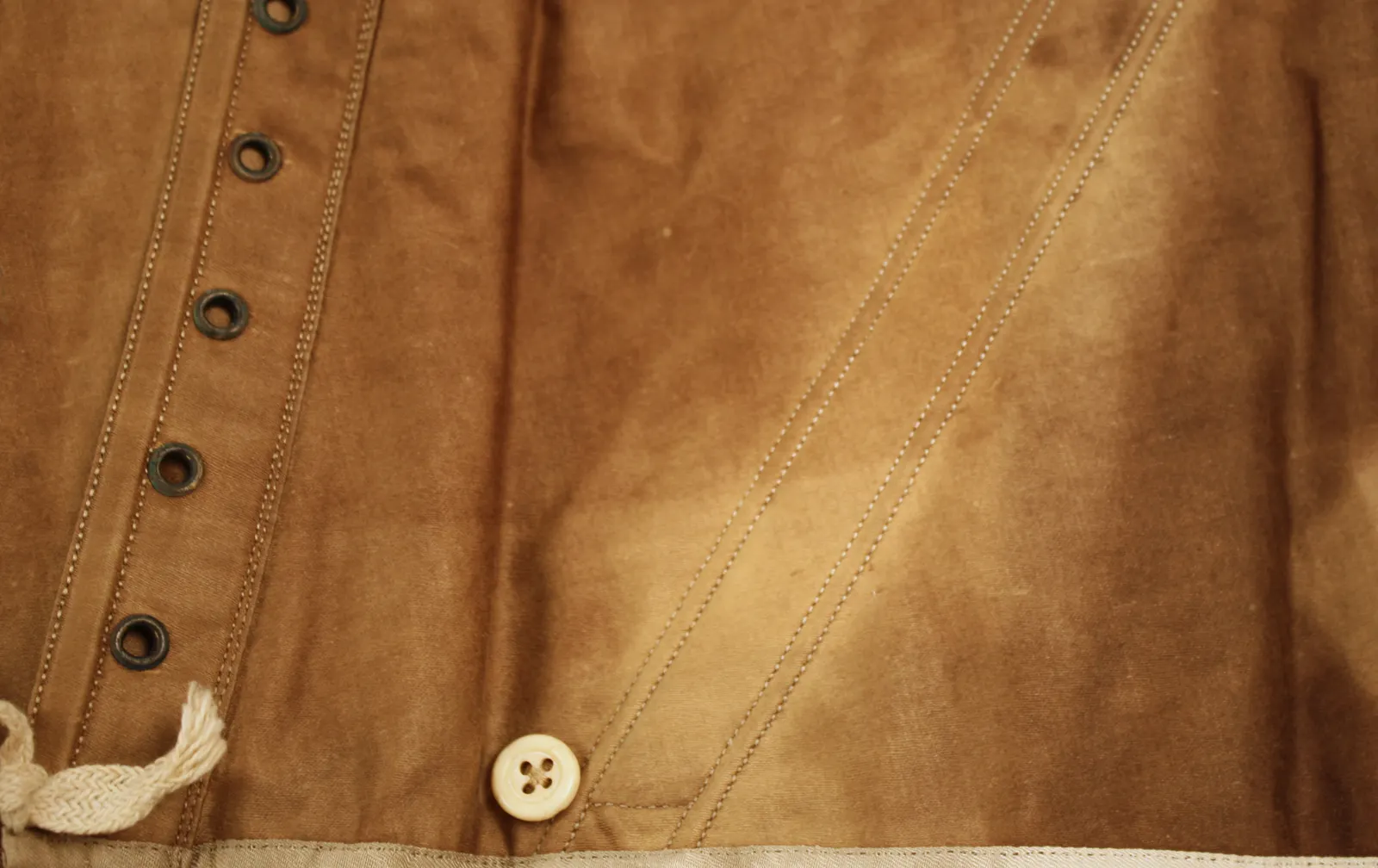
Detail of an early 19th-century corset, probably British (Met 2013.515): metal-rimmed eyelets down a stitched band, the end of a braided cord at lower left, and paired lines of stitching.
"Corset" by Unknown maker — https://commons.wikimedia.org/wiki/File:Corset_MET_2013.515_d1.jpg — CC0 1.0 (https://creativecommons.org/publicdomain/zero/1.0/)
Sömmerring described the stays of his day as a cone sewn from strips, usually open at the back, with the two edges meeting when laced [2]. The strips, he wrote, were commonly of whalebone or cane, formerly of iron, and some stays had steel rods called planchettes set in at the front or back [2]. A surviving pair adds another material. The Rijksmuseum records its green taffeta stays of 1740–1790 (BK-1978-295) as made with osiers, which is willow, along with linen, taffeta and silk [4].
The Met's early 19th-century corset (2013.515) is recorded as cotton, linen, silk, metal and bone, and the detail photograph shows metal-rimmed eyelets for the lace [5]. On the 1880s corset at the top of this page, the front opens on a busk, the fastening strip down the center. Metal studs on one edge pass through loops on the other [1]. Here stays means the 18th-century garment and corset the 19th-century one; the 18th-century clothing entry places stays among a woman's layers of about 1770–1800.
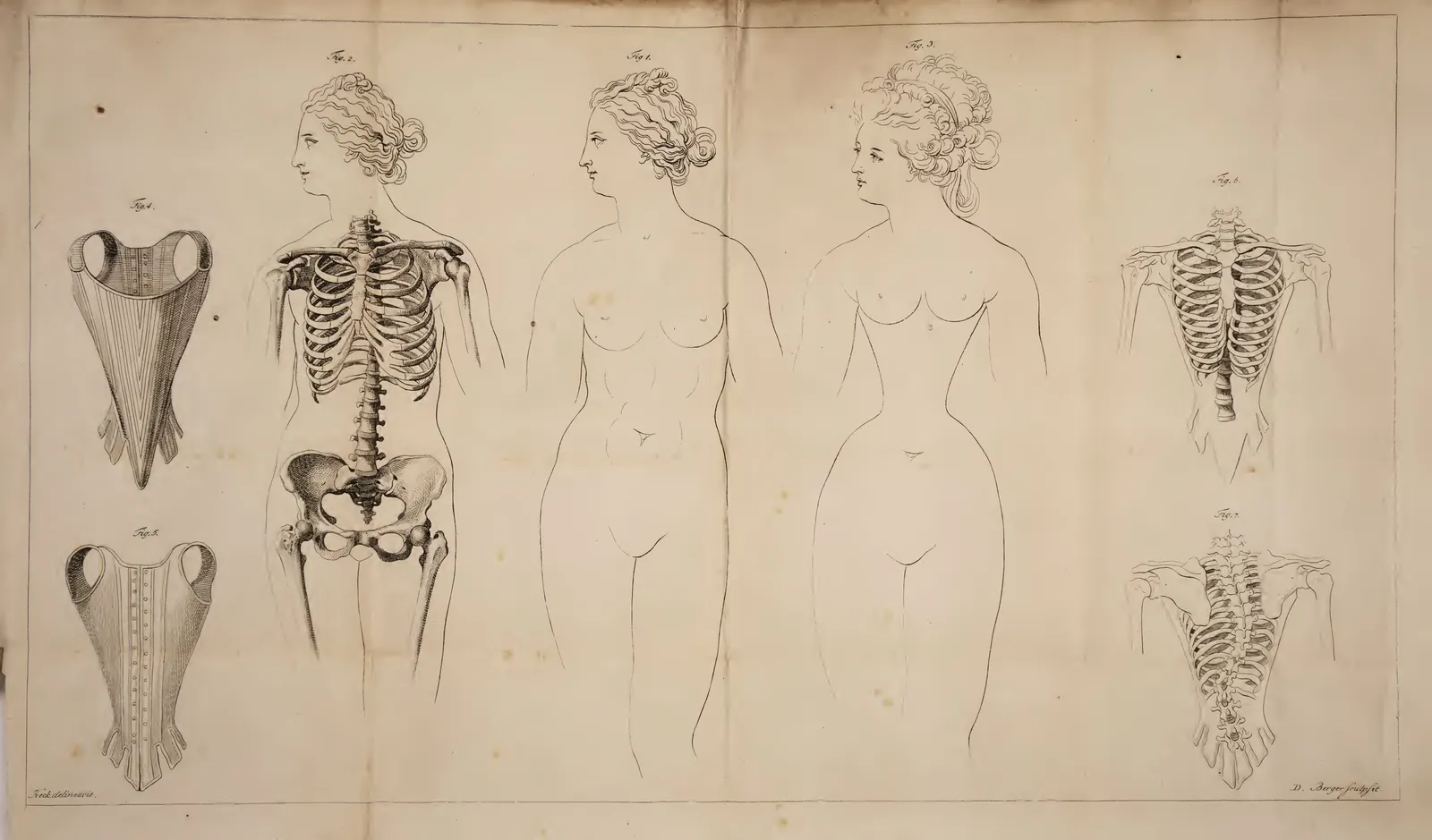
The folding plate of Sömmerring's 1793 treatise, drawn by Keck and engraved by D. Berger. Its first figure copies a drawing of the Medici Venus; the sixth and seventh, a rib cage he says lacing had changed, were drawn from nature. A physician's argument in pictures.
"Folding plate, figures 1–7, from Über die Wirkungen der Schnürbrüste" by Keck (drawing) and D. Berger (engraving), for Samuel Thomas von Sömmerring, Public domain
"Folding plate, figures 1–7, from Über die Wirkungen der Schnürbrüste" by Keck (drawing) and D. Berger (engraving), for Samuel Thomas von Sömmerring — https://commons.wikimedia.org/wiki/File:%C3%9Cber_die_Wirkungen_der_Schn%C3%BCrbr%C3%BCste_(IA_b30345649).pdf — Public domain (published Berlin 1793; author Sömmerring d. 1830; plate signed by Keck and D. Berger, death years not verified but long past (inferred); PD in US (published before 1931) and EU; Public Domain Mark 1.0 on the scan); modified: page 87 of the 90-page PDF extracted as a 300 ppi JPEG; not cropped; colours not altered
Sömmerring wrote as a practicing physician, basing his account on his own comparisons of bodies changed by stays with bodies never laced [2]. His Über die Wirkungen der Schnürbrüste (On the Effects of Stays), printed in Berlin in 1793, calls itself a new, completely reworked edition [2]. It does two separate things.
First, it lists. Sömmerring set down about a hundred complaints that physicians had blamed on stays, naming one authority for each [2]. They run from headaches to a "Sieches und kurzes Leben," a sickly and short life, credited to Camper [2]. Then he says he will discuss in detail only the effects on body shape and on pregnancy, birth and nursing [2].
Second, it argues from anatomy: the chest is shaped like a cone with its point upward, stays like one with its point downward, so the ribs, the spine or the breastbone must give way [2]. Lacing, in his account, pushes the lower ribs together and draws each rib's front end toward its back end [2]. Over time it presses the spinous processes, the bony points down the back of the spine, close together and out of line [2]. He also describes the preserved body of a barely grown girl with a deep furrow below the breastbone that, in his reading, lacing had made [2].
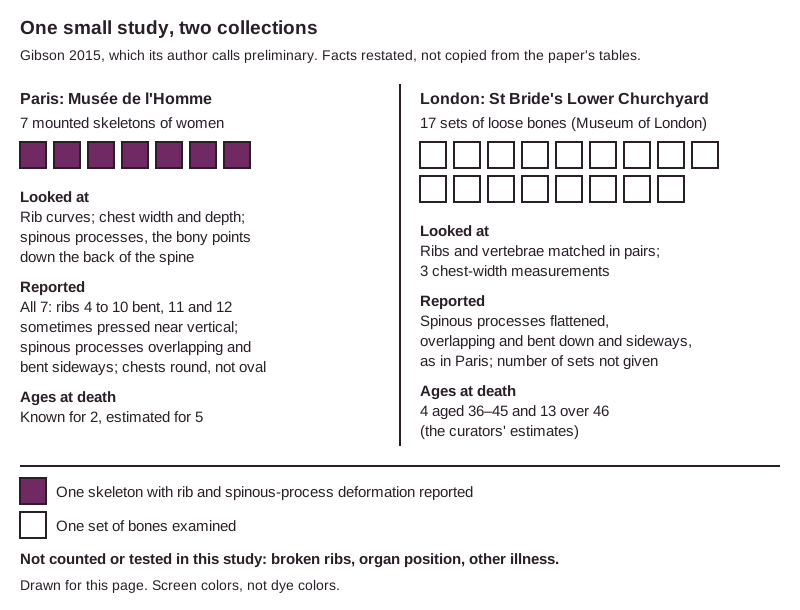
Wider than a phone screen: swipe sideways along the diagram, or open it full size.
What the 2015 study examined and reported, restated for this page, not copied from the paper. Each square is one skeleton or one set of bones. Screen colors, not dye colors.
Diagram: Tailor, Weaver, Jeweler, Dyer, CC BY 4.0
"One small study, two collections: what a 2015 skeleton study examined and reported" by Tailor, Weaver, Jeweler, Dyer, from https://tailorweaverjewelerdyer.com/construction/corset-claims/. Licensed under CC BY 4.0: https://creativecommons.org/licenses/by/4.0/
Data: Facts restated from R. Gibson, "Effects of Long Term Corseting on the Female Skeleton: A Preliminary Morphological Examination," NEXUS 23(2): 45–60 (2015), https://doi.org/10.15173/nexus.v23i2.983; Drawn for this page
Rebecca Gibson's paper in NEXUS: The Canadian Student Journal of Anthropology calls itself a preliminary morphological examination, a first look at bone shape [3]. She examined seven mounted skeletons of women in the Musée de l'Homme in Paris, a collection assembled piecemeal from unrelated individuals [3]. She also examined 17 sets of loose bones from St Bride's Lower Churchyard, held by the Museum of London [3].
In all seven Paris skeletons, Gibson reported rib and spinous-process deformation consistent with long-term pressure on growing bones [3]. The ribs from the fourth to the tenth pair curved more than normal, some into an S shape, and the eleventh and twelfth were sometimes pressed almost vertical [3]. In cross-section the chests were round, whereas a typical rib cage is oval, wider from side to side than from front to back [3]. She weighed other causes, among them rickets and deformity present from birth, and found that the pattern did not fit them [3].
The London bones were loose and could not be reassembled into whole rib cages, but Gibson describes the same pattern in their spinous processes and gives three chest-width measurements [3]. Sömmerring had described a similar crowding of the spinous processes in 1793 [2].
| Paris, Musée de l'Homme | London, St Bride's Lower Churchyard | |
|---|---|---|
| Remains | 7 mounted skeletons of women | 17 sets of loose bones |
| Looked at | Rib curves, chest width and depth, spinous processes | Ribs and vertebrae in matched pairs; 3 chest-width measurements |
| Reported | All 7: ribs 4 to 10 bent, 11 and 12 sometimes near vertical, spinous processes overlapping and bent sideways, chests round | Spinous processes flattened, overlapping and bent, as in Paris; number of sets not given |
| Ages at death | 2 known, 5 estimated | 4 aged 36–45, 13 over 46 (curators' estimates) |
Gibson also looked at ages at death. In her samples the women reached or passed the life expectancy at birth of their time and place, and a few may have outlived the average age at death once childhood deaths are set aside [3]. She notes that this says nothing about their quality of life [3]. With seven skeletons in Paris and 17 sets of bones in London, the result describes those women, not corset wearers in general.
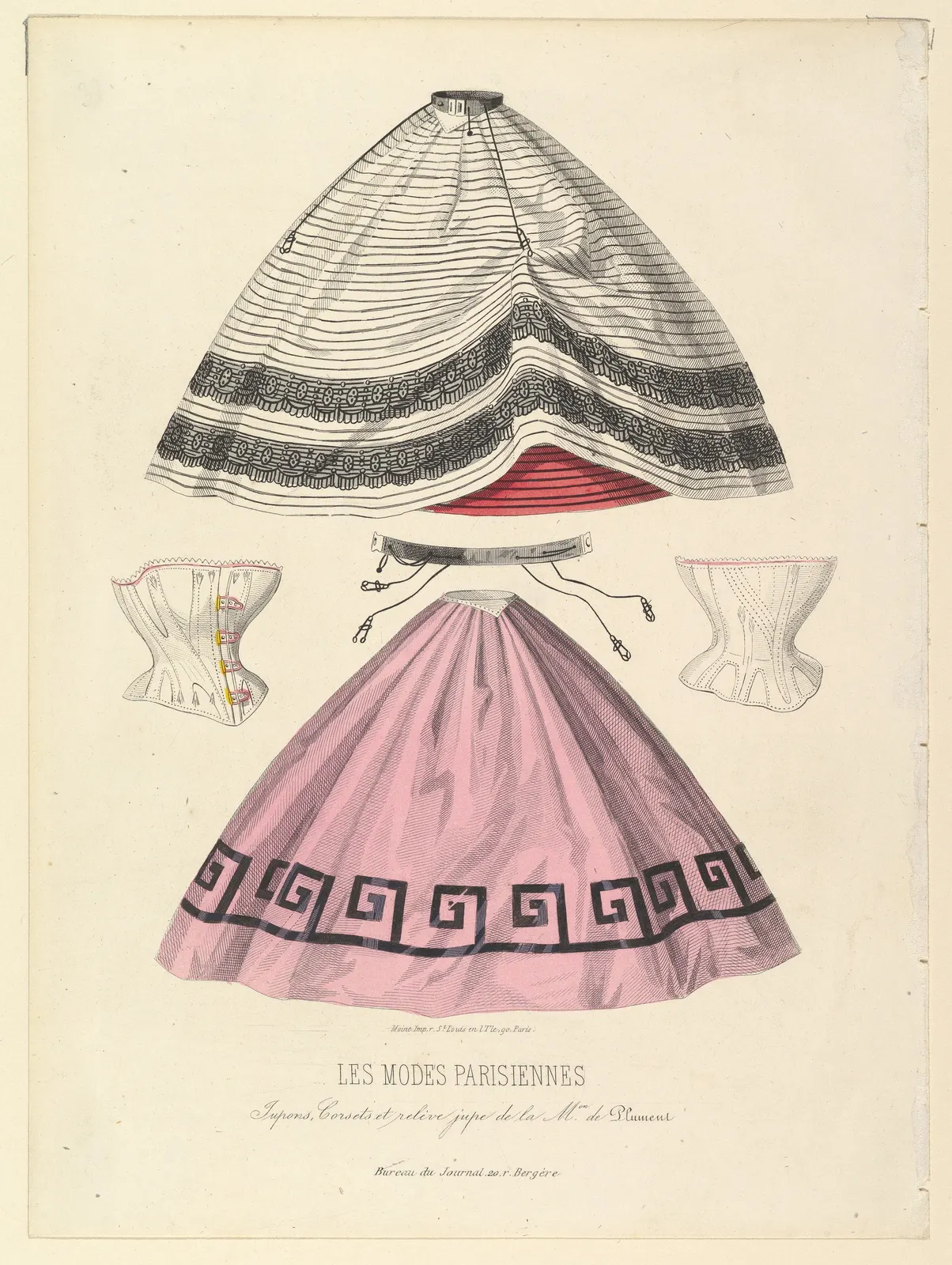
A hand-colored steel engraving from Les Modes Parisiennes, 1862 (Met 40.124.121), titled for petticoats, corsets and a skirt lifter from the Maison de Plument. A fashion plate, not evidence of what corsets did to the body.
"Jupons, corsets et relève jupe de la Maison de Plument, from Les Modes Parisiennes Illustrées" by Anonymous (Imprimerie Moine), CC0 1.0
"Jupons, corsets et relève jupe de la Maison de Plument, from Les Modes Parisiennes Illustrées" by Anonymous (Imprimerie Moine) — https://commons.wikimedia.org/wiki/File:Jupons,_corsets_et_rel%C3%A8ve_jupe_de_la_Maison_de_Plument,_from_Les_Modes_Parisiennes_Illustr%C3%A9es_MET_DP819137.jpg — CC0 1.0 (https://creativecommons.org/publicdomain/zero/1.0/)
Sömmerring raised the idea, but as a belief rather than a case. Some stays, he wrote, were so firm, hard and unbending that violent lacing would sooner break the ribs ("eher die Rippen zerbrechen") than change their shape [2]. In the passages of his treatise read for this page, he reports no broken rib.
Gibson's paper does not count fractures. Two of her photographs of London bones mark rib breaks, one labelled as before death, but the text does not discuss them or tie them to corsets [3]. No source read here measured how often corset wearers broke ribs, and neither Gibson nor the passages of Sömmerring read here mention removing ribs to narrow the waist. Fractures are marked evidence insufficient.
On organs the only source read here is Sömmerring, who wrote that lacing squeezes the lower lungs, forces the diaphragm up and changes the stomach's place and shape [2]. The colon, he said, is pushed up, while the rectum, uterus and bladder are pushed down [2]. As support he cited Mascagni's life-size drawing of a liver misshapen by stays and said he had seen several such livers himself [2]. Gibson's study examined bones, not organs, and no study read here measured organ position, so it is marked evidence insufficient.
Everything else on Sömmerring's list rests on the testimony he gathered, one authority per complaint [2]. None of it is tested in the passages of his treatise read here or in Gibson's paper, so each complaint stays at evidence insufficient, except the short life covered above.
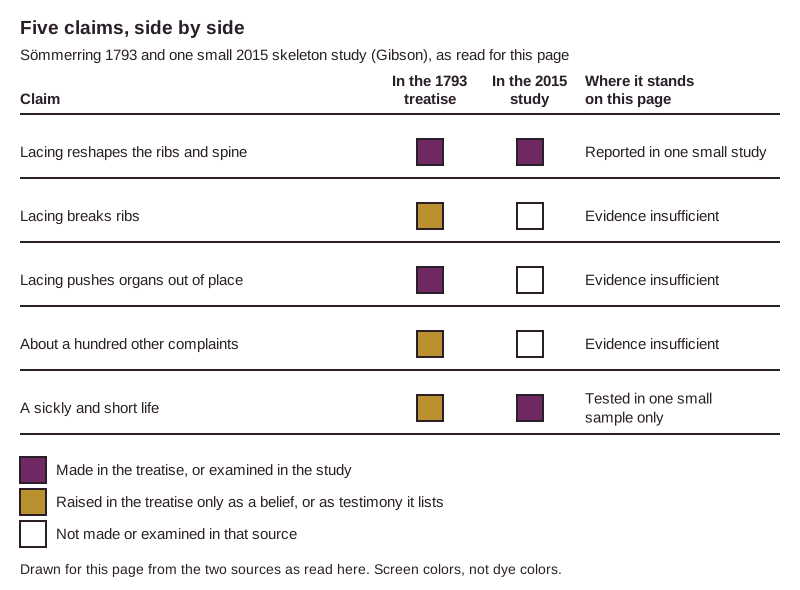
Wider than a phone screen: swipe sideways along the diagram, or open it full size.
Whether the 1793 treatise makes each claim and the 2015 study examines it, and where each stands. Drawn for this page; screen colors, not dye colors.
Diagram: Tailor, Weaver, Jeweler, Dyer, CC BY 4.0
"Five corset claims, side by side" by Tailor, Weaver, Jeweler, Dyer, from https://tailorweaverjewelerdyer.com/construction/corset-claims/. Licensed under CC BY 4.0: https://creativecommons.org/licenses/by/4.0/
Data: S. Th. Sömmerring, Über die Wirkungen der Schnürbrüste (Berlin, 1793), public domain (facts restated); R. Gibson, NEXUS 23(2): 45–60 (2015), https://doi.org/10.15173/nexus.v23i2.983 (facts restated); Claims and their status compiled for this page
The table repeats the chart, one claim per row. Each row names who made the claim and the kind of evidence behind it. A claim with no readable study behind it is marked evidence insufficient, as the site's method page explains.
| Claim | Made by | Evidence read for this page | Where it stands |
|---|---|---|---|
| Lacing reshapes the ribs and spine | Sömmerring, 1793, a physician's treatise with rib-cage figures he says were drawn from nature | A 2015 study, called preliminary by its author: bent ribs and spinous processes in all seven Paris skeletons | Reported in one small study |
| Lacing breaks ribs | Sömmerring, 1793, as a belief about very stiff stays; no case given | No study read here counted fractures; two rib breaks in the 2015 study's photographs are not tied to corsets | Evidence insufficient |
| Lacing pushes organs out of place | Sömmerring, 1793, citing Mascagni's liver drawing and livers he says he saw | No study read here examined organs | Evidence insufficient |
| Stays cause about a hundred other complaints | Physicians listed by Sömmerring, 1793, one authority each | Not tested in the passages of the treatise read here or in the 2015 study | Evidence insufficient |
| Stays bring a sickly and short life | Camper, as listed by Sömmerring, 1793 | 2015 study, small sample: ages at death reached or passed life expectancy at birth; quality of life unknown | Tested in one small sample only |
Gibson has since published a 2020 book, The Corseted Skeleton: A Bioarchaeology of Binding, and a 2023 article in American Anthropologist on "the historical inaccuracies of the bioarchaeology of corsets," in its title's words [7][8]. Neither could be read for this page, so nothing here rests on them. Arsenic green dresses raise a similar question about clothes and harm, and the arsenic green entry sorts it by test records.
Tailor, Weaver, Jeweler, Dyer. “Corsets and Ribs: Bending Reported in Seven Paris Skeletons.” Published 27 October 2026. https://tailorweaverjewelerdyer.com/construction/corset-claims/. Accessed: add the date you read it.
Facts here carry numbered links to the sources listed above. How entries are checked: Weighing the Evidence: How This Site Checks Facts. Every substantive change is dated on Corrections. Spotted a mistake or have a better source? Contact and Correspondence.
"Pocket" by Unknown maker — https://commons.wikimedia.org/wiki/File:Pocket_MET_1996.2_CP4.jpg — CC0 1.0 (https://creativecommons.org/publicdomain/zero/1.0/)
"Effets du tourniquet sur les jupons en crinoline" by Honoré Daumier — https://commons.wikimedia.org/wiki/File:Effets_du_tourniquet_sur_les_jupons_en_crinoline._N%C2%B016,_G.2037(3).jpg — CC0 1.0 (https://creativecommons.org/publicdomain/zero/1.0/)

