


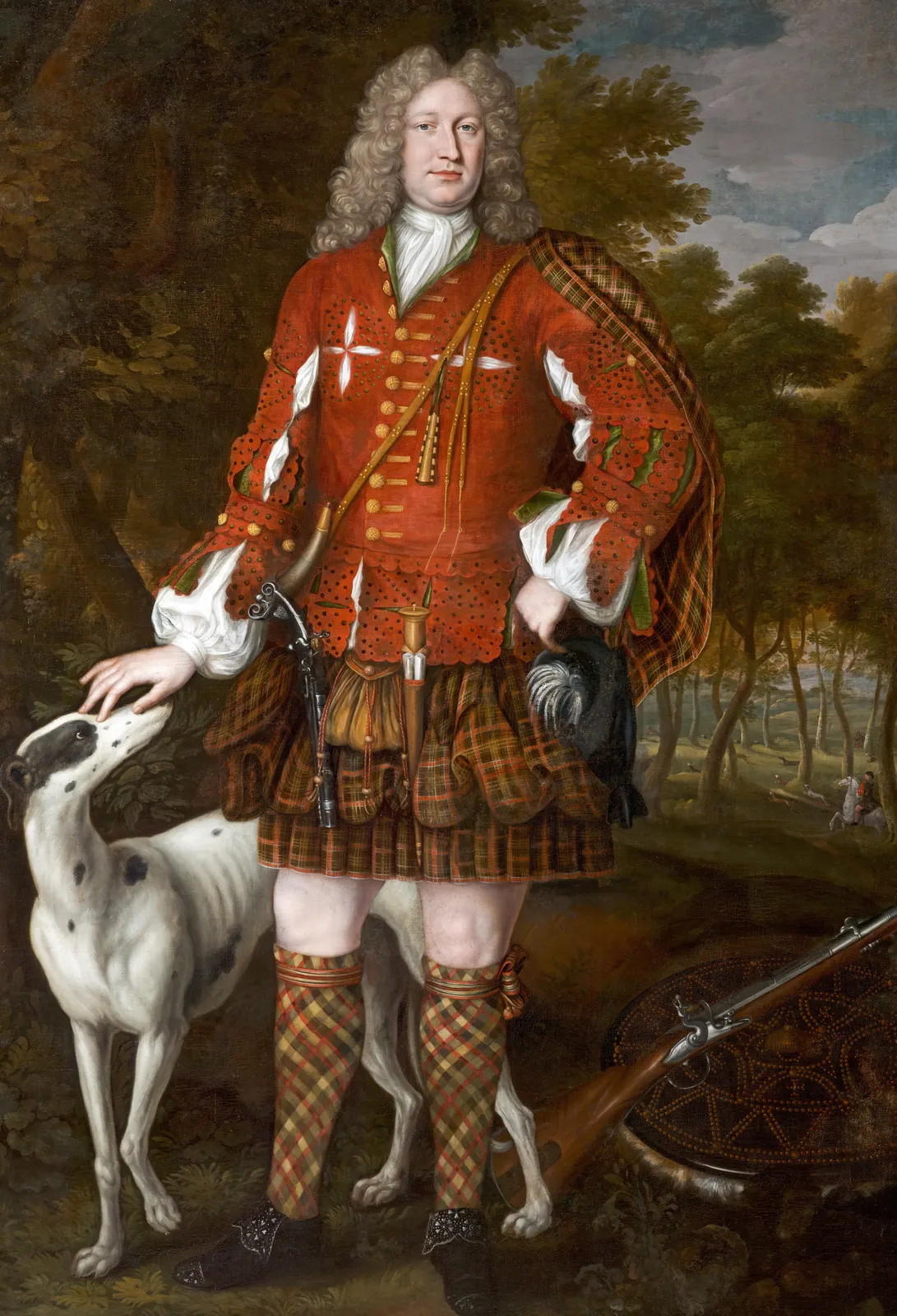
Picture credit
"Kenneth Sutherland, 3rd Lord Duffus, d. 1734. Jacobite" by Richard Waitt — https://commons.wikimedia.org/wiki/File:Kenneth-sutherland-3rd-lord-duffus-d-1734-jacobite.jpg — Public domain (Richard Waitt d. 1732, PD in US and EU)
By Tailor, Weaver, Jeweler, Dyer Published
Build card
This card as data: types-of-weave-build-card.csv (CSV) · file notes (JSON): where the values come from, version and license
Data: Facts from William Watson, Textile Design and Colour (1912), William H. Dooley, Textiles (1914), and Art Institute of Chicago collection records (catalogue data, CC0), each named in the source column
Wider than a phone screen: swipe sideways along the diagram, or open it full size.
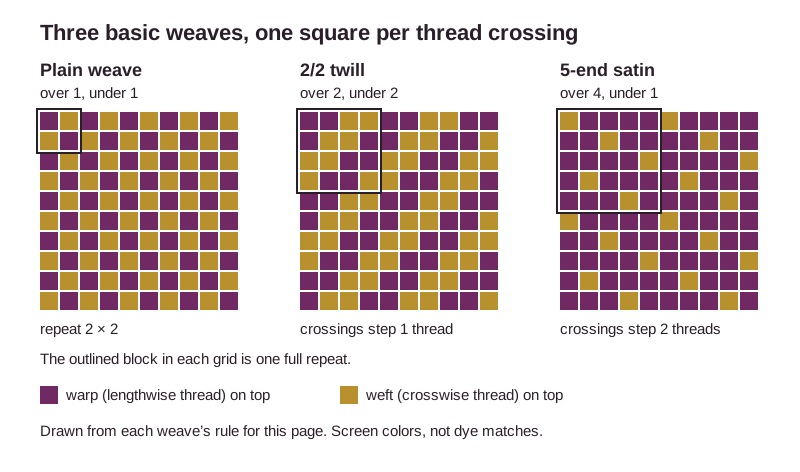
Plain weave, 2/2 twill and 5-end satin, one square per thread crossing, drawn from each weave's rule with one repeat outlined. Screen colors, not dye matches.
Diagram: Tailor, Weaver, Jeweler, Dyer, CC BY 4.0
"Three basic weaves, one square per thread crossing" by Tailor, Weaver, Jeweler, Dyer, from https://tailorweaverjewelerdyer.com/weaves/types-of-weave/. Licensed under CC BY 4.0: https://creativecommons.org/licenses/by/4.0/
Data: Computed for this page from the plain-weave, 2/2 twill and 5-end satin rules
When you pull one thread from a linen napkin's cut edge, a fringe of cross threads stays. That fringe is the second of the two sets of threads in woven cloth: the lengthwise warp and the crosswise weft [1]. Plain weave, twill and satin, the first three classes of weave in William Dooley's 1914 textbook, cross warp and weft at right angles [1][2]. They differ only in where the crossings fall.
Satin names one of those arrangements, not a fiber. In a satin each thread of one set floats over all but one of the other in every repeat, and the crossings are spread apart so they do not form a twill's diagonal lines [1][2]. The Art Institute of Chicago catalogs satin weave in silk, in linen, and in cotton and rayon [3][4][5].
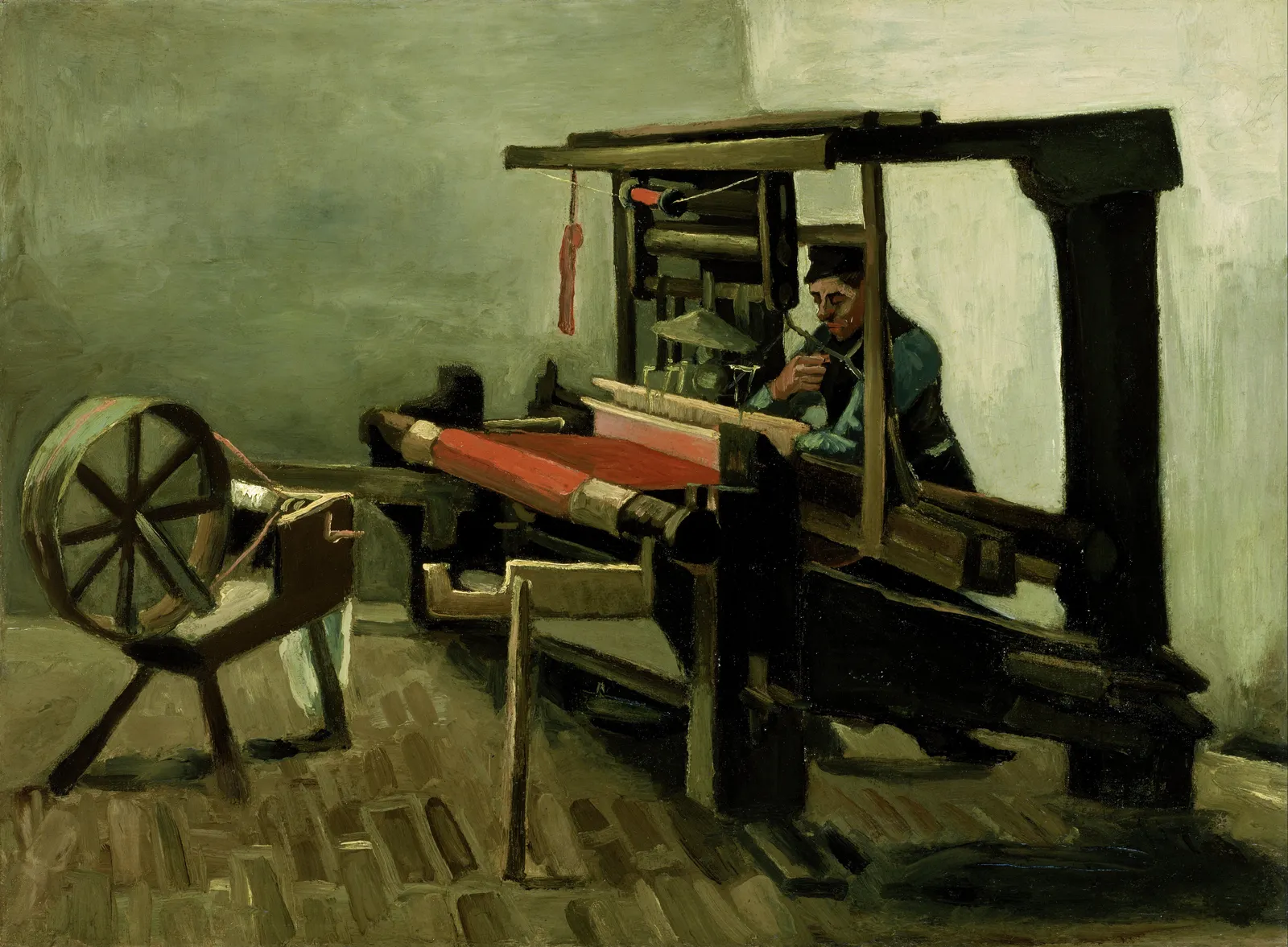
Vincent van Gogh, "Weaver," 1884: a man inside a wooden handloom, red cloth on the beam before him. The Commons file page gives Museum of Fine Arts, Boston, 58.356, not checked with the museum.
"Weaver" by Vincent van Gogh — https://commons.wikimedia.org/wiki/File:Vincent_van_Gogh_-_Weaver_-_Google_Art_Project.jpg — Public domain (Vincent van Gogh d. 1890, PD in US and EU)
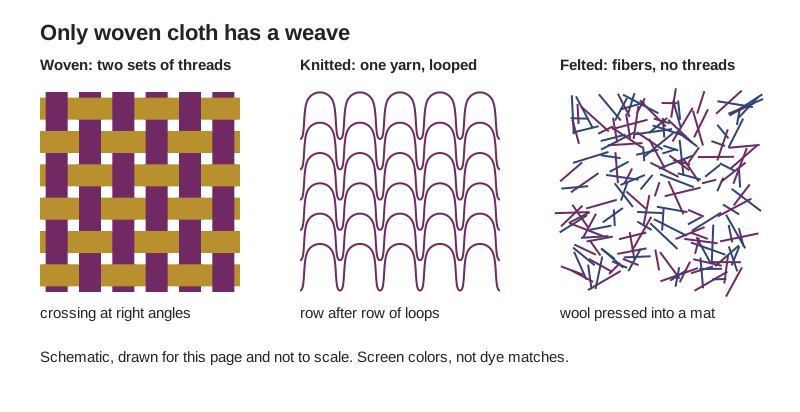
Only woven cloth has a weave in this sense. Dooley separates weaving, which uses two sets of threads, from knitting, netting, looping and braiding, which work one thread or one set [2]. He describes knitting as looping a single thread, and felt as wool rolled or pressed into a flat mat [2]. So a knitted stocking or a piece of felt has no plain, twill or satin structure.
Weavers call warp threads ends and weft threads picks [1], which is why a satin repeating on five threads is a 5-end satin.
Wider than a phone screen: swipe sideways along the diagram, or open it full size.
Two sets of threads crossing, one yarn looped row after row, and fibers pressed into a mat, after Dooley's 1914 distinctions. Schematic, not to scale; screen colors.
Diagram: Tailor, Weaver, Jeweler, Dyer, CC BY 4.0
"Only woven cloth has a weave" by Tailor, Weaver, Jeweler, Dyer, from https://tailorweaverjewelerdyer.com/weaves/types-of-weave/. Licensed under CC BY 4.0: https://creativecommons.org/licenses/by/4.0/
Data: Distinctions from William H. Dooley, Textiles, revised edition (1914), Project Gutenberg, https://www.gutenberg.org/ebooks/24077; schematic drawn for this page
Plain weave is the simplest crossing: each weft goes over one warp and under the next, and the following weft does the reverse [1][2]. It repeats on two threads each way, so a loom needs at least two shafts, frames lifting separate sets of warp threads [1]; that minimum is computed for this page.
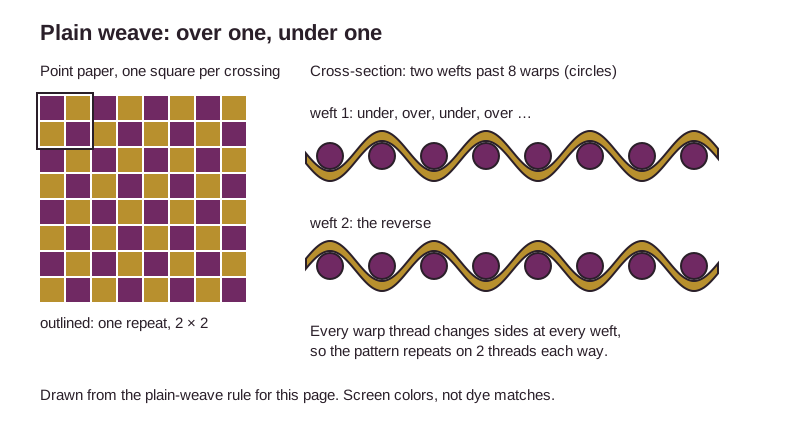
Wider than a phone screen: swipe sideways along the diagram, or open it full size.
Plain weave on point paper with its 2 × 2 repeat outlined, and two wefts passing eight warps seen end-on: under, over, then the reverse. Screen colors, not dye matches.
Diagram: Tailor, Weaver, Jeweler, Dyer, CC BY 4.0
"Plain weave: over one, under one" by Tailor, Weaver, Jeweler, Dyer, from https://tailorweaverjewelerdyer.com/weaves/types-of-weave/. Licensed under CC BY 4.0: https://creativecommons.org/licenses/by/4.0/
Data: Computed for this page from the plain-weave rule
William Watson's 1912 textbook lists tabby, calico and taffeta as trade names for plain cloth, which ranges from heavy canvas to fine cotton muslin [1]. The Art Institute of Chicago catalogs a pocket of about 1799 from New England as cotton plain weaves, lined with linen [6]; the 18th-century clothing entry shows where such a pocket was worn.
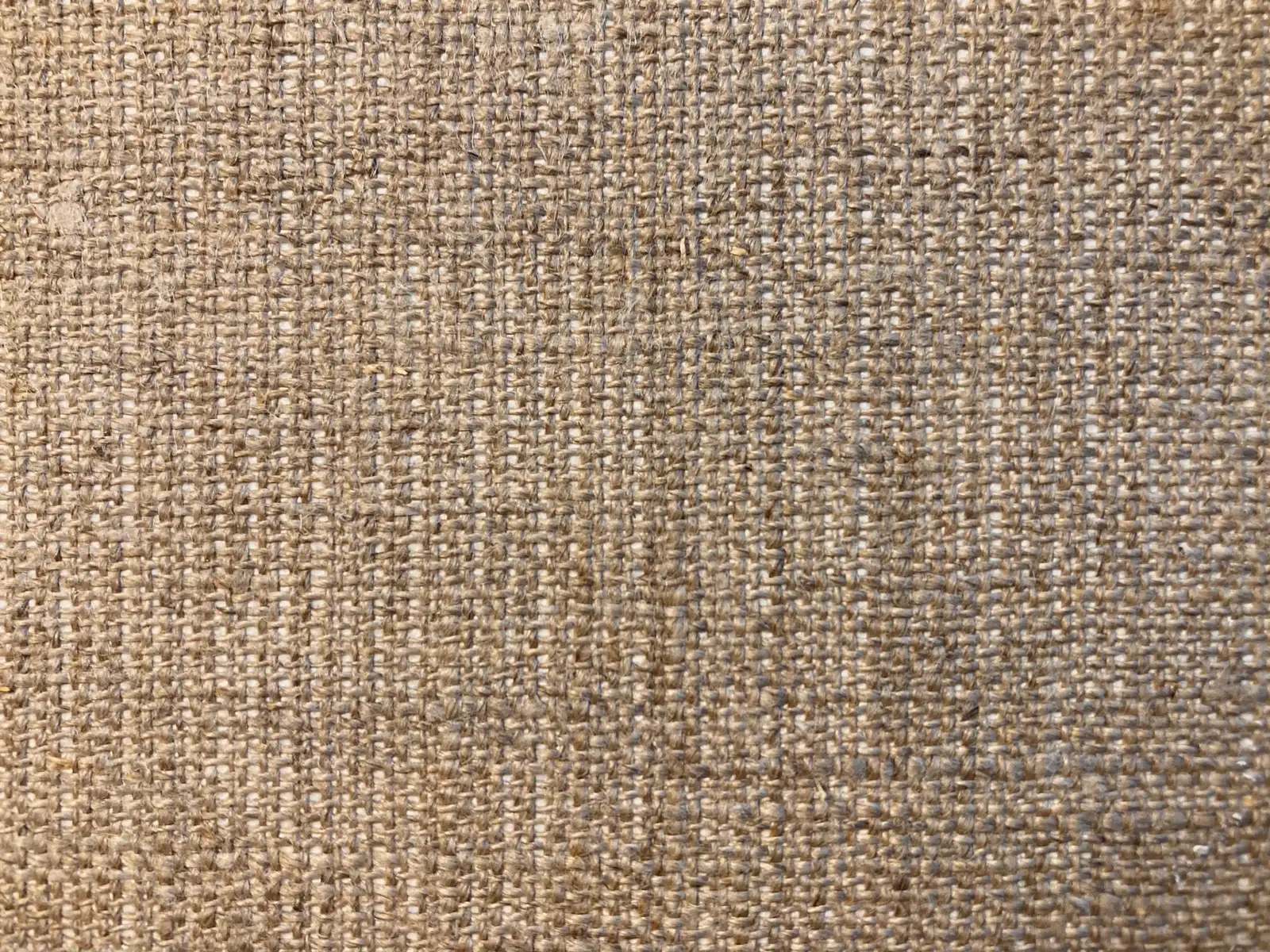
The back of a primed linen artist's canvas, according to its Commons file page: over one, under one in real yarn.
"Linen canvas" by JohanahoJ — https://commons.wikimedia.org/wiki/File:Linen_canvas.jpg — CC BY-SA 4.0 (https://creativecommons.org/licenses/by-sa/4.0/)
In a twill the crossings move one thread sideways with each new weft, so the floats line up into diagonals [1][2]. Watson notes that a twill needs at least three threads, and that the 2-and-2 twill is probably the most used weave after plain [1].
Read 2/2 as warp over two, under two. A 2/1 twill repeats on three threads and a 2/2 or 3/1 on four, and each needs at least that many shafts (computed). The lines show on both sides of the cloth but run the opposite way on the back [1]. The Art Institute of Chicago catalogs an 1860s Norwich shawl as silk, twill weave [7].
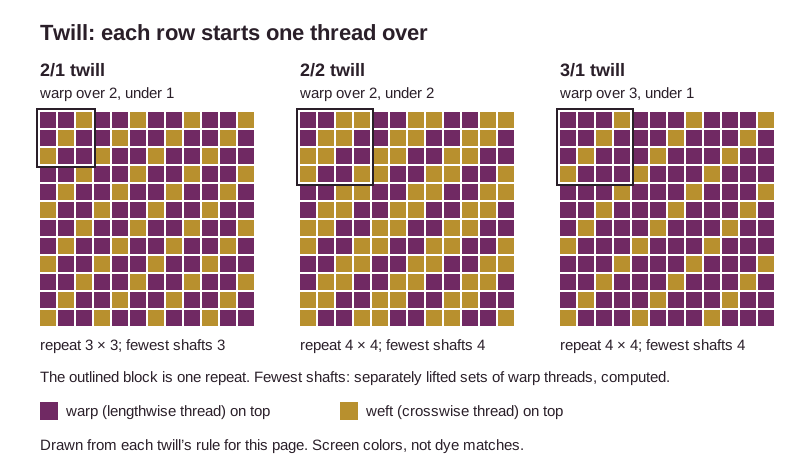
Wider than a phone screen: swipe sideways along the diagram, or open it full size.
Regular twills 2/1, 2/2 and 3/1 with one repeat outlined; each row of crossings starts one thread over. Screen colors, not dye matches.
Diagram: Tailor, Weaver, Jeweler, Dyer, CC BY 4.0
"Three regular twills: 2/1, 2/2 and 3/1" by Tailor, Weaver, Jeweler, Dyer, from https://tailorweaverjewelerdyer.com/weaves/types-of-weave/. Licensed under CC BY 4.0: https://creativecommons.org/licenses/by/4.0/
Data: Computed for this page from the 2/1, 2/2 and 3/1 twill rules
Color makes the steps visible. Scotland's tartan register says tartans are usually woven in a 2/2 twill, which gives the cloth a hatched look in its mixed blocks [8]; the tartan entry counts the colors that result. Watson colors a 2-and-2 twill four dark and four light in warp and weft to make a check [1], and the houndstooth entry follows what such a short color order does.
A satin weave is a weave in which each thread of one set passes over all but one of the other set in every repeat, so the face is almost all warp or almost all weft [1]. A twill's crossings step one thread at a time; a regular satin's step by more than one, so they no longer form a twill's distinct lines [1]. Nisbet's 1906 textbook calls the result an even, smooth surface [9].
The step follows a rule. Watson allows any move except 1 and one less than the thread count, provided it shares no factor other than 1 with the thread count [1]. Worked through for this page, five threads is the smallest repeat with such a move, a step of 2 or 3; Watson says four and six threads cannot make a regular satin, and Nisbet calls those satins imperfect [1][9].
| Threads per repeat | Moves that work |
|---|---|
| 3, 4 or 6 | none |
| 5 | 2, 3 |
| 7 | 2, 3, 4, 5 (Nisbet lists it; Watson finds lines too distinct) |
| 8 | 3, 5 |
| 9 | 2, 4, 5, 7 |
| 10 | 3, 7 |
| 11 | 2 to 9 |
| 12 | 5, 7 |
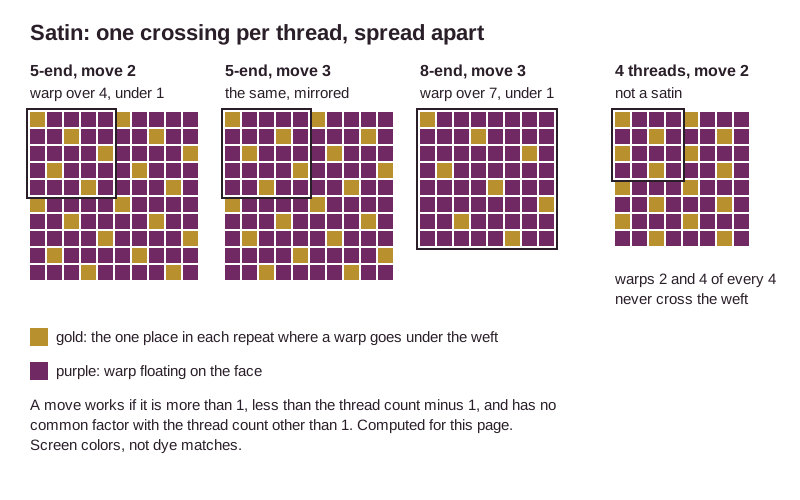
Wider than a phone screen: swipe sideways along the diagram, or open it full size.
5-end satins with moves of 2 and 3, an 8-end satin with a move of 3, and a failed try on 4 threads, where two warps never cross. Computed for this page; screen colors.
Diagram: Tailor, Weaver, Jeweler, Dyer, CC BY 4.0
"Regular satins on 5 and 8 threads, and a failed attempt on 4" by Tailor, Weaver, Jeweler, Dyer, from https://tailorweaverjewelerdyer.com/weaves/types-of-weave/. Licensed under CC BY 4.0: https://creativecommons.org/licenses/by/4.0/
Data: Satin moves computed for this page; the rule matches William Watson, Textile Design and Colour (1912), p. 18
Long floats give satin its smooth face [2]. Watson writes that, with some exceptions, the more often the threads cross, the firmer the cloth [1]. In the 8-end satin above, each thread is held down once in eight crossings and lies loose across seven threads, where plain weave holds it at every other crossing; if a satin snags, those floats are what get caught.
Satin names a weave, and in the trade a cloth woven that way; none of the sources read here uses it for a fiber. The French dictionary TLFi records zatin in 1352 for a lustrous silk cloth whose weft does not show on the right side, satin de coton in 1821, satin de laine in 1839, and from 1751 a weaving sense, a satin on five shafts [10]. Dooley still calls satin cloth silk, but notes low-grade satin generally had a cotton weft [2].
| Art Institute of Chicago record | Date | Medium as catalogued |
|---|---|---|
| 1891.7, Dress for Christ Child, Spain | 18th century | silk, satin weave, embroidered |
| 1989.560, Napkin Depicting The Five Senses, London | 1891 | linen, satin weave self-patterned by reversing of faces |
| 1982.1468, Panel (Design 101), New York | 1955 | cotton and rayon, weft-float faced satin weave; screen printed |
Sateen is used two ways in these books. Watson calls the whole family sateen weaves, warp and weft sateens alike [1]; Dooley's glossary gives sateen as a light cotton cloth finished to imitate silk satin [2]. Neither ties the satin weave to one fiber.
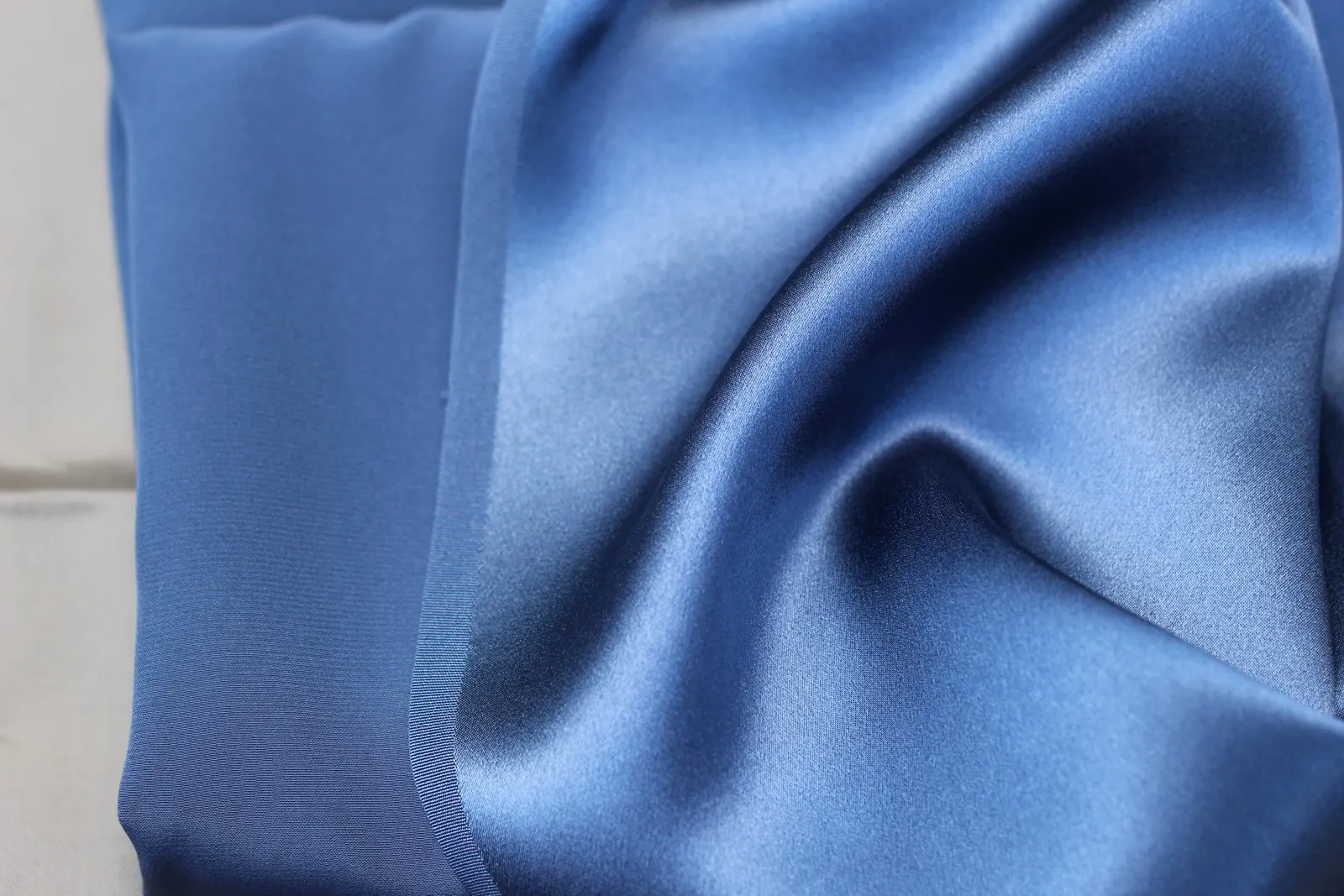
Cloth folded to show its shiny face at right and dull back at left; its Commons file page calls it silk charmeuse.
"Charmeuse" by Enby — https://commons.wikimedia.org/wiki/File:Charmeuse.jpg — CC BY-SA 4.0 (https://creativecommons.org/licenses/by-sa/4.0/)
Turn the scrap over first: plain weave looks the same on both sides, and a twill's diagonal runs the other way on the back [1]. Watson notes, for twills, that warp floats on one side match weft floats on the other [1]; worked through for this page, a warp-faced satin is weft-faced on the back for the same reason.
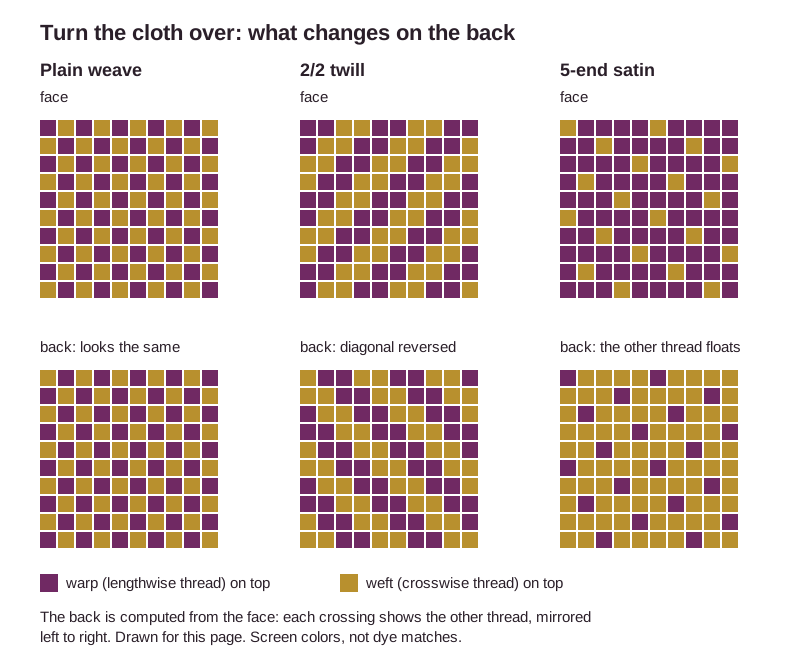
Wider than a phone screen: swipe sideways along the diagram, or open it full size.
Each weave's face above and its back below, computed by turning the cloth over sideways: plain stays the same, 2/2 twill reverses, 5-end satin swaps threads. Screen colors.
Diagram: Tailor, Weaver, Jeweler, Dyer, CC BY 4.0
"Face and back of plain weave, 2/2 twill and 5-end satin" by Tailor, Weaver, Jeweler, Dyer, from https://tailorweaverjewelerdyer.com/weaves/types-of-weave/. Licensed under CC BY 4.0: https://creativecommons.org/licenses/by/4.0/
Data: Computed for this page from the plain-weave, 2/2 twill and 5-end satin rules
Then read the face. Small even crossings mean plain weave, floats lined up in diagonals mean twill, and a smooth face of long floats with no clear diagonal points to satin.
A shuttle and bobbins of yarn beside a folded length of cloth on a weaver's worktable.
Illustration: Tailor, Weaver, Jeweler, Dyer. Generated schematic image — not a photograph or historical record. Reuse terms: may be shared with this full caption and a link to the source page; not licensed under CC BY.
| Weave | Repeat, threads each way | Fewest shafts | Longest float | On the back |
|---|---|---|---|---|
| Plain weave, 1/1 | 2 | 2 | 1 | the same |
| Twill, 2/2 | 4 | 4 | 2 | diagonal reversed |
| Satin, 5-end, warp-faced | 5 | 5 | 4 | weft-faced |
| Satin, 8-end, warp-faced | 8 | 8 | 7 | weft-faced |
Tailor, Weaver, Jeweler, Dyer. “Types of Weave: Satin Is a Structure, Not a Fiber.” Published 27 October 2026. https://tailorweaverjewelerdyer.com/weaves/types-of-weave/. Accessed: add the date you read it.
Facts here carry numbered links to the sources listed above. How entries are checked: Weighing the Evidence: How This Site Checks Facts. Every substantive change is dated on Corrections. Spotted a mistake or have a better source? Contact and Correspondence.
"Kenneth Sutherland, 3rd Lord Duffus, d. 1734. Jacobite" by Richard Waitt — https://commons.wikimedia.org/wiki/File:Kenneth-sutherland-3rd-lord-duffus-d-1734-jacobite.jpg — Public domain (Richard Waitt d. 1732, PD in US and EU)
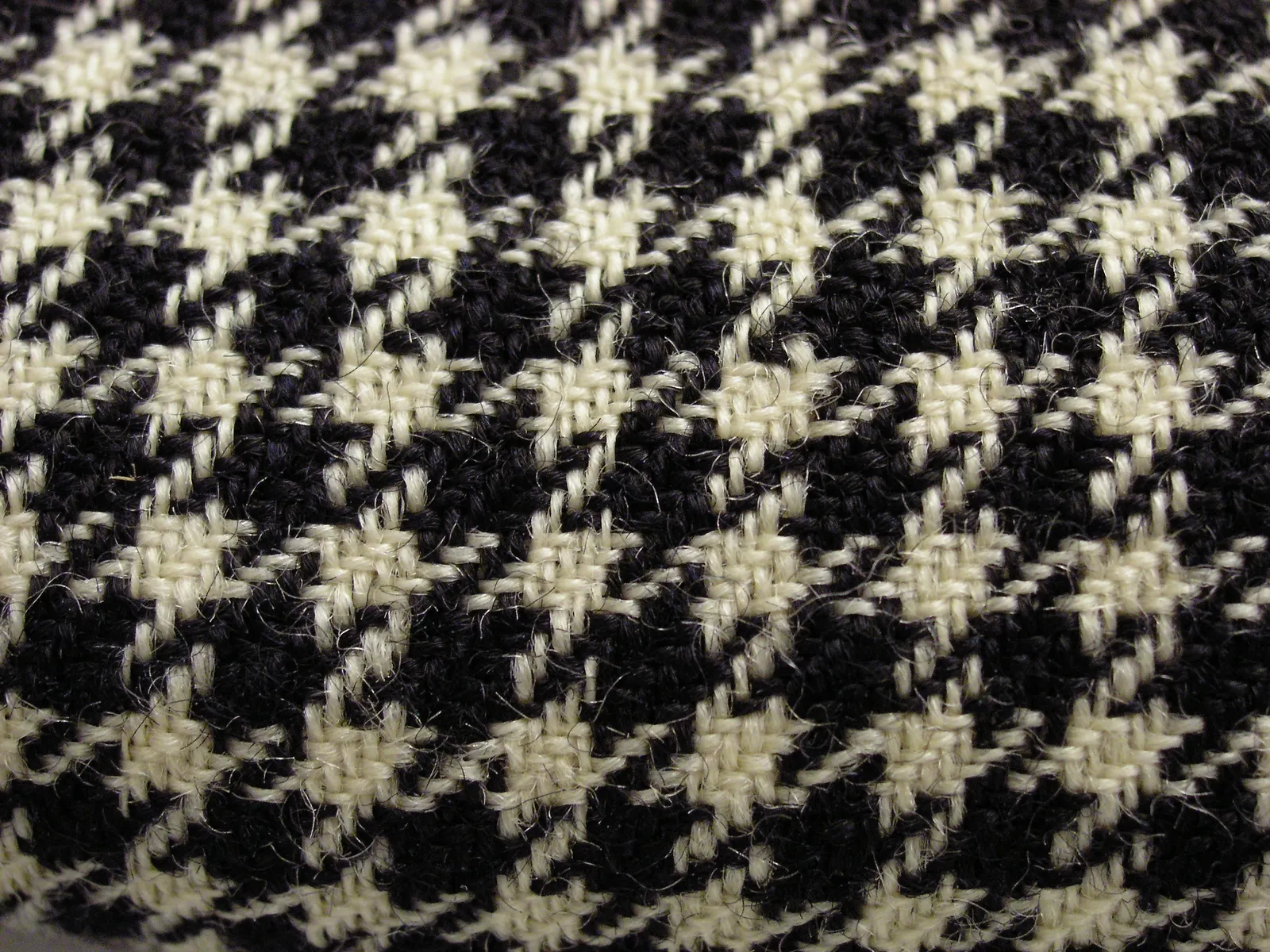
"Blanket" by Auckland Museum — https://commons.wikimedia.org/wiki/File:Blanket_(AM_1931.509-5).jpg — CC BY 4.0 (https://creativecommons.org/licenses/by/4.0/)

