
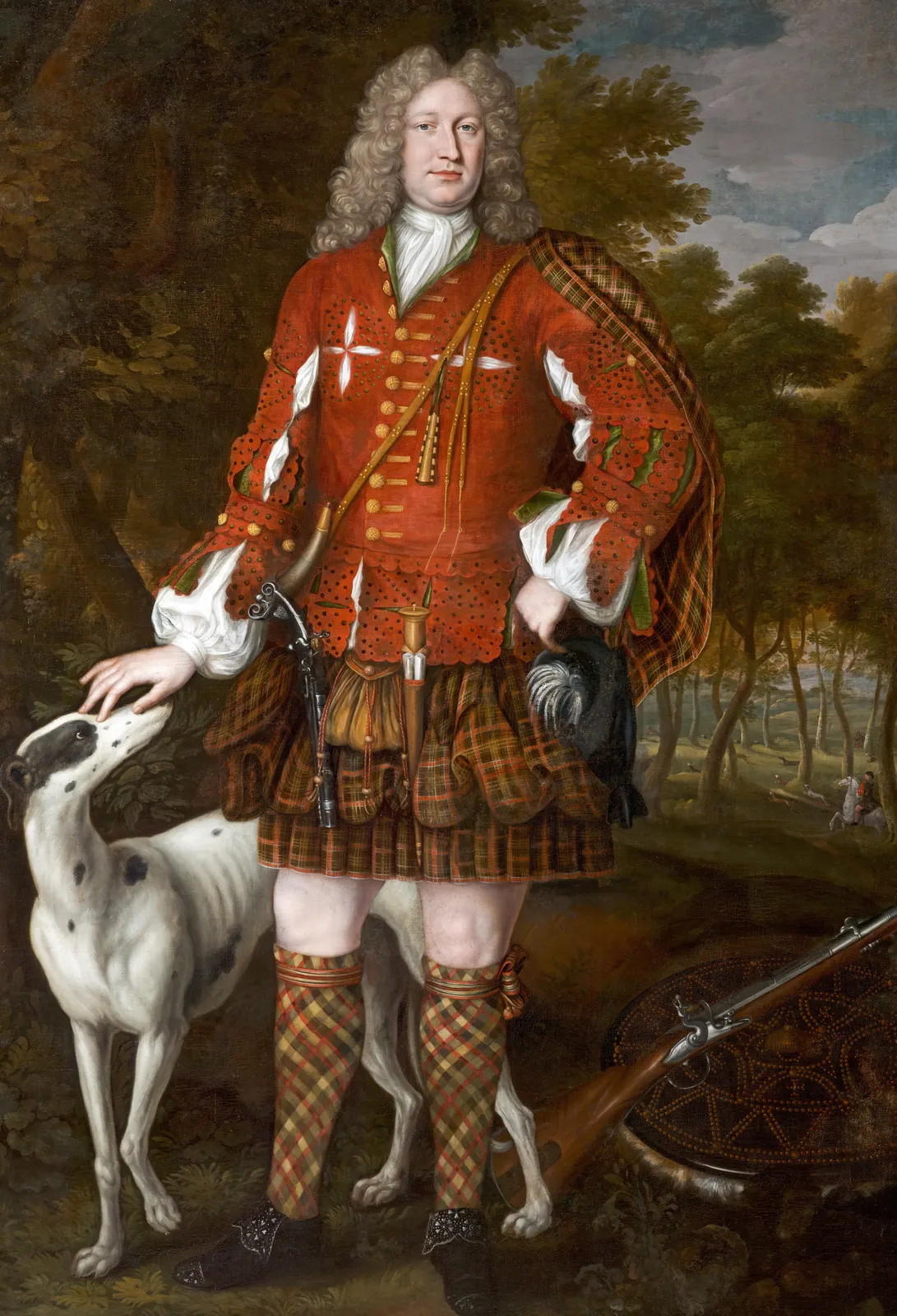
Picture credit
"Kenneth Sutherland, 3rd Lord Duffus, d. 1734. Jacobite" by Richard Waitt — https://commons.wikimedia.org/wiki/File:Kenneth-sutherland-3rd-lord-duffus-d-1734-jacobite.jpg — Public domain (Richard Waitt d. 1732, PD in US and EU)
By Tailor, Weaver, Jeweler, Dyer Published
Build card
This card as data: houndstooth-build-card.csv (CSV) · file notes (JSON): where the values come from, version and license
Data: Facts from William Watson, Textile Design and Colour (1912) and the Auckland War Memorial Museum record for 1931.509, each named in the source column; the key construction point is computed for this page
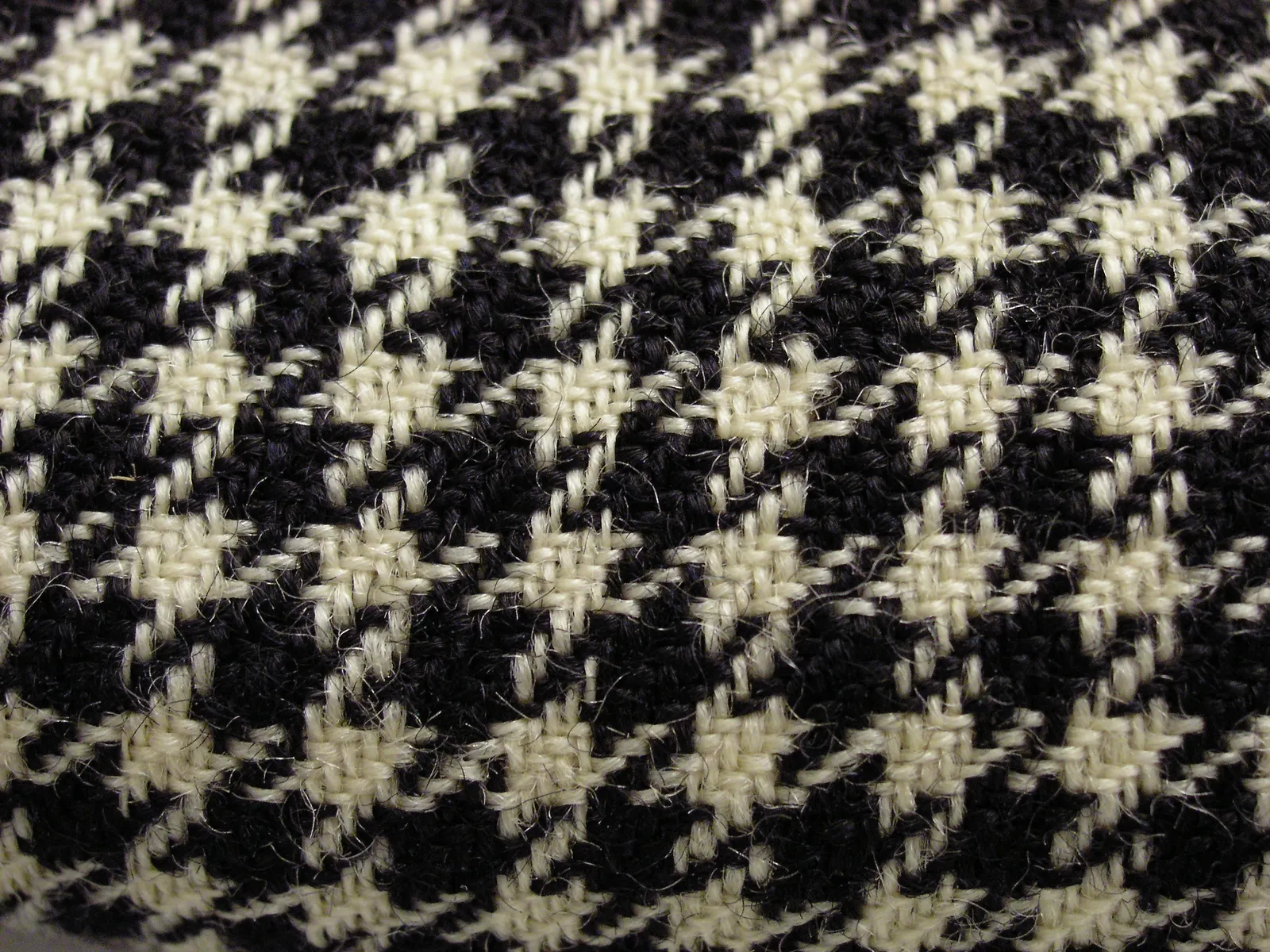
A wool blanket handwoven in Ayrshire around 1840, Auckland Museum 1931.509, seen close. Single cream threads cross into the black at the edge of each light check.
"Blanket" by Auckland Museum — https://commons.wikimedia.org/wiki/File:Blanket_(AM_1931.509-5).jpg — CC BY 4.0 (https://creativecommons.org/licenses/by/4.0/)
Step back from a houndstooth coat and the checks blur; step close and every check has hooked teeth. In woven houndstooth, nobody draws those teeth: they form where dark and light threads cross. William Watson's 1912 weaving textbook calls a pattern made this way a colour and weave effect, "the form or pattern in two or more colours produced by colour and weave in combination," often unlike either one alone [1].
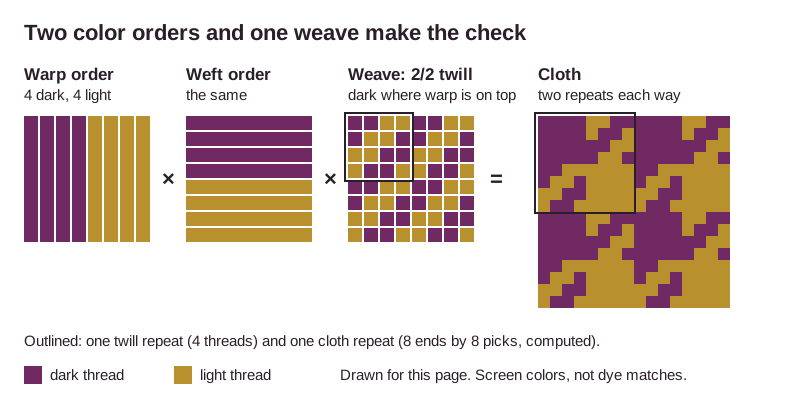
In the version drawn for this page, four dark threads alternate with four light ones in the lengthwise warp and again in the crosswise weft, woven in a 2/2 twill. Each block of 8 by 8 crossings then holds a dark square, a light square and two blocks of stepped twill, and the steps stick out from the squares as teeth (computed). Watson gives this same order and weave as his typical shepherd's check, and his 1912 book does not use the word houndstooth [1].
Wider than a phone screen: swipe sideways along the diagram, or open it full size.
Two color orders and a 2/2 twill, shown with dark where the warp is on top, give the cloth at right. Screen colors, not dye matches.
Diagram: Tailor, Weaver, Jeweler, Dyer, CC BY 4.0
"Two color orders and one weave make the check" by Tailor, Weaver, Jeweler, Dyer, from https://tailorweaverjewelerdyer.com/weaves/houndstooth/. Licensed under CC BY 4.0: https://creativecommons.org/licenses/by/4.0/
Data: Computed for this page from a 4 dark, 4 light order in warp and weft and the 2/2 twill rule
Woven cloth has two sets of threads: the warp runs the length of the loom and the weft crosses it at right angles [1]. Weavers call warp threads ends and weft threads picks [1]. Watson's recipe for such a pattern has three parts: the order of colors in the warp, the order in the weft, and the weave [1].
Here the warp is laid four dark, four light, over and over, and the weft goes in with the same order. The weave is a 2/2 twill. Each warp thread passes over two weft threads and under two, and each new pick starts one thread over, so the floats line up on a diagonal [1]. As the types of weave entry counts it, a 2/2 twill repeats on 4 threads each way.
Dark and light yarn beside a shuttle, before any weaving starts.
Illustration: Tailor, Weaver, Jeweler, Dyer. Generated schematic image — not a photograph or historical record. Reuse terms: may be shared with this full caption and a link to the source page; not licensed under CC BY.
The whole check repeats every 8 threads each way, the least common multiple of the 8-thread color order and the 4-thread twill, which is how Watson sizes a repeat [1].
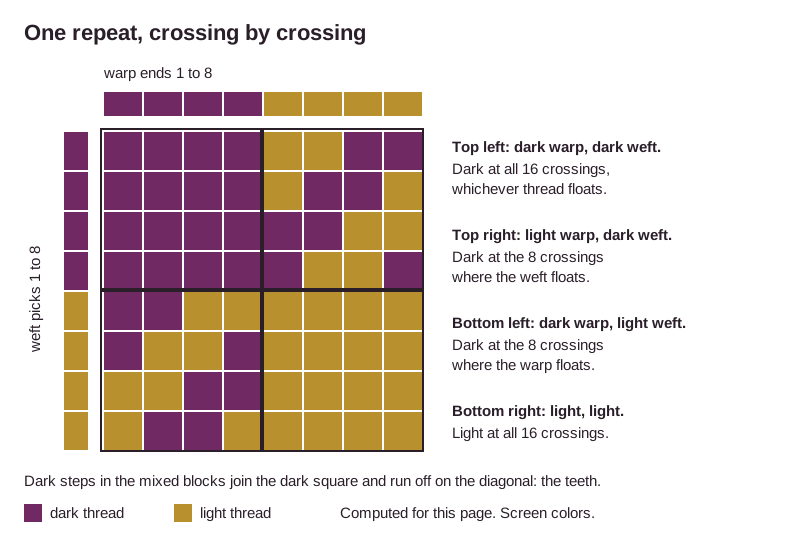
Wider than a phone screen: swipe sideways along the diagram, or open it full size.
One repeat enlarged: each square is one crossing and shows the color of the thread on top. Computed for this page; screen colors.
Diagram: Tailor, Weaver, Jeweler, Dyer, CC BY 4.0
"One houndstooth repeat, crossing by crossing" by Tailor, Weaver, Jeweler, Dyer, from https://tailorweaverjewelerdyer.com/weaves/houndstooth/. Licensed under CC BY 4.0: https://creativecommons.org/licenses/by/4.0/
Data: Computed for this page from a 4 dark, 4 light order in warp and weft and the 2/2 twill rule
Each crossing shows the color of the thread on top. Watson sketches such patterns on squared paper the same way, filling in dark ends where the warp floats and dark picks where the weft floats [1].
Where dark crosses dark, the crossing is dark whichever thread floats, as Watson notes for any color crossing itself [1]. In the two mixed blocks, dark shows only where the dark thread is on top, in steps two threads wide; those steps join the dark square and run off it on the diagonal as the tooth (computed).
| Block of the repeat | Warp × weft | Dark crossings |
|---|---|---|
| Top left | dark × dark | 16 of 16 |
| Top right | light × dark | 8 of 16, where the weft floats |
| Bottom left | dark × light | 8 of 16, where the warp floats |
| Bottom right | light × light | 0 of 16 |
Placing the twill in a different position against the colors changes the check slightly, which Watson gives as the reason his two shepherd's-check examples differ; he notes that a cloth must keep one relation between color and weave along its whole length [1].
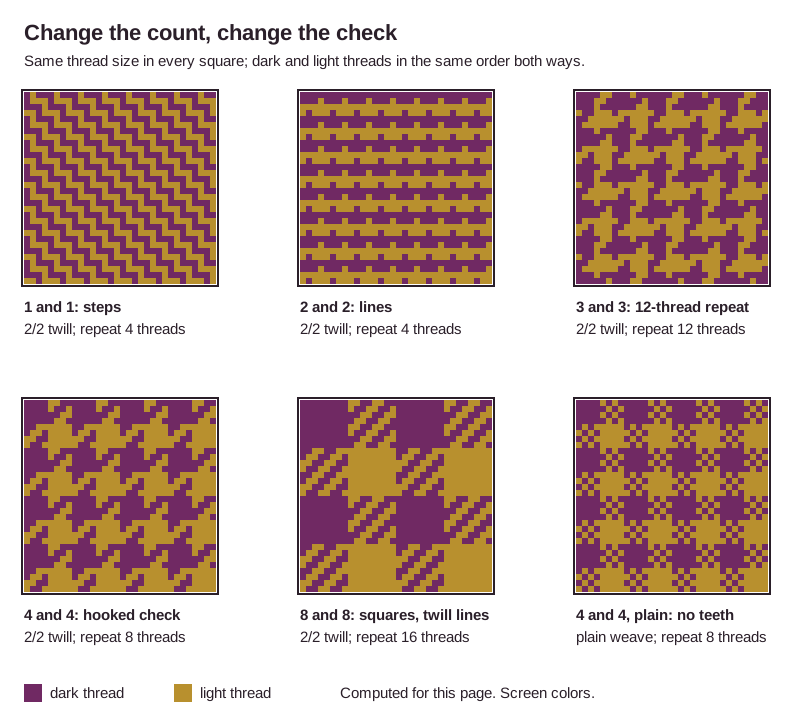
Wider than a phone screen: swipe sideways along the diagram, or open it full size.
Six color orders at the same thread size, five in a 2/2 twill and one in plain weave. Computed for this page; screen colors.
Diagram: Tailor, Weaver, Jeweler, Dyer, CC BY 4.0
"Change the count, change the check" by Tailor, Weaver, Jeweler, Dyer, from https://tailorweaverjewelerdyer.com/weaves/houndstooth/. Licensed under CC BY 4.0: https://creativecommons.org/licenses/by/4.0/
Data: Computed for this page; the names step pattern, line effect and shepherd's check are William Watson's, Textile Design and Colour (1912), pp. 157 and 163
The hooks depend on the count. Halve the order to 2 dark, 2 light and the same twill gives lines, not small teeth; Watson calls that order on the 2-and-2 twill the typical line effect [1]. One and one gives zigzag steps, which he files under step patterns [1].
Weave 4 and 4 in plain weave instead, and the mixed blocks turn to dots with no teeth at all (computed).
| Order, each way | Weave | Repeat, threads | What forms (computed) | Watson's name |
|---|---|---|---|---|
| 1 dark, 1 light | 2/2 twill | 4 | zigzag steps | step pattern |
| 2 dark, 2 light | 2/2 twill | 4 | lines, no teeth | line effect |
| 3 dark, 3 light | 2/2 twill | 12 | irregular shapes | none given |
| 4 dark, 4 light | 2/2 twill | 8 | hooked check | shepherd's check |
| 8 dark, 8 light | 2/2 twill | 16 | squares joined by twill lines | none given |
| 4 dark, 4 light | plain weave | 8 | squares joined by dots, no teeth | none given |
Every row comes out half dark, because each order is half dark and warp and weft carry the same one (computed). Watson works the 3-and-3 order through on squared paper and gets the same 12-thread repeat [1].
None of the sources read for this page defines puppytooth. The drawings show only that halving the count gives lines, not a smaller tooth; the same 4-and-4 check in finer, closer-set yarn would come out smaller (computed). Watson's 1921 second edition does define the glen check, in full the Glen Urquhart check: a colour and weave check in plain or 2-and-2 twill that combines two orders, such as 2-and-2 with 4-and-4 [3]. The houndstooth drawn here keeps one order throughout.
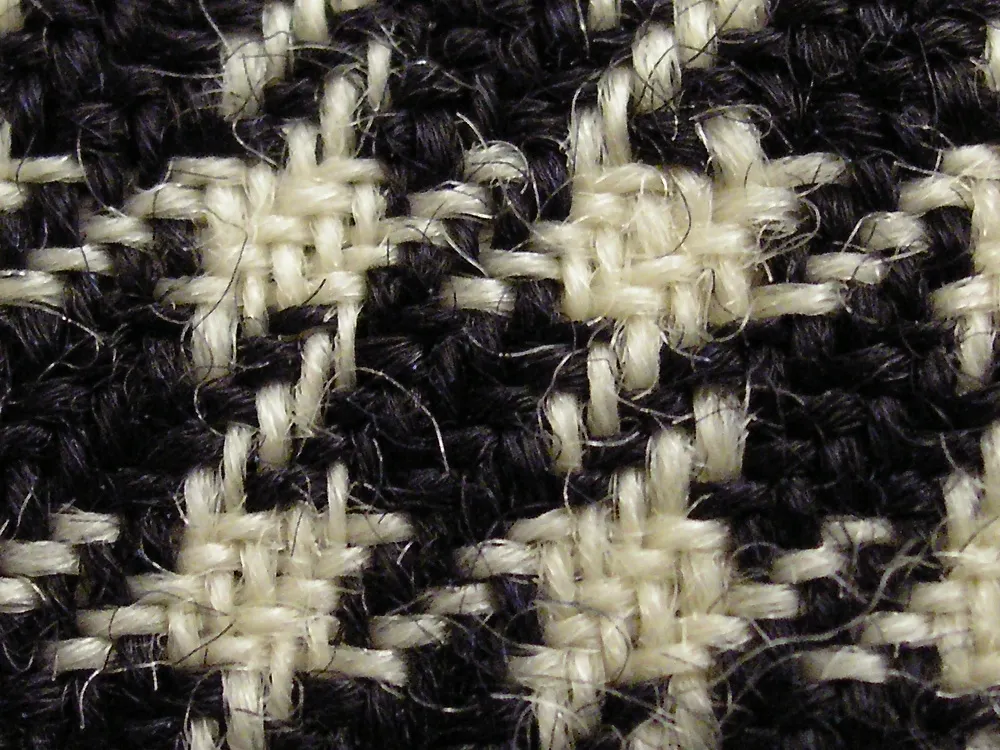
Cropped from the close-up at the top of the page: single cream threads run out from each light check and lie over the black ones.
"Blanket (detail)" by Auckland Museum — https://commons.wikimedia.org/wiki/File:Blanket_(AM_1931.509-5).jpg — CC BY 4.0 (https://creativecommons.org/licenses/by/4.0/); modified: cropped to a small area of the close-up photograph; not enlarged; colours not altered
The Auckland War Memorial Museum's record describes 1931.509 as a black and white wool blanket in a "hounds tooth" check, woven with borders and fringe, handwoven around 1840 in Ayrshire by Matthew Fowlds (1806–1907) [2]. Friends in Kilmarnock gave it to James Goldie of South Canterbury, the record says, and he wore it until his death in 1911 [2].
In the detail above, the points of each light check are single cream threads lying over the black. The record gives no thread order or weave, so the blanket can be set beside the drawings here by eye, not thread by thread. Watson adds that the way threads group in a cloth can hide the small details of a squared-paper sketch or bring them out [1], and this fuzzy wool softens the edges.
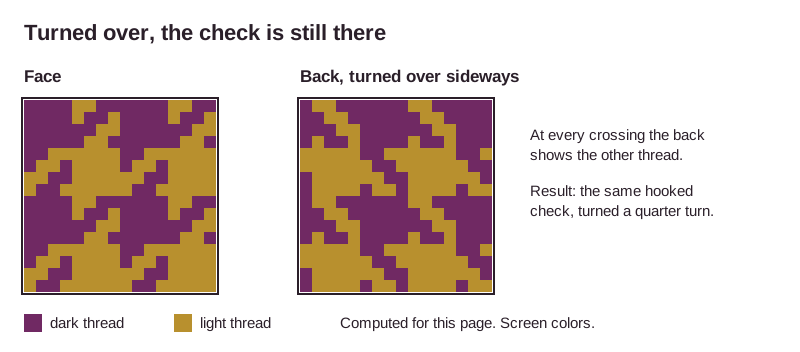
Wider than a phone screen: swipe sideways along the diagram, or open it full size.
The 4-and-4 check face up and turned over: the back is the same check, turned a quarter turn. Computed for this page; screen colors.
Diagram: Tailor, Weaver, Jeweler, Dyer, CC BY 4.0
"Face and back of a 4-and-4 twill check" by Tailor, Weaver, Jeweler, Dyer, from https://tailorweaverjewelerdyer.com/weaves/houndstooth/. Licensed under CC BY 4.0: https://creativecommons.org/licenses/by/4.0/
Data: Computed for this page from a 4 dark, 4 light order and the 2/2 twill rule
Woven houndstooth carries its dark and light in the threads before the loom is set up. William Dooley's 1914 textbook calls such cloth yarn-dyed, made of yarns dyed before weaving or spun from dyed wool [4]; the indigo dye entry follows how one dye gets into fiber at all. Watson notes that the warp floats on one side of a twill are weft floats on the other [1], so the drawn check turned over is still a check, turned a quarter turn (computed). A printed check behaves differently: by Dooley's general test, a printed figure on the face does not go through to the back, where only its outline shows [4].
Knitting builds cloth another way. Dooley describes it as looping a single thread, where weaving crosses two sets of threads at right angles [4]. A knitted check has no warp and weft to cross, so its hooks cannot come from twill floats.
Tailor, Weaver, Jeweler, Dyer. “Houndstooth: In Woven Cloth, the Teeth Come From the Weave.” Published 27 October 2026. https://tailorweaverjewelerdyer.com/weaves/houndstooth/. Accessed: add the date you read it.
Facts here carry numbered links to the sources listed above. How entries are checked: Weighing the Evidence: How This Site Checks Facts. Every substantive change is dated on Corrections. Spotted a mistake or have a better source? Contact and Correspondence.
"Kenneth Sutherland, 3rd Lord Duffus, d. 1734. Jacobite" by Richard Waitt — https://commons.wikimedia.org/wiki/File:Kenneth-sutherland-3rd-lord-duffus-d-1734-jacobite.jpg — Public domain (Richard Waitt d. 1732, PD in US and EU)
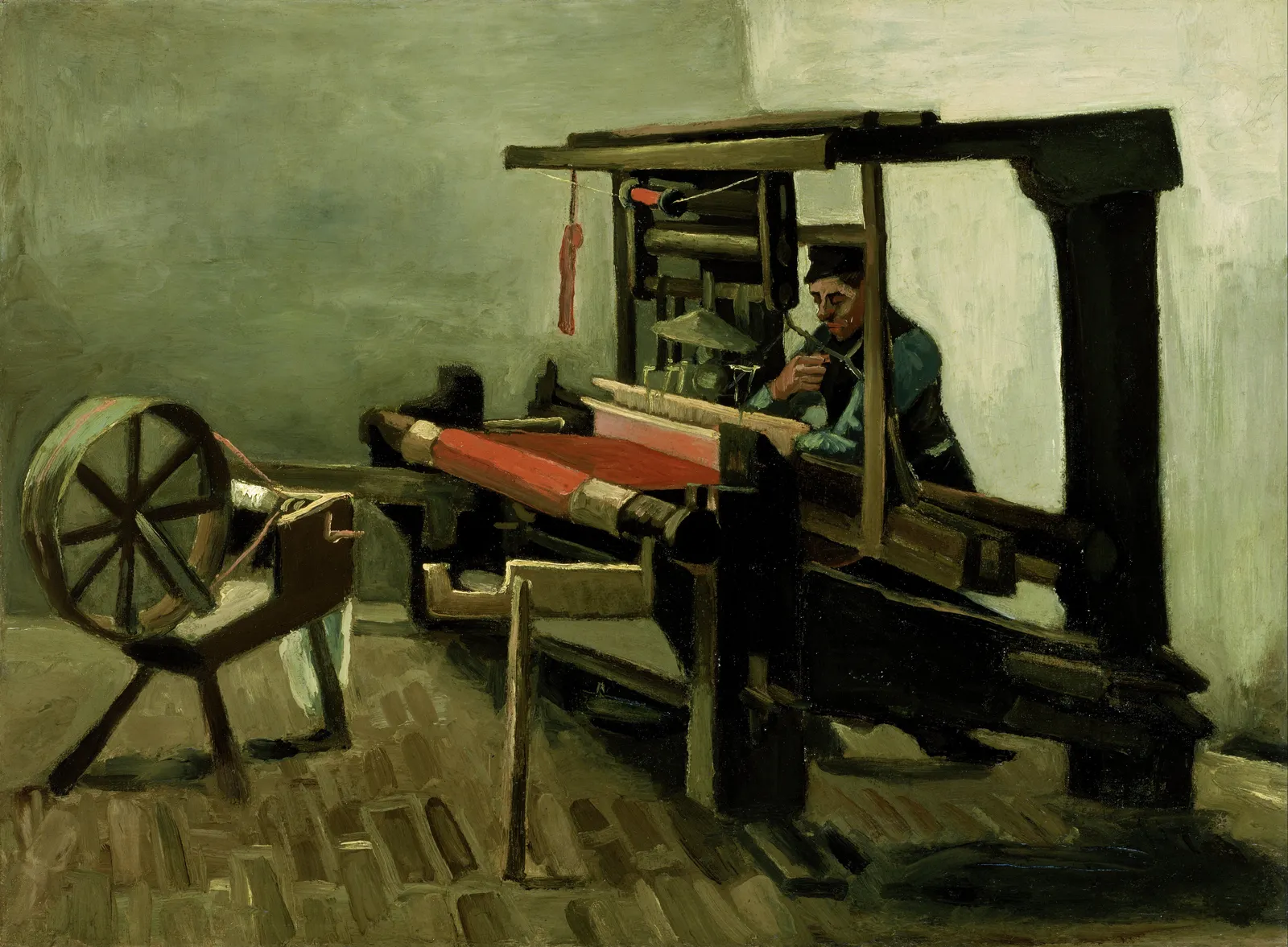
"Weaver" by Vincent van Gogh — https://commons.wikimedia.org/wiki/File:Vincent_van_Gogh_-_Weaver_-_Google_Art_Project.jpg — Public domain (Vincent van Gogh d. 1890, PD in US and EU)

