

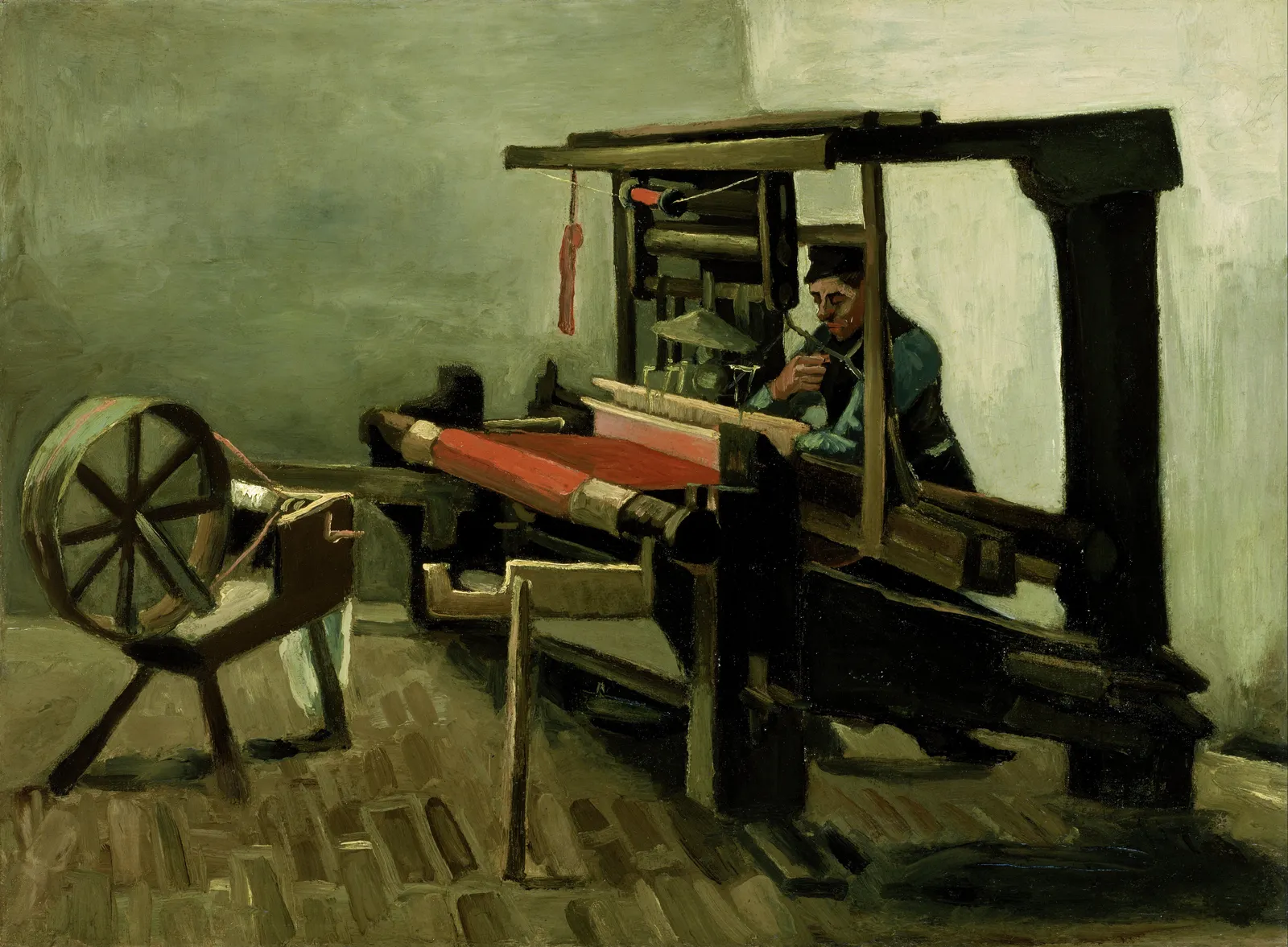
Picture credit
"Weaver" by Vincent van Gogh — https://commons.wikimedia.org/wiki/File:Vincent_van_Gogh_-_Weaver_-_Google_Art_Project.jpg — Public domain (Vincent van Gogh d. 1890, PD in US and EU)
By Tailor, Weaver, Jeweler, Dyer Published
Build card
This card as data: tartan-build-card.csv (CSV) · file notes (JSON): where the values come from, version and license
Data: Facts from the Scottish Register of Tartans guidance (Crown copyright), the Scottish Register of Tartans Act 2008 s. 2 (Open Government Licence v3.0) and the Wikimedia Commons file page of Richard Waitt's Lord Duffus portrait, each named in the source column; color count computed for this page
Wider than a phone screen: swipe sideways along the diagram, or open it full size.
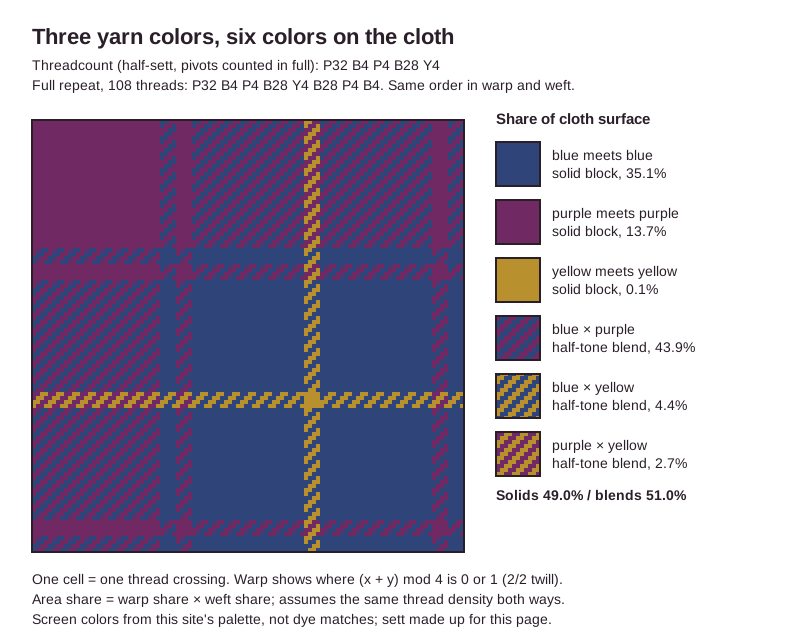
One full repeat of a sett made up for this page, not copied from the tartan register, drawn one cell per thread crossing from the threadcount P32 B4 P4 B28 Y4. Three yarn colors make three solid blocks and three half-tone blends; the percentages give each block type's share of the cloth, computed from the threadcount.
Diagram: Tailor, Weaver, Jeweler, Dyer, CC BY 4.0
"Three yarn colors, six colors on the cloth" by Tailor, Weaver, Jeweler, Dyer, from https://tailorweaverjewelerdyer.com/weaves/tartan/. Licensed under CC BY 4.0: https://creativecommons.org/licenses/by/4.0/
Data: Sample sett P32 B4 P4 B28 Y4, made up for this page; shares computed for this page
A blue crosswise thread, the weft, passes over two purple lengthwise threads, the warp, then under two. On the next pass it starts one thread later, so the crossings step sideways and a diagonal climbs the cloth. That small offset is the stagger in what the register calls a "2/2 staggered twill," and it gives tartan its hatched look [1]. Tartan is a woven pattern in which one sequence of colored stripes, called the sett, runs both lengthwise and crosswise [1].
Where a stripe crosses a stripe of its own color, you get a solid block. Where it crosses a different color, the weave shows both yarns in equal amounts, and from farther back your eye reads a new shade. Three yarn colors therefore give you up to six colors on the cloth: three solids and three blends.
In the sample sett drawn for this page, the blends cover 51% of the surface. The largest single color is a purple-blue mix. No dye pot ever held it.
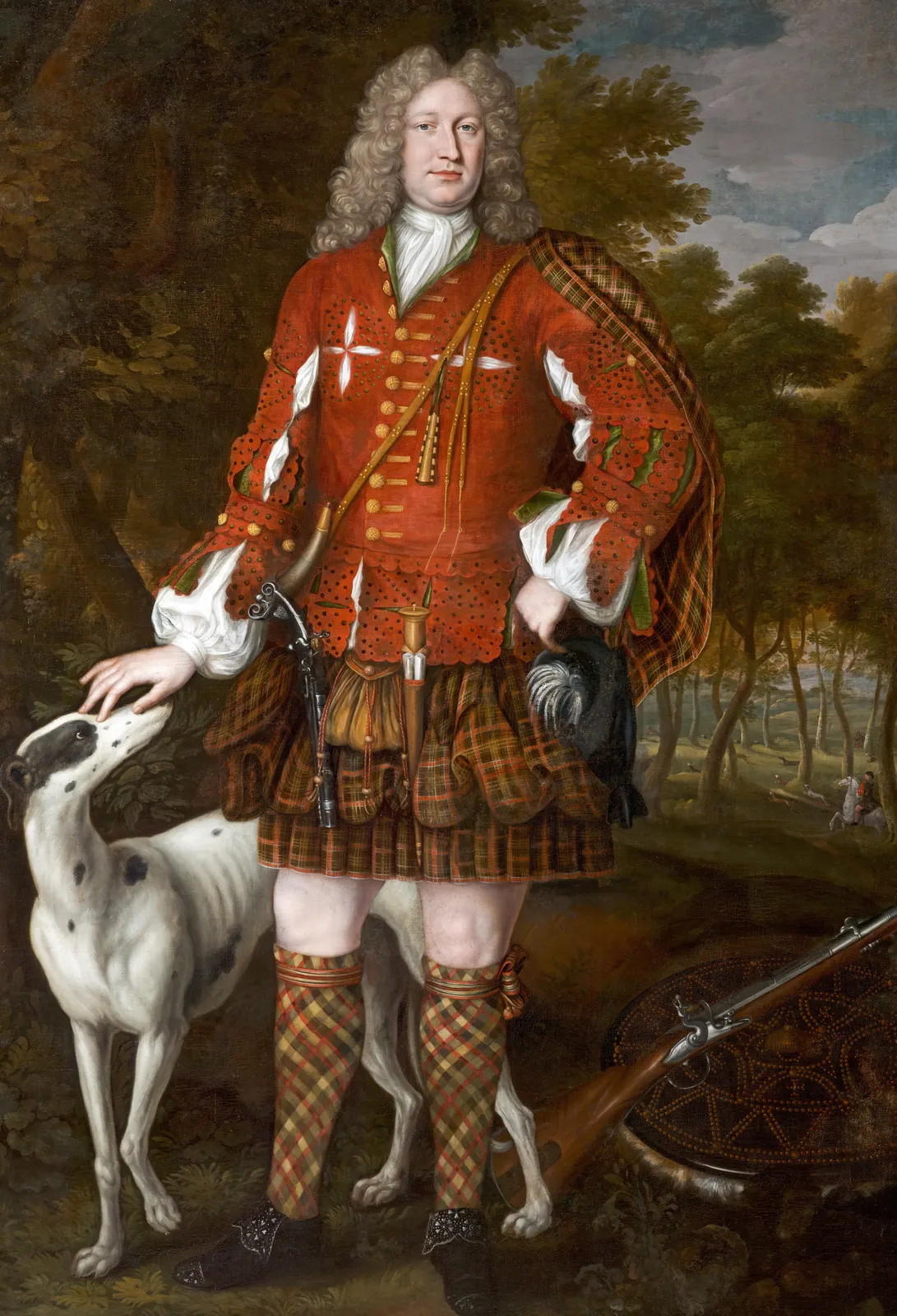
Richard Waitt's portrait of Kenneth Sutherland, 3rd Lord Duffus, about 1712. Tartan is pleated around his waist and hangs over his left shoulder, and his hose are in a diagonal check. The Commons file page records the painting at the National Galleries of Scotland as PG 1095, a number not checked with the gallery.
"Kenneth Sutherland, 3rd Lord Duffus, d. 1734. Jacobite" by Richard Waitt, Public domain
"Kenneth Sutherland, 3rd Lord Duffus, d. 1734. Jacobite" by Richard Waitt — https://commons.wikimedia.org/wiki/File:Kenneth-sutherland-3rd-lord-duffus-d-1734-jacobite.jpg — Public domain (Richard Waitt d. 1732, PD in US and EU)
Scottish law gives the short answer. The Scottish Register of Tartans Act 2008 defines a tartan as "a design which is capable of being woven consisting of two or more alternating coloured stripes which combine vertically and horizontally to form a repeated chequered pattern" [5]. The register set up under that act opened on 5 February 2009 and is run by the National Records of Scotland [4].
The register's guidance adds the rule that matters most for construction: the order and width of the warp stripes is repeated exactly in the weft [1]. A tartan's checks are built from the same bands in both directions, not from two unrelated stripe patterns laid across each other.
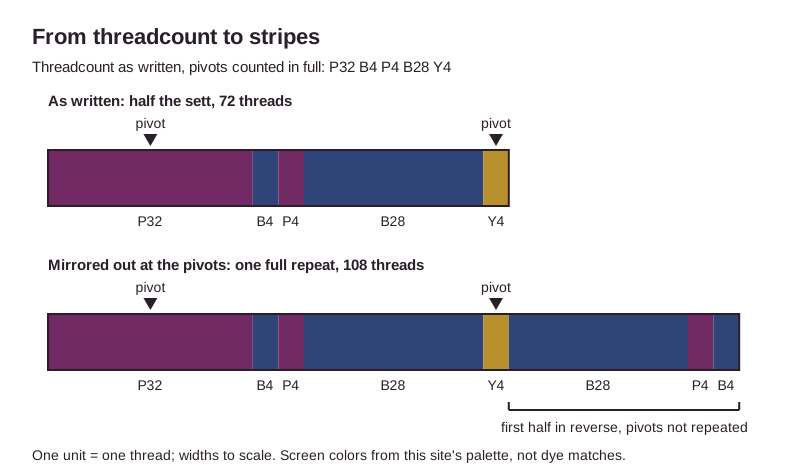
Most setts are symmetrical [1]. The stripe list runs to a pivot, a stripe where the pattern reflects like a mirror image, then runs back in reverse order to the next pivot [2]. A rarer asymmetric sett has no pivots and starts again from its first stripe [2].
Wider than a phone screen: swipe sideways along the diagram, or open it full size.
The threadcount P32 B4 P4 B28 Y4 as written (top) and mirrored out at its pivots into one full repeat of 108 threads (bottom). Drawn from that threadcount with the pivots counted in full, one unit per thread, so the stripe widths are to scale. Screen colors, not dye matches.
Diagram: Tailor, Weaver, Jeweler, Dyer, CC BY 4.0
"From threadcount to stripes" by Tailor, Weaver, Jeweler, Dyer, from https://tailorweaverjewelerdyer.com/weaves/tartan/. Licensed under CC BY 4.0: https://creativecommons.org/licenses/by/4.0/
Data: Sample sett P32 B4 P4 B28 Y4, made up for this page; threadcount notation as described by the Scottish Register of Tartans, https://www.tartanregister.gov.uk/threadcount
A threadcount writes the sett as capital letters and numbers: each letter stands for a color, and each number says how many threads of that color the weaver sets on the loom [2]. The register's example, B24 W4 B24 R2 K24 G24 W2, means 24 blue threads, then 4 white, 24 blue, 2 red, 24 black, 24 green and 2 white [2].
For a symmetrical sett you only need half the list, because the second half mirrors the first. The register marks the two pivots with a slash, as in B/24 … W/2, and marks an asymmetric sett with three dots at each end [2].
The sett drawn for this page is P32 B4 P4 B28 Y4, with the purple and yellow pivots counted in full. Mirrored out, one complete repeat is P32 B4 P4 B28 Y4 B28 P4 B4, which comes to 108 threads. With four dark and four light threads each way, the same 2/2 twill draws the hooked checks computed in the houndstooth entry.
On size, the register says a six-inch sett usually holds about 240 to 260 threads, and it suggests a 2–3 inch sett for a tie and 6–7 inches for a kilt or skirt [2]. At that density the page's 108 threads would measure roughly 2.5 to 2.7 inches on the cloth. So this is a tie-scale sett.
A kilt-scale version would need more than twice as many threads. Under the register's rules, scaling a sett up or down with the same colors and geometry does not make a new tartan [3].
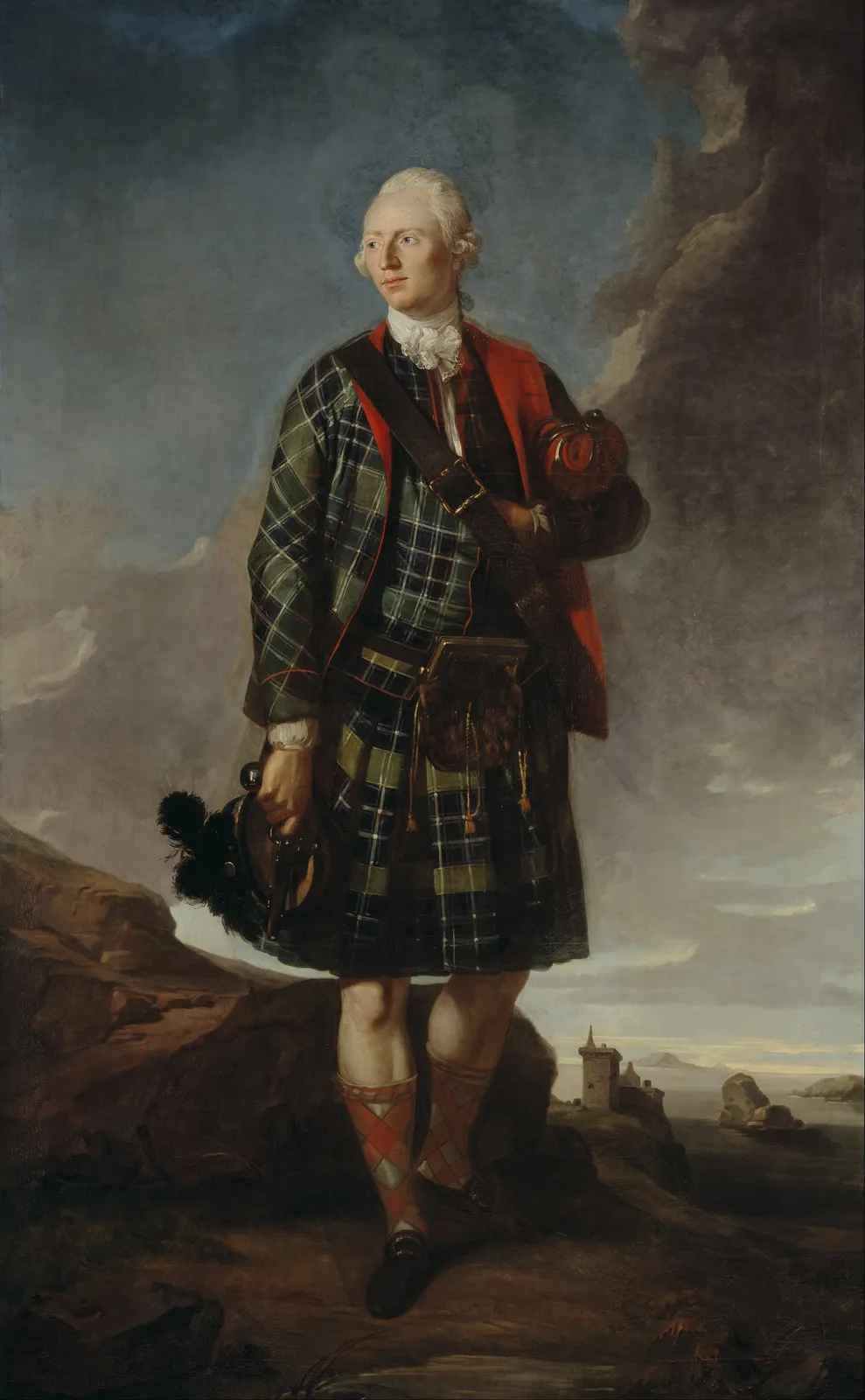
Sir Alexander Macdonald, painted in 1772 and attributed to Sir George Chalmers. His coat and the pleated wrap below it are cut from one green and dark tartan, whose check repeats across the cloth in both directions. The Commons file page records the painting at the National Galleries of Scotland as PG 2609, a number not checked with the gallery.
"Sir Alexander Macdonald [Sir Alasdair MacDhòmhnaill Shlèite], 1744 - 1795. 9th Baronet of Sleat and 1st Baron Macdonald of Slate" by Sir George Chalmers (attributed), Public domain
"Sir Alexander Macdonald [Sir Alasdair MacDhòmhnaill Shlèite], 1744 - 1795. 9th Baronet of Sleat and 1st Baron Macdonald of Slate" by Sir George Chalmers (attributed) — https://commons.wikimedia.org/wiki/File:Attributed_to_Sir_George_Chalmers_-_Sir_Alexander_Macdonald_(Sir_Alasdair_MacDh%C3%B2mhnaill_Shl%C3%A8ite),_1744_-_1795._9th_Baronet_of_Sleat_and_1st_Baron_Macdonald_of_Slate_-_Google_Art_Project.jpg — Public domain (George Chalmers d. 1791, PD in US and EU)
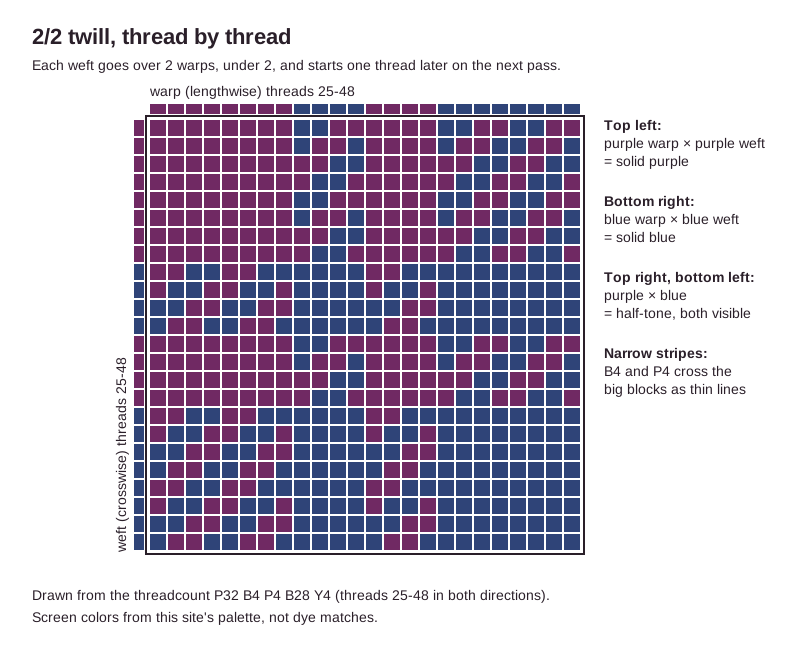
Wider than a phone screen: swipe sideways along the diagram, or open it full size.
A 24 × 24 crop (threads 25–48 in both directions) of the same sett. Each cell is one crossing: it shows the warp color where (x + y) mod 4 is 0 or 1, and the weft color otherwise, which is a 2/2 twill. Screen colors, not dye matches.
Diagram: Tailor, Weaver, Jeweler, Dyer, CC BY 4.0
"2/2 twill close-up: where a solid block meets a half-tone" by Tailor, Weaver, Jeweler, Dyer, from https://tailorweaverjewelerdyer.com/weaves/tartan/. Licensed under CC BY 4.0: https://creativecommons.org/licenses/by/4.0/
Data: Sample sett P32 B4 P4 B28 Y4, made up for this page
The register's guidance says that traditionally, tartans are usually woven in a 2/2 twill [1]. The fraction means two up, two down: in the diagrams on this page, each weft goes over two warp threads and under two, starting one thread later on each pass. Turn the cloth over and the diagonal runs the other way [9].
That order repeats every four warp threads and no two of the four rise and fall in step, so a loom needs at least four shafts, frames that each lift a separate set of warp threads [9]; that minimum is computed for this page from the repeat. For how twill compares with plain and satin weave, see the three basic weaves.
Follow one block of cloth to see the result. If a purple warp stripe crosses a purple weft stripe, every visible thread is purple and the block is solid. If a purple warp stripe crosses a blue weft stripe, purple shows on half the surface and blue on the other half. The register calls this equal mixture a half-tone [1].
Up close, a half-tone is a field of tiny diagonal steps in two colors. The register notes that the staggered twill gives tartan its hatched appearance, "particularly obvious in the half-tone areas" [1]. From farther back, the steps merge. The register's threadcount guidance says that where different colors cross, "new shades are created" [2].
Wider than a phone screen: swipe sideways along the diagram, or open it full size.
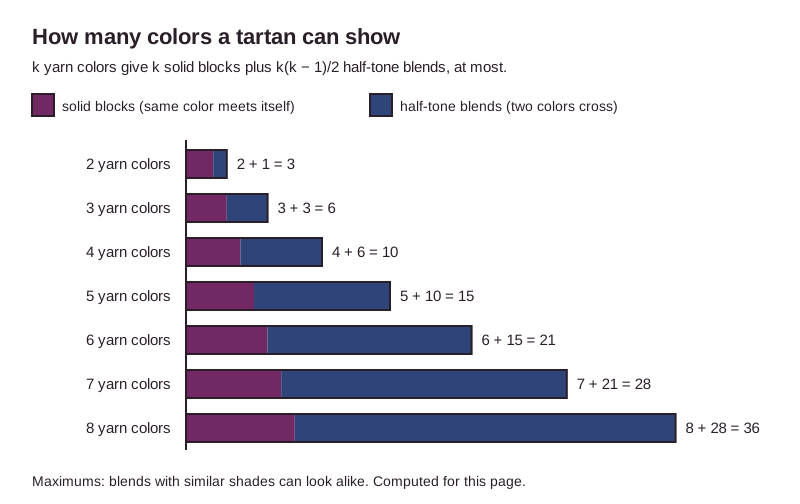
Solid blocks (k) and half-tone blends (k(k − 1)/2) for k = 2 to 8 yarn colors, drawn from tartan-color-count.csv. These are maximums, computed for this page; blends with similar shades can look alike.
Diagram: Tailor, Weaver, Jeweler, Dyer, CC BY 4.0
"How many colors a tartan can show" by Tailor, Weaver, Jeweler, Dyer, from https://tailorweaverjewelerdyer.com/weaves/tartan/. Licensed under CC BY 4.0: https://creativecommons.org/licenses/by/4.0/
Data: Counts computed for this page: k solid blocks and k(k - 1)/2 half-tone blends
Because the warp and weft use the same list, every color in the sett crosses every other color somewhere. With k yarn colors you get k solid blocks plus one blend for each pair of colors, which is k(k − 1)/2 blends.
| Yarn colors | Solid blocks | Half-tone blends | Colors on the cloth, at most |
|---|---|---|---|
| 2 | 2 | 1 | 3 |
| 3 | 3 | 3 | 6 |
| 4 | 4 | 6 | 10 |
| 5 | 5 | 10 | 15 |
| 6 | 6 | 15 | 21 |
| 8 | 8 | 28 | 36 |
Computed by this site; full table, including seven colors, in tartan-color-count.csv.
The last column is a maximum. Two blends with similar shades can look almost alike, so the number your eye separates may be lower.
The geometry has one more rule, worked out for this page from the sett itself. Two side-by-side blocks always share one stripe and differ in the other, since neighboring stripes in a sett are different colors. So a solid block borders only blends, and two solids can meet only at their corners.
Wider than a phone screen: swipe sideways along the diagram, or open it full size.
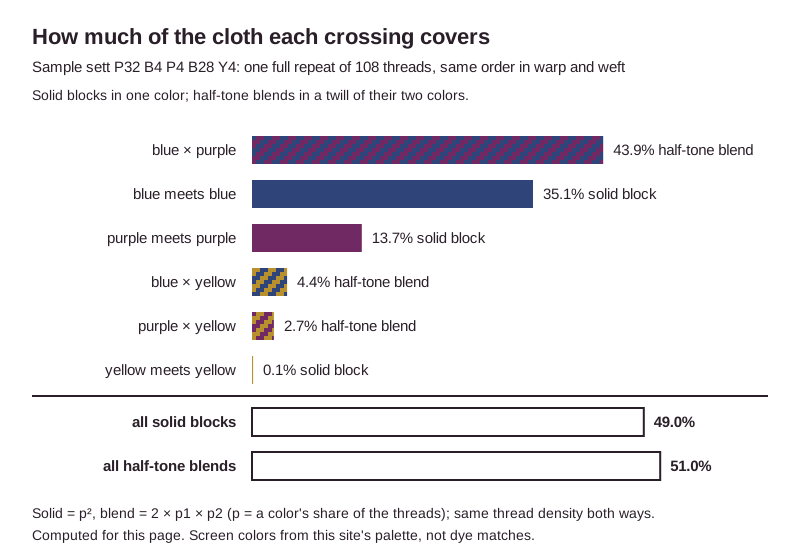
Each crossing type's share of the cloth in the sample sett P32 B4 P4 B28 Y4, drawn from tartan-blend-share.csv. Blends are filled with a 2/2 twill of their two screen colors; the table below gives the same numbers.
Diagram: Tailor, Weaver, Jeweler, Dyer, CC BY 4.0
"How much of the cloth each crossing covers" by Tailor, Weaver, Jeweler, Dyer, from https://tailorweaverjewelerdyer.com/weaves/tartan/. Licensed under CC BY 4.0: https://creativecommons.org/licenses/by/4.0/
Data: Sample sett P32 B4 P4 B28 Y4, made up for this page; shares computed for this page
This part is computed for this page; every crossing is listed in the CSV below. A crossing's share of the cloth is the warp share of one color times the weft share of the other. Since warp and weft use the same list, a solid block covers p² of the cloth, where p is that color's share of the threads, and a blend of two colors covers 2 × p1 × p2.
In the page's sett, purple has 40 of 108 threads (37.0%), blue has 64 (59.3%) and yellow has 4 (3.7%). The solids add up to 49.0% of the surface and the blends to 51.0%. The purple-blue blend alone covers 43.9%, more than solid blue at 35.1%.
| Crossing | Type | Share of the cloth |
|---|---|---|
| blue × blue | solid block | 35.12% |
| purple × purple | solid block | 13.72% |
| yellow × yellow | solid block | 0.14% |
| blue × purple | half-tone blend | 43.90% |
| blue × yellow | half-tone blend | 4.39% |
| purple × yellow | half-tone blend | 2.74% |
| all solid blocks | subtotal | 48.97% |
| all half-tone blends | subtotal | 51.03% |
The register's own five-color example points the same way. Computed for this page, its asymmetric sett ...B24 W4 B24 R2 K24 G24 W2... [2] comes out at 67.7% blend, and solid blue ties with two blends at 21.3% each.
A simple rule falls out of the math. In a two-color tartan, the blend covers more cloth than the main solid whenever the main color has less than two-thirds of the threads. The calculation assumes the same thread thickness both ways.
Method and data. The sett diagrams, the share table and the blend file are computed for this page from the threadcount P32 B4 P4 B28 Y4, and the color-count chart and table from the counting rule above. So the numbers in the text, the build card and the files come from one source, and the CSV files repeat them. Area shares assume equal thread density in warp and weft.
Wider than a phone screen: swipe sideways along the diagram, or open it full size.
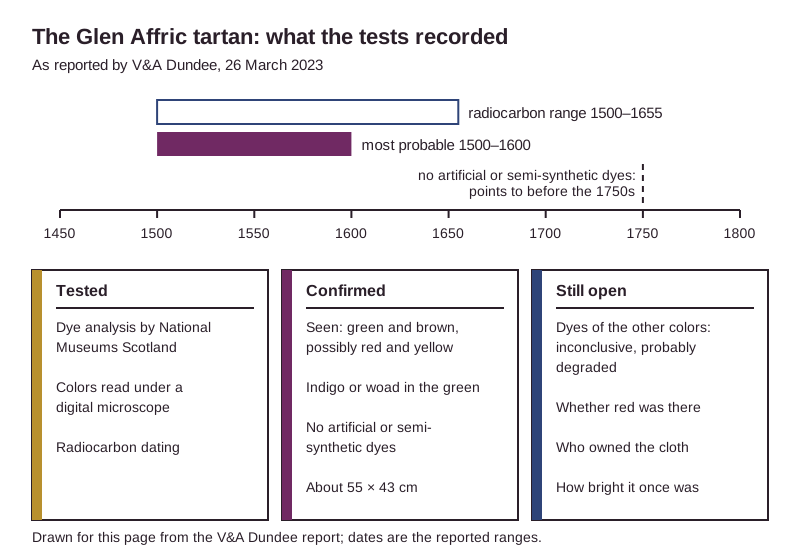
What the Glen Affric tests recorded, as V&A Dundee reported them in March 2023: the radiocarbon range, the dye results and what stayed open. Drawn for this page from that report; the text below gives the same facts.
Diagram: Tailor, Weaver, Jeweler, Dyer, CC BY 4.0
"The Glen Affric tartan: what the tests recorded" by Tailor, Weaver, Jeweler, Dyer, from https://tailorweaverjewelerdyer.com/weaves/tartan/. Licensed under CC BY 4.0: https://creativecommons.org/licenses/by/4.0/
Data: V&A Dundee, "Scotland's oldest tartan discovered by Scottish Tartans Authority", 26 March 2023, https://www.vam.ac.uk/dundee/info/scotland-s-oldest-tartan-discovered-by-scottish-tartans-authority (facts restated, not copied)
The Glen Affric tartan shows how little a faded scrap can tell you. It was found in a peat bog in Glen Affric around forty years before 2023, and the Scottish Tartans Authority had it tested [6]. Scientists from National Museums Scotland identified four colors under a digital microscope: green and brown, and possibly red and yellow [6].
Dye analysis confirmed indigo or woad in the green (how an indigo vat dyes cloth). The other colors were inconclusive, probably because the dyes had degraded [6]. No artificial or semi-synthetic dyes turned up, which pointed to a date before the 1750s, and radiocarbon testing gave 1500 to 1655, with 1500 to 1600 the most probable range [6]. On those results, V&A Dundee reported it as the oldest true tartan known from Scotland, a piece about 55 by 43 cm (22 by 17 inches) [6].
This site calls that the fade record: an object's known color history, limited to tests, storage conditions and treatment that someone documented. For Glen Affric, the record confirms a blue dye in the green and stops there. It does not tell you how bright the red once was, or whether red was there at all. Peter MacDonald of the Authority also warned against building history around the piece: Clan Chisholm controlled the area, but the Authority did not know who owned the cloth [6].
No. In a 2004 essay for the Scottish Tartans Authority, MacDonald explains that the weaving trade sold one sett in "modern," "ancient" or "old," "muted" and "weathered" shades, and that these are shade ranges for the same tartan [7]. The register agrees that changing the shades of an existing tartan does not create a new one [3]. Shade names also say nothing about how old a pattern is [7].
MacDonald dates the "old" range to near the end of the first half of the 20th century and says it does not match the natural-dye shades of old Highland pieces [7]. He calls "muted," dating from the early 1970s, the best commercial match to the natural dyes used until about 1855 [7].
He also ran a small test that belongs in the fade record. He left modern-color cloth under glass in direct sunlight with half of it covered, and after about 18 months the exposed half had faded toward the "ancient" range [7]. The "weathered" story, about a tartan said to have been dug up at Culloden in the 1950s, has no such record. MacDonald writes that the firm behind the related "reproduction" range could not provide provenance, and the original specimen cannot be traced [7].
That is why every historical color on this site carries a "screen approximation" label and a link to a photo of the real object. A hex code describes a screen color, not a dyed yarn. The colors in this page's diagrams are site palette colors picked for contrast, so they carry no historical claim at all.
No. The Scottish Register of Tartans says there is not a tartan for every name, even a Scottish one [1]. Tartans exist for clans and their septs (associated families), for some Lowland families, and for geographical districts. The register also says there are no laws about which tartan you may wear, only traditions [1].
Mostly, yes. A threadcount gives the order of colors and the number of threads in each stripe, which is what a weaver needs to set up the loom [2]. You also need the color key: the register asks applicants to explain the color codes they use, since each capital letter stands for a specific shade [2]. A threadcount can even be taken from a woven sample, if the piece is large enough to show the full sett [2].
Tailor, Weaver, Jeweler, Dyer. “Tartan: How Three Yarn Colors Make Up to Six on the Cloth.” Published 27 October 2026. https://tailorweaverjewelerdyer.com/weaves/tartan/. Accessed: add the date you read it.
Facts here carry numbered links to the sources listed above. How entries are checked: Weighing the Evidence: How This Site Checks Facts. Every substantive change is dated on Corrections. Spotted a mistake or have a better source? Contact and Correspondence.
"Weaver" by Vincent van Gogh — https://commons.wikimedia.org/wiki/File:Vincent_van_Gogh_-_Weaver_-_Google_Art_Project.jpg — Public domain (Vincent van Gogh d. 1890, PD in US and EU)
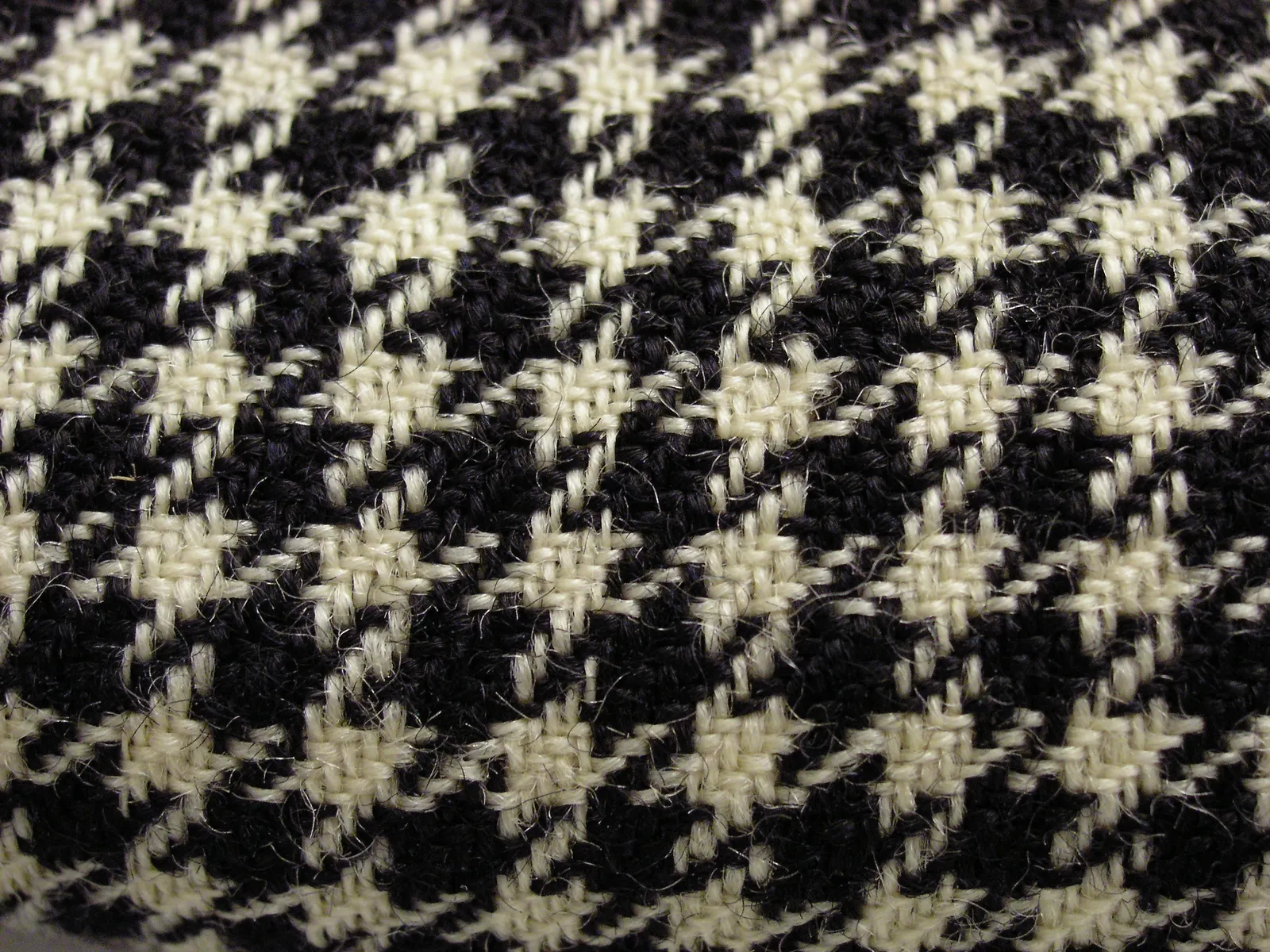
"Blanket" by Auckland Museum — https://commons.wikimedia.org/wiki/File:Blanket_(AM_1931.509-5).jpg — CC BY 4.0 (https://creativecommons.org/licenses/by/4.0/)

