


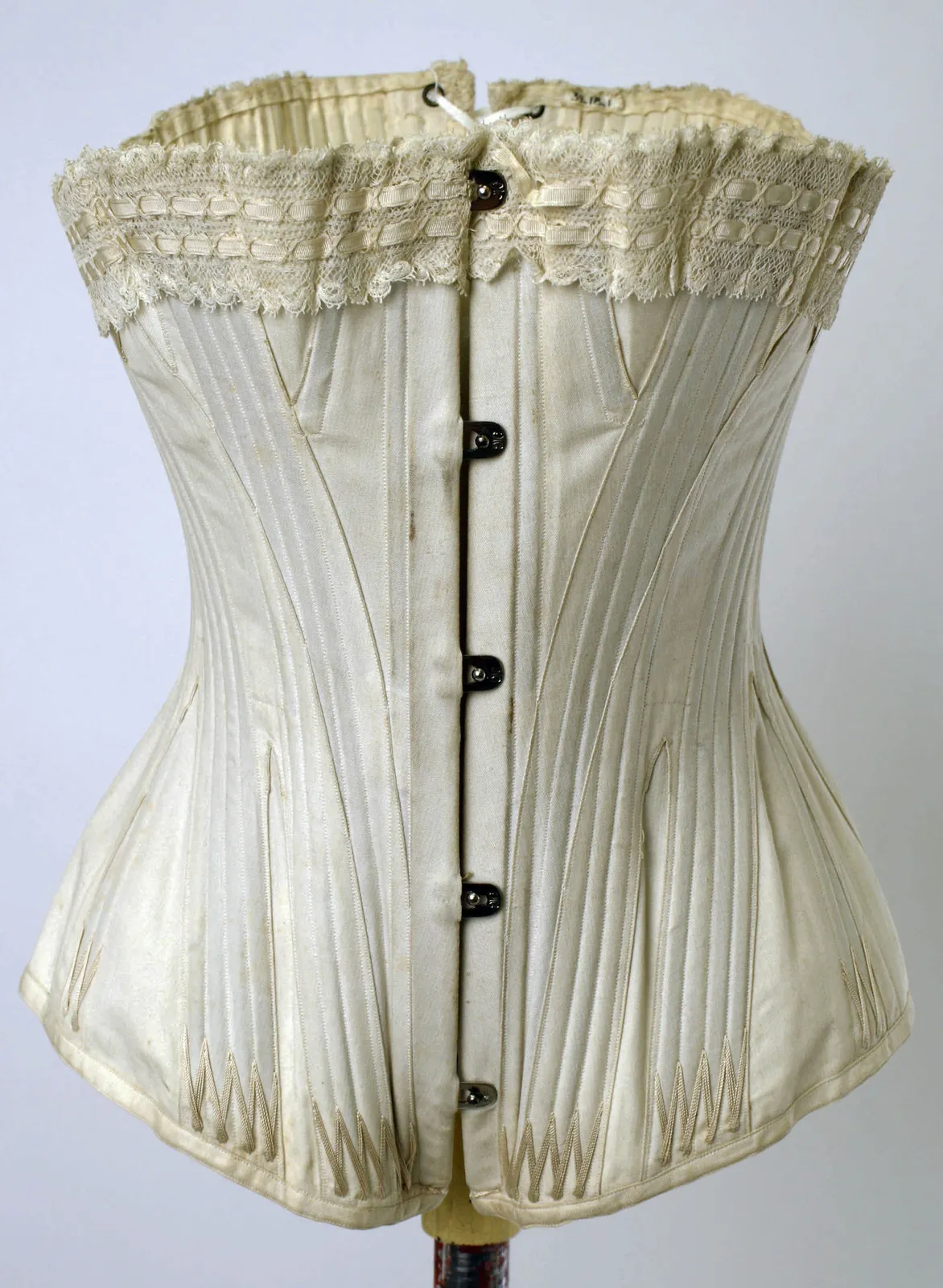
Picture credit
"Corset" by Unknown maker — https://commons.wikimedia.org/wiki/File:Corset_MET_CI39.18.1_F.jpg — CC0 1.0 (https://creativecommons.org/publicdomain/zero/1.0/)
By Tailor, Weaver, Jeweler, Dyer Published
Build card
This card as data: 18th-century-clothing-build-card.csv (CSV) · file notes (JSON): where the values come from, version and license
Data: The Metropolitan Museum of Art Open Access data (CC0): 2009.300.2241, C.I.40.173.6a–e, 2015.97, 2009.300.648; Art Institute of Chicago collection data (CC0): 2007.356; Rijksmuseum, Amsterdam, collection data (CC0): BK-1978-295, BK-1974-40; Cleveland Museum of Art open access data (CC0): 1920.314; Paris Musées, Palais Galliera G.4539, collection data (CC0); Encyclopédie, Recueil de planches vol. 9 (1771), via ARTFL Encyclopédie, and F.-A. de Garsault, L'Art de la lingère (1771), public domain (facts restated)
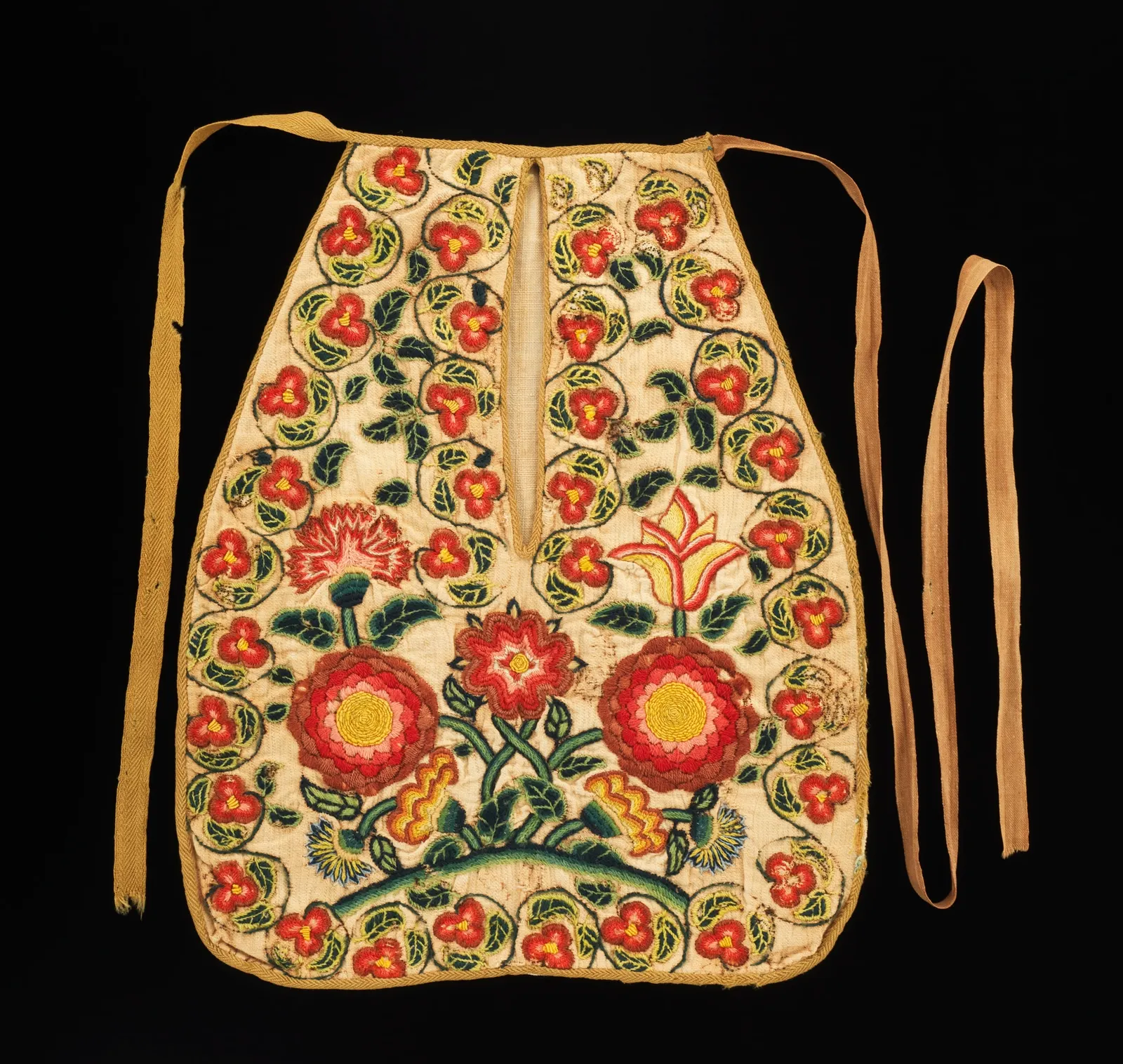
An American pocket of about 1784 (Met 2009.300.2241): a flat bag of cotton and wool worked with flowers, with a bound slit down the middle and long tapes at the top.
"Pocket" by Unknown maker — https://commons.wikimedia.org/wiki/File:Pocket_MET_1996.2_CP4.jpg — CC0 1.0 (https://creativecommons.org/publicdomain/zero/1.0/)
Pick up an 18th-century pocket and two long tapes trail from a bag with a slit. The Met's American pocket of about 1784 is a flat embroidered bag of cotton and wool, with nothing on it that would join it to a gown [1]. The Art Institute of Chicago's catalogue entry for another pocket, dated about 1799, explains why: women's clothes of the 18th and early 19th centuries were not made with sewn-in pockets, so a separate pocket was tied around the waist, hidden under the skirts and reached through slits or open seams [2].
That makes the pocket one layer in a stack. From the skin out, a woman's clothes of about 1770–1800 ran shift, stockings and garters, stays, pocket, petticoat and gown, with a kerchief, apron and cap on top. The objects and period texts on this page name each layer, but they rarely spell out the order, so most of the order here is inferred from which garment lies over which.
A separate bag can go missing on its own, and a nursery rhyme remembers one that did. The Real Mother Goose (1916) prints it as "Lucy Locket lost her pocket, / Kitty Fisher found it" [3]. The rhyme shows a pocket as a thing a woman could lose, without saying how or why.
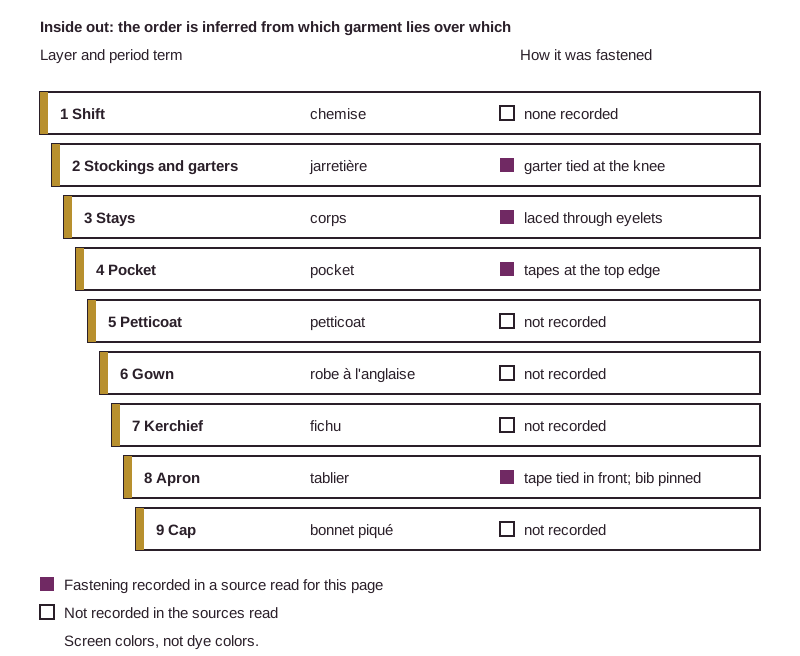
Wider than a phone screen: swipe sideways along the diagram, or open it full size.
The nine layers from the inside out, drawn for this page from the layers file below. A filled square means a source read for this page records how that layer fastened; an empty square means none does. Screen colors, not dye colors.
Diagram: Tailor, Weaver, Jeweler, Dyer, CC BY 4.0
"Nine layers of women's dress, c. 1770–1800" by Tailor, Weaver, Jeweler, Dyer, from https://tailorweaverjewelerdyer.com/construction/18th-century-clothing/. Licensed under CC BY 4.0: https://creativecommons.org/licenses/by/4.0/
Data: The Metropolitan Museum of Art Open Access data (CC0): 2009.300.2241, C.I.40.173.6a–e, 2015.97, 2009.300.648; Rijksmuseum, Amsterdam, collection data (CC0): BK-1974-40; Cleveland Museum of Art open access data (CC0): 1920.314; Paris Musées, Palais Galliera G.4479 and G.4539, collection data (CC0); Encyclopédie, Recueil de planches vol. 9 (1771) and vol. 12 (1765), via ARTFL Encyclopédie, University of Chicago (facts restated); F.-A. de Garsault, L'Art de la lingère (Paris, 1771), public domain (facts restated); The Workwoman's Guide (London, 1838), Project Gutenberg eBook #75494, public domain; Order of layers and fastening status compiled for this page
The objects behind this list come from several places: pockets and stockings made in America, stays from Italy, a petticoat and a gown from Britain, a shift in a Dutch collection and fashion plates printed in Paris. They never belonged to one woman, and no single source read for this page gives the whole sequence, so the list is a stack assembled from many wardrobes, not a fixed rule.
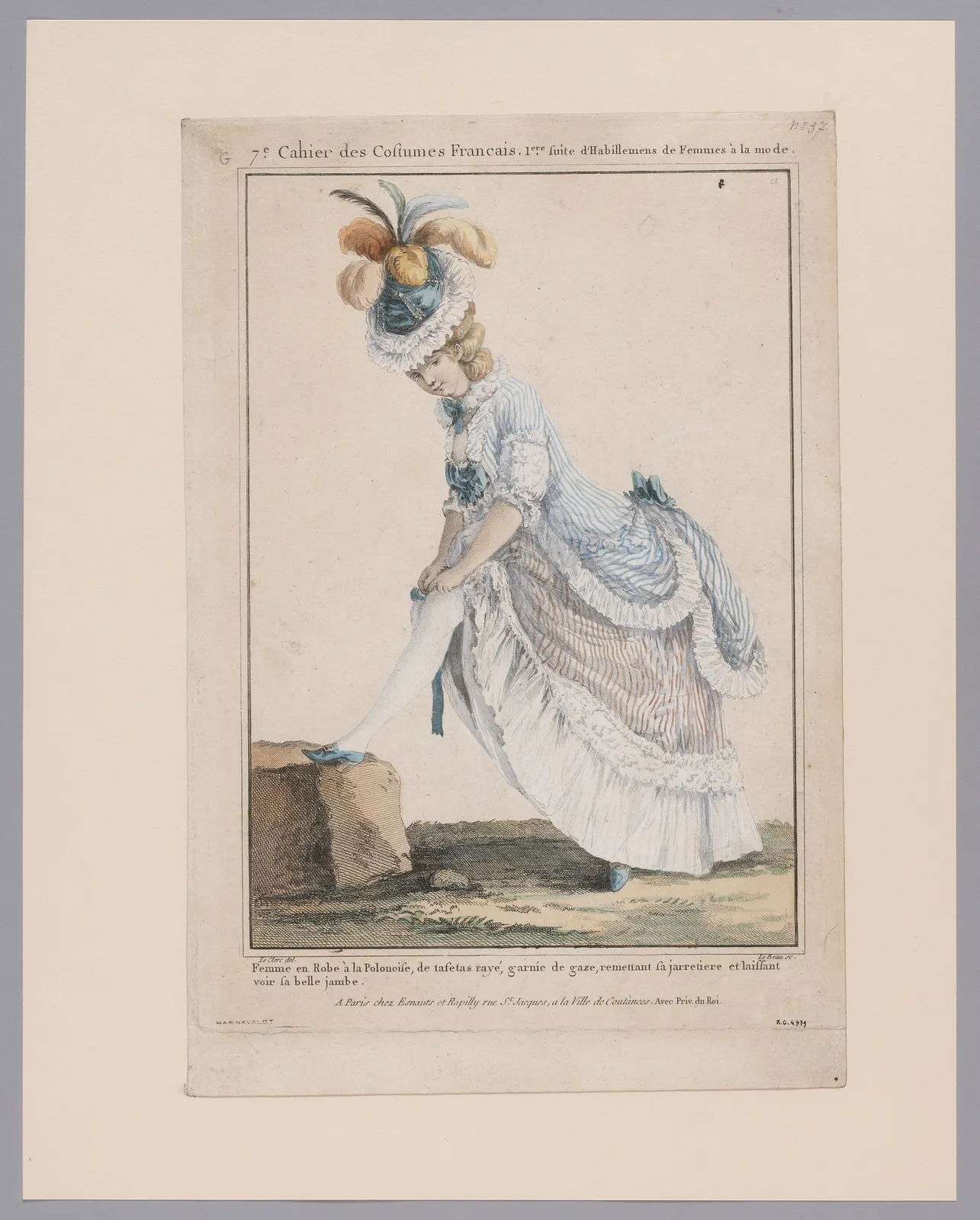
A Galerie des Modes plate of about 1780 (Palais Galliera G.4479), drawn by Pierre Thomas Le Clerc and engraved by Pierre Adrien Le Beau. One foot on a rock, a woman ties a blue garter at the knee over a white stocking.
"Femme remettant sa jarretière en robe à la polonaise blanche à rayures rouges et bleues, Galerie des modes" by Pierre Thomas Le Clerc (designer) and Pierre Adrien Le Beau (engraver), CC0 1.0
"Femme remettant sa jarretière en robe à la polonaise blanche à rayures rouges et bleues, Galerie des modes" by Pierre Thomas Le Clerc (designer) and Pierre Adrien Le Beau (engraver) — https://commons.wikimedia.org/wiki/File:Femme_remettant_sa_jarreti%C3%A8re_en_robe_%C3%A0_la_polonaise_blanche_%C3%A0_rayures_rouges_et_bleues,_Galerie_des_modes,_Fonds_d'esta,_G.4479.jpg — CC0 1.0 (https://creativecommons.org/publicdomain/zero/1.0/)
The first layer was linen. In L'Art de la lingère (1771), François-Alexandre de Garsault describes three ways to cut a woman's chemise, one called à la Françoise and two à l'Angloise, each built from straight lengths of linen with triangular pieces, pointes, set in narrow end up [6]. Every chemise de femme, he says, has a scooped opening at the top front, usually about six pouces (French inches) deep [6].
A surviving shift in the Rijksmuseum shows the same kind of shaping. The museum's record for BK-1974-40 describes a woman's linen shift with triangular inserts in the side seams, which it gives as the mark of a woman's shift, and no slits, which mark a man's [7]. Because the record dates it only to 1700–1900, it shows the cut rather than a decade. None of the sources read for this page says how a shift fastened.
Stockings come next in this stack, though nothing fixes exactly when. The Cleveland Museum of Art has a knitted pair made in New York in 1790, 79 cm (31 1/8 in.) long [8]. In the plate above, from a series of Paris fashion plates titled for the years 1778 to 1787, a fully dressed woman is tying her garter back on at the knee, and the engraved caption says so in French: "remettant sa jarretière" [4][9]. Since a garter could be retied with the gown already on, this layer was never as fixed in the order as a numbered list makes it look.
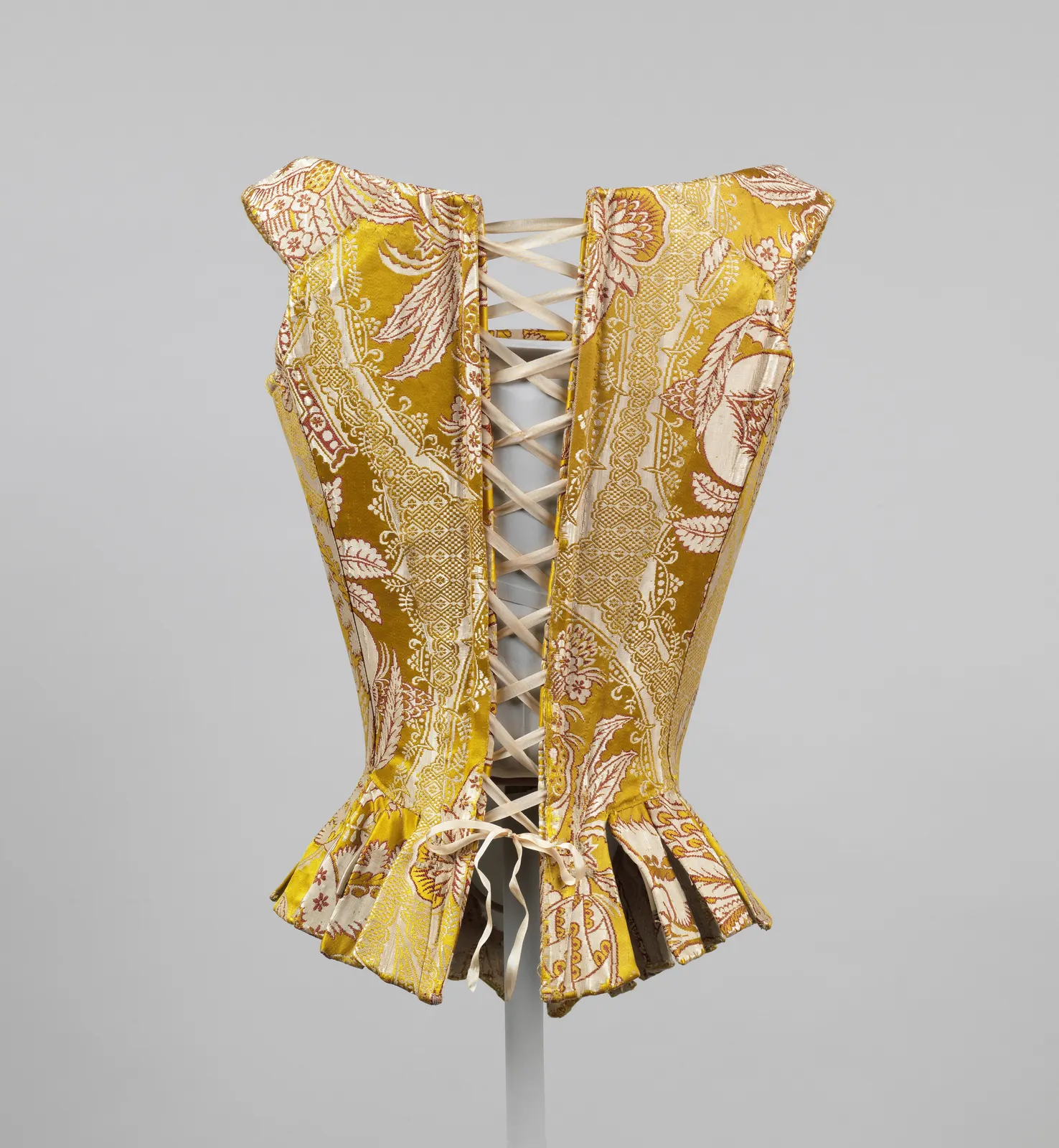
Italian stays of the 1770s, catalogued by The Met as a corset (C.I.40.173.6a–e), seen from the back. A flat lace zigzags down the opening, and pleated tabs splay out below the waist.
"Corset" by Unknown maker — https://commons.wikimedia.org/wiki/File:Corset_MET_DP240326.jpg — CC0 1.0 (https://creativecommons.org/publicdomain/zero/1.0/)
Stays went on over the shift in this stack. The plates for the tailor's trade in the Encyclopédie (1771) give the French name, corps, and label the parts of a pair: the lace (lacet), the fronts and backs, the shoulder straps (épaulettes), the tabs (basques) and the eyelets the lace runs through [5].
The stiffening went inside. One plate shows busks of whalebone that slide into the thickness of the front, with loops for pulling them out again, along with whalebones of different thicknesses for filling the body [5]. Whalebone was not the only stiffening on record: the Rijksmuseum's green taffeta stays of 1740–1790 (BK-1978-295) are recorded as made of osiers, which is willow, with linen, taffeta and silk, and they have pink shoulder ribbons [10].
The Met's Italian pair shows one way stays closed. A lace zigzags down the back opening, and below the waist the tabs fan out in a row. Laced shut, a pair of stays works like a frame around the body, and every layer after it goes on over that frame.
The names overlapped. In the 1771 plates, corps is the boned garment, a "corps à demi baleiné, dit corset baleiné" is a half-boned version, and another plate gives a corset its own sleeve pieces [5]. Museums today title the same kind of object differently: The Met catalogues its Italian pair as a corset, and the Rijksmuseum calls its pair a korset [11][10]. In English, The Workwoman's Guide of 1838 heads a section "Stays or Corsets" [12].
Here the 18th-century garment is called stays. Claims that stays harmed the body are weighed against the sources in corsets and ribs, not on this page.
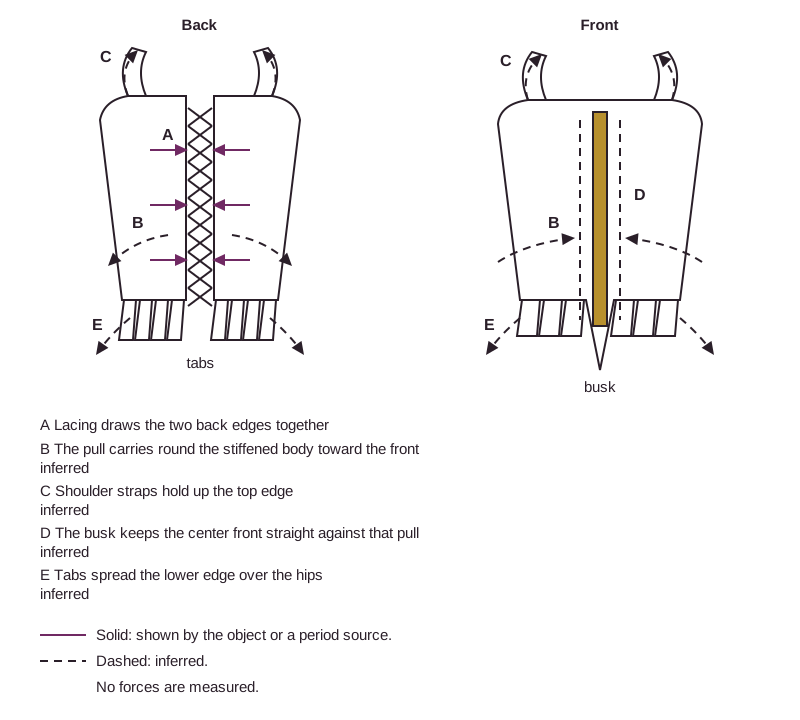
This site calls the drawing below the tension map: a qualitative diagram of where a garment takes strain, marking the lacing, ties and fastenings that bear load without putting a number on any of them. A solid line is shown by the object or a period source, and a dashed line is inferred and labelled that way.
Wider than a phone screen: swipe sideways along the diagram, or open it full size.
The tension map for a pair of stays, drawn for this page as a schematic of the back and front from the parts named in the 1771 Encyclopédie plates, not traced from any one object. Only the lacing path is solid; the other four are dashed and labelled inferred. No forces are measured. Screen colors, not dye colors.
Diagram: Tailor, Weaver, Jeweler, Dyer, CC BY 4.0
"The tension map: stays, back and front" by Tailor, Weaver, Jeweler, Dyer, from https://tailorweaverjewelerdyer.com/construction/18th-century-clothing/. Licensed under CC BY 4.0: https://creativecommons.org/licenses/by/4.0/
Data: Encyclopédie, Recueil de planches vol. 9 (1771), Tailleur d'habits et tailleur de corps, plates XX–XXIII, via ARTFL Encyclopédie, University of Chicago (facts restated); The Metropolitan Museum of Art, C.I.40.173.6a–e, photograph and data row (CC0); Paths drawn for this page; dashed paths are inferred and no forces are measured
Only one path is solid: the lace pulling the two back edges together, which the Met photograph shows and the 1771 plates name [11][5]. The table gives what each path rests on.
| Path on the map | Line | What it rests on |
|---|---|---|
| A. Lacing draws the two back edges together | Solid | Shown on Met C.I.40.173.6a–e; the lace (lacet) and eyelets are named in the 1771 plates |
| B. The pull carries round the stiffened body toward the front | Dashed (inferred) | Inferred from the lacing and the stiffened body; no source read here describes it |
| C. Shoulder straps hold up the top edge | Dashed (inferred) | Straps (épaulettes) are named in the 1771 plates; the load on them is inferred |
| D. The busk keeps the center front straight against that pull | Dashed (inferred) | Busks slid into the front are shown in the 1771 plates; their part in the pull is inferred |
| E. Tabs spread the lower edge over the hips | Dashed (inferred) | Tabs (basques) are named in the 1771 plates and seen on the Met stays; the load on them is inferred |
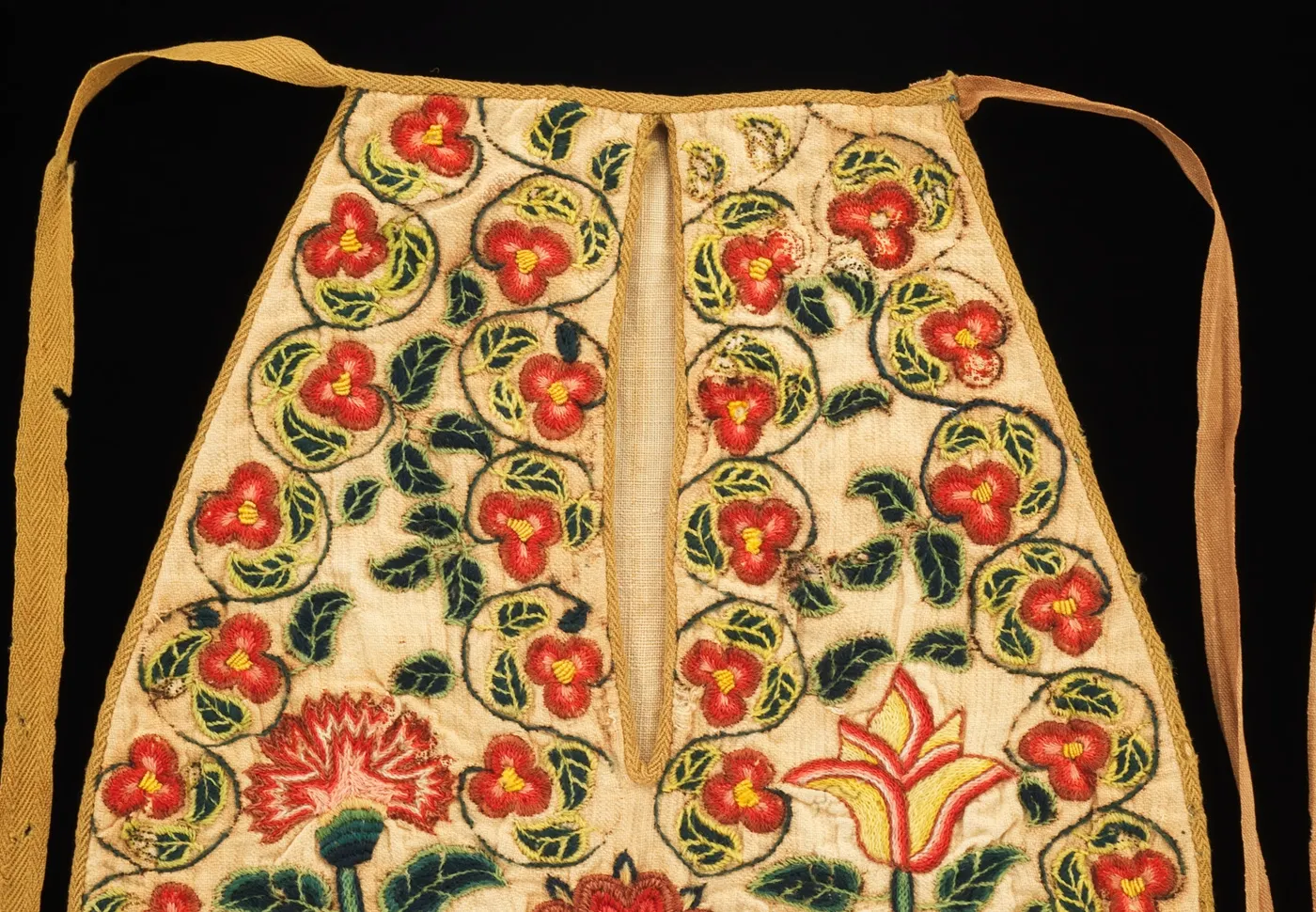
The top of the same Met pocket, cropped from the full photograph. The tape binding the top edge runs on past the left corner as a tie, a second, plain tape leaves the right corner, and the slit is bound on both edges.
"Pocket (detail)" by Unknown maker, CC0 1.0
"Pocket (detail)" by Unknown maker — https://commons.wikimedia.org/wiki/File:Pocket_MET_1996.2_CP4.jpg — CC0 1.0 (https://creativecommons.org/publicdomain/zero/1.0/); modified: cropped to the top of the pocket (slit, binding and tapes) from the full photograph; colours not altered
Look closely at the Met pocket. Recorded as cotton and wool, it has a slit down the middle with bound edges, and the tape along the top edge carries on past the corner to become a tie [1].
The Art Institute of Chicago's pocket (2007.356) is later, about 1799, attributed to Sally Standish and made in Massachusetts or Rhode Island. Its record lists cotton plain weaves, some embroidered with silk and some printed, pieced together and lined with linen, at 37.2 × 32.4 cm (14 5/8 × 12 3/4 in.) [2]. Plain weave is one of the three basic weaves, drawn thread by thread on that page.
The same catalogue entry puts the tapes along the pocket's top edge. It also suggests that this one may have been sewn as practice for bigger patchwork, such as a bedcover [2].
Period reference books treat the pocket as a bag too, though not always a loose one. The Encyclopédie of 1765 defines poche, as a tailor's term, as a small bag of linen or leather attached to some garments of men and women, and the coats, waistcoats and breeches it goes on to name are men's [13]. Decades after the clothes on this page, The Workwoman's Guide (1838) gave three choices: "Pockets are either worn tied round the waist, fastened into the petticoat, or buttoned upon the stays" [12].
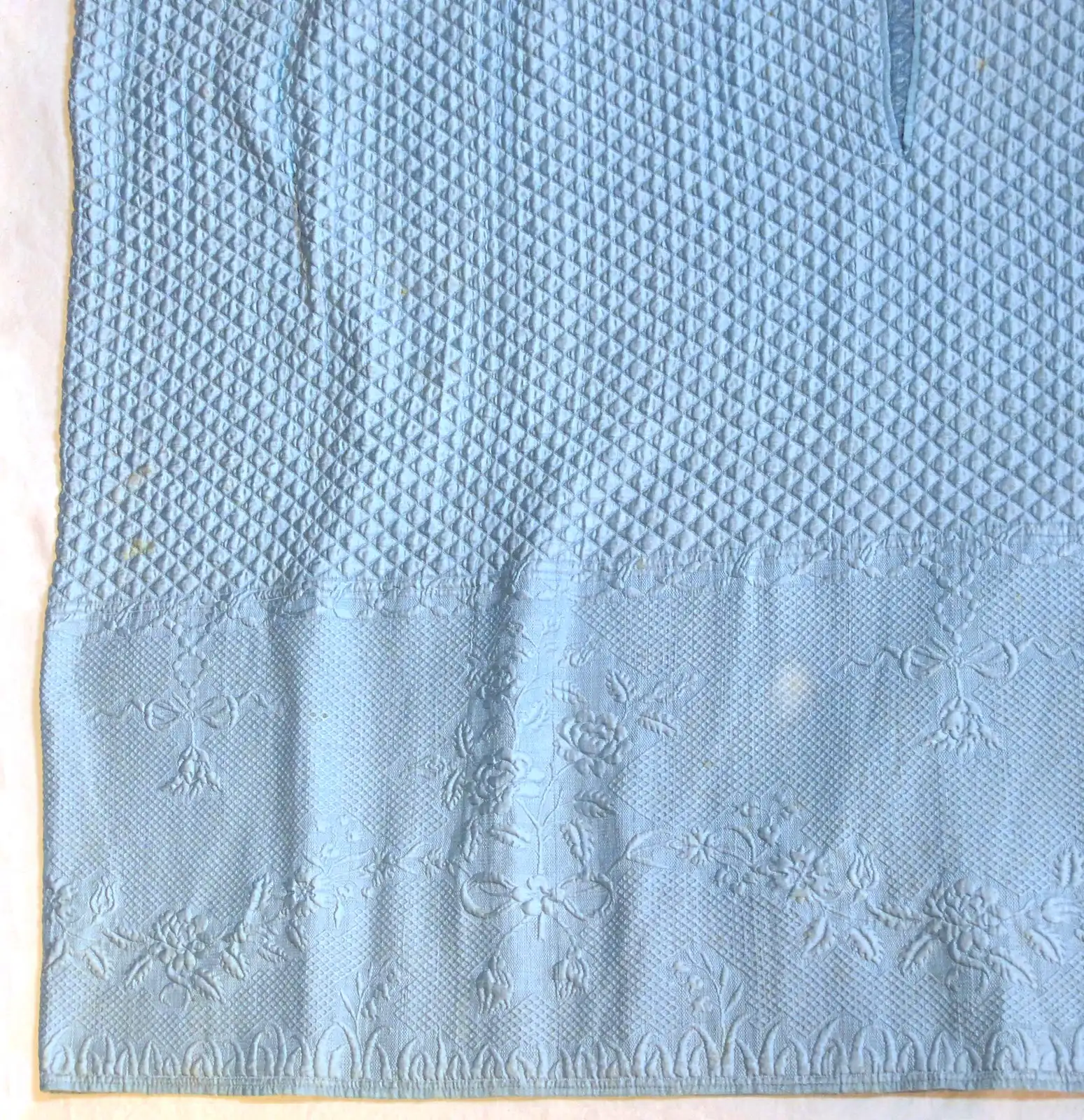
Part of a quilted silk petticoat, British, 1760–80 (Met 2015.97), as the museum photographed it: diamond quilting above a border quilted with flowers and bows, with a slit near the top of the picture.
"Petticoat" by Unknown maker — https://commons.wikimedia.org/wiki/File:Petticoat_MET_2015.97_F.jpg — CC0 1.0 (https://creativecommons.org/publicdomain/zero/1.0/)
In this stack the petticoat went on over the stays and the pocket, and under an open-fronted gown its front was on view. The Met's British petticoat of 1760–80 is recorded as silk and cotton, and its surface is quilted in a small diamond grid above a border of quilted flowers and bows [14].
Near the top of the photograph a slit opens in the quilting. According to the Art Institute's description, slits or open seams in the skirts were how a hidden pocket was reached, although the photograph alone does not say what this particular slit was for [2].
How petticoats of these decades closed at the waist is not recorded in the sources read for this page. The nearest description found is a later one: The Workwoman's Guide (1838) has servants' petticoats "merely set into a tape round the waist, without any body," and skirts left open behind or at the sides near the top [12]. Later skirts took a different route to width, and the crinoline entry follows how the name of a horsehair cloth ended up on a cage of hoops.
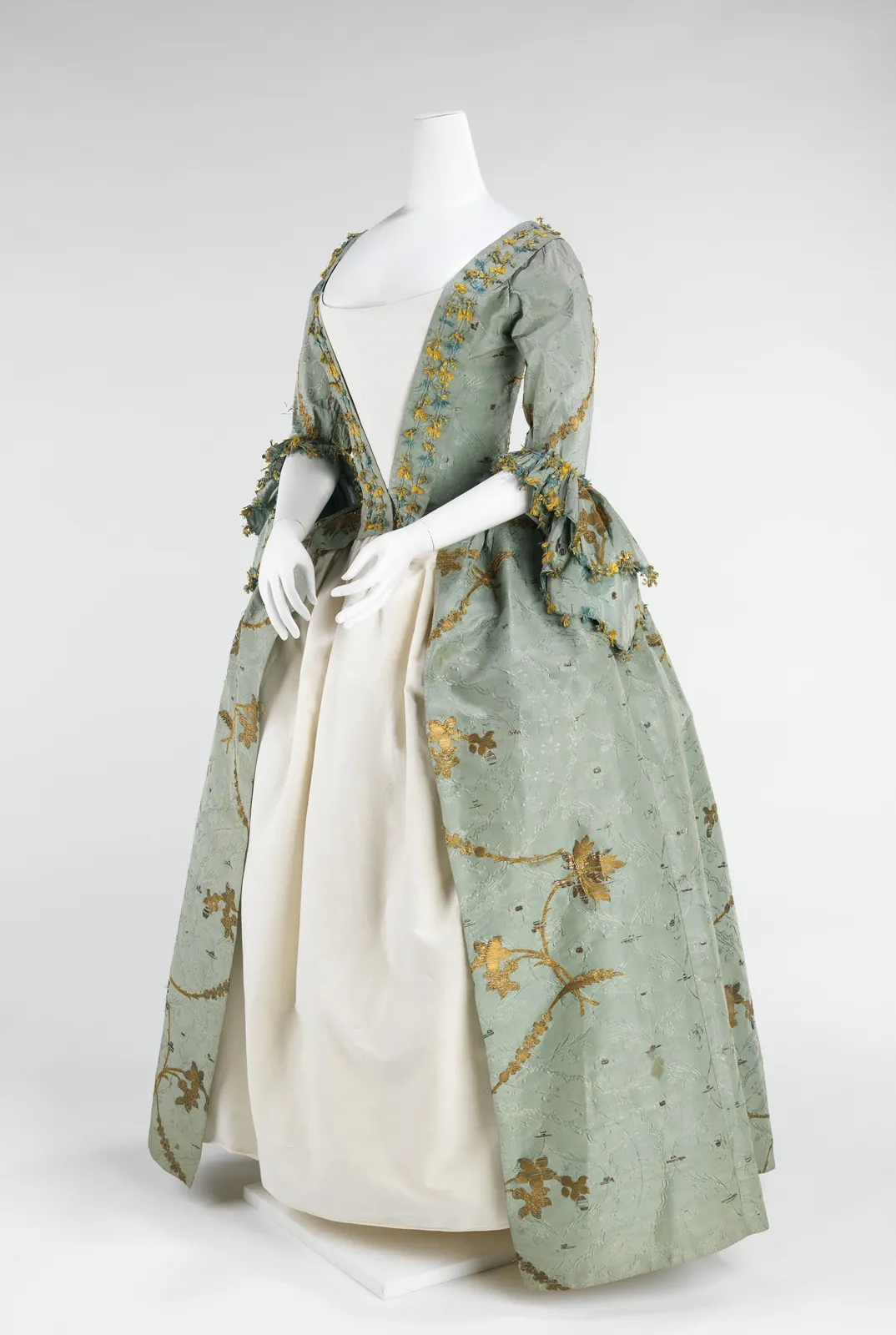
A British robe à l'anglaise of 1770–75 (Met 2009.300.648), silk and metal by the museum's record. On the display form the bodice edges stand apart down the front, and the skirt parts to show a plain white petticoat.
"Robe à l'Anglaise" by Unknown maker — https://commons.wikimedia.org/wiki/File:Robe_%C3%A0_l'Anglaise_MET_34.507_threequarter_CP4.jpg — CC0 1.0 (https://creativecommons.org/publicdomain/zero/1.0/)
The gown was the last of the main garments. The Met's British robe à l'anglaise of 1770–75 is recorded as silk and metal, and the photograph shows it opening down the front over the petticoat [15].
The name was in use at the time. A Galerie des Modes plate of about 1780 labels a gown with a long train "Robe à l'Angloise, queue trainante," in the plate's own spelling [16]. The same plate, in the next section, shows what went over the shoulders.
How a gown like this one fastened is left open here. The Met's data row gives only the name, date and materials. None of the period texts read for this page describes the closure.
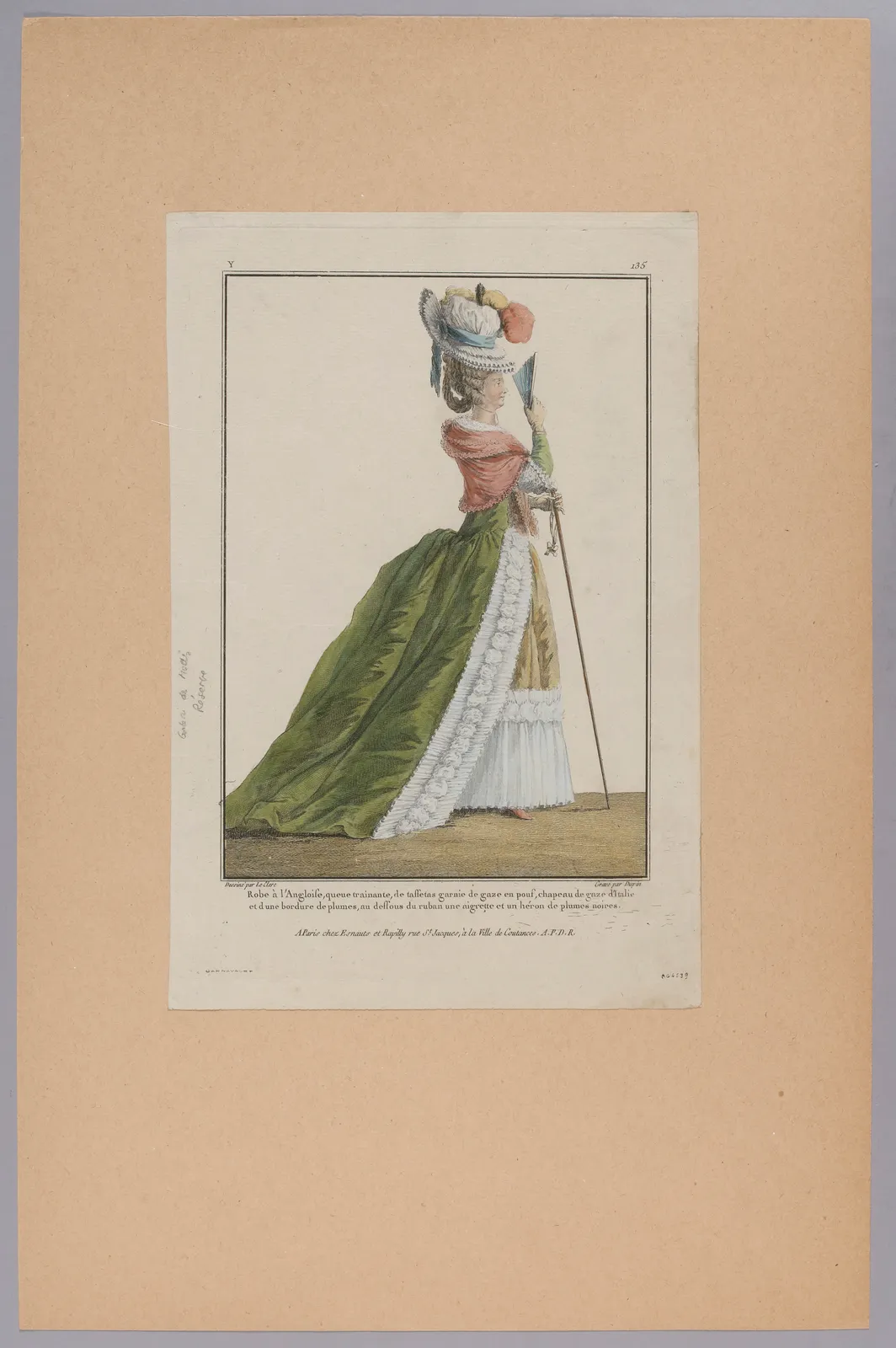
Plate 135 of the Galerie des Modes, about 1780 (Palais Galliera G.4539), drawn by Le Clerc and engraved by Dupin. A ruffled pink covering, drawn like a kerchief, lies over the shoulders of a green robe à l'anglaise with a long train.
"Robe à l'anglaise avec grande queue de taffetas bordée de ruchés blancs, planche n° 135, 23e cahier, Galerie des modes" by Pierre Thomas Le Clerc (designer) and Nicolas Dupin (engraver), CC0 1.0
"Robe à l'anglaise avec grande queue de taffetas bordée de ruchés blancs, planche n° 135, 23e cahier, Galerie des modes" by Pierre Thomas Le Clerc (designer) and Nicolas Dupin (engraver) — https://commons.wikimedia.org/wiki/File:Robe_%C3%A0_l'anglaise_avec_grande_queue_de_taffetas_bord%C3%A9e_de_ruch%C3%A9s_blancs,_planche_n%C2%B0_135,_23e_cahier,_Galerie_des_modes,_,_G.4539.jpg — CC0 1.0 (https://creativecommons.org/publicdomain/zero/1.0/)
The smaller pieces come last in this stack. Garsault's 1771 book covers all three. His fichu doublé is a square of muslin, trimmed with lace all round or left plain when made of batiste [6]. In the plate above, a ruffled covering drawn like a kerchief sits over the gown's shoulders, on the outside of the stack, though the engraved caption does not name it [16].
His apron for a lady's maid is the most fully described fastening on this page. The top is pleated onto a linen tape long enough to go round the waist and come back to tie in front, and a rectangular bib, taller than wide, is raised over the chest and pinned there [6]. A pocket with a hemmed slit is sewn on near the right side, so an apron could carry a pocket of its own while the pocket under the skirts stayed a separate bag [6].
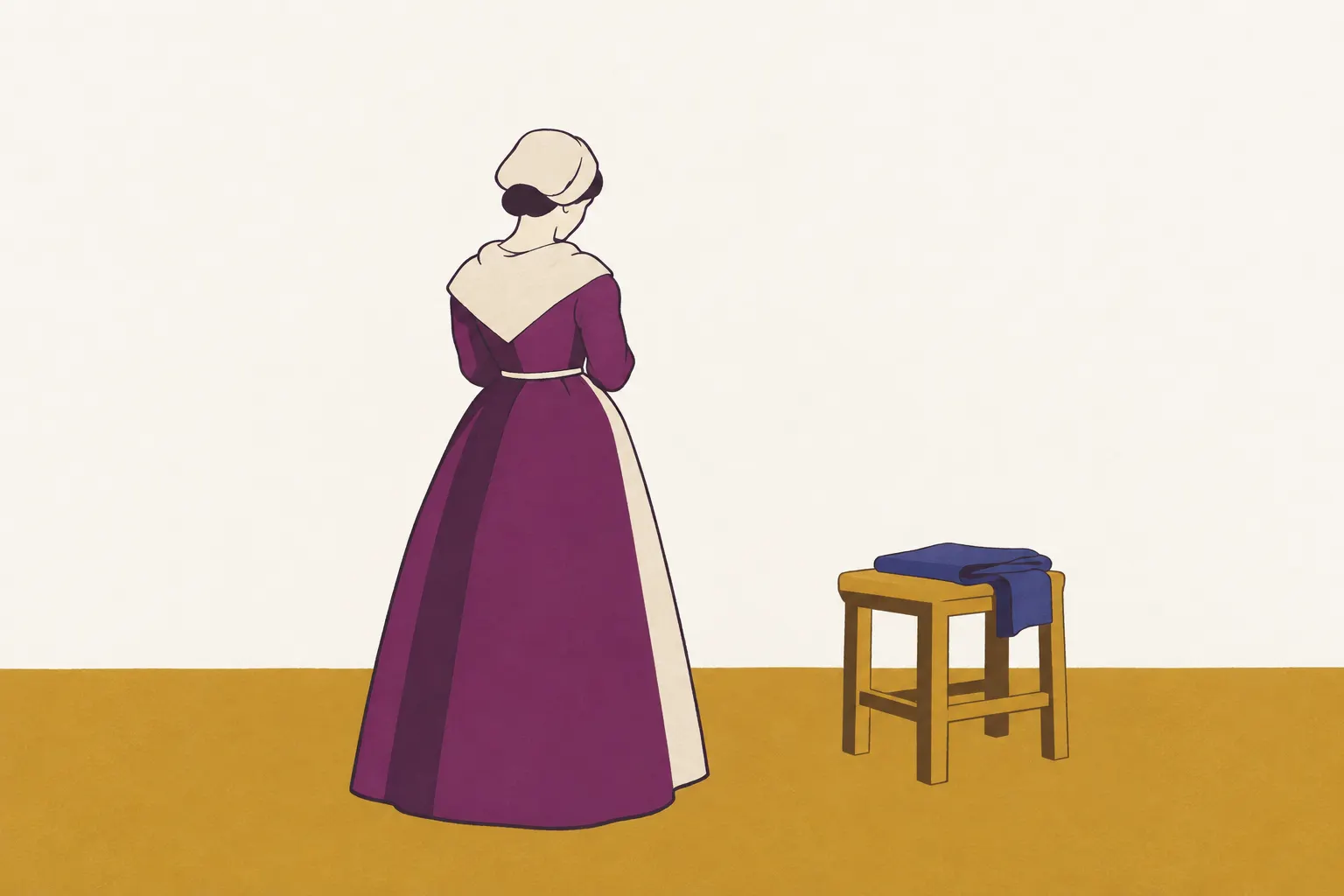
A woman, seen from behind, ties a linen apron over her gown.
Illustration: Tailor, Weaver, Jeweler, Dyer. Generated schematic image — not a photograph or historical record. Reuse terms: may be shared with this full caption and a link to the source page; not licensed under CC BY.
For the head, Garsault starts from the bonnet piqué, a quilted cap in three pieces with linen outside, a fustian lining and cotton between. He calls it the base of every piece fastened on the head and says every coiffure is mounted on one [6]. How the cap itself stayed on is not described in the passages read for this page.
The surviving pockets on this page were not. The Met's pocket of about 1784 and the Art Institute of Chicago's of about 1799 are both separate bags, and the Art Institute's description says women's clothing of the 18th and early 19th centuries was not made with sewn-in pockets [1][2]. By 1838, The Workwoman's Guide also mentions pockets fastened into the petticoat [12].
From the skin out, the sources on this page give a linen shift, stockings held up with garters, stays, a tie-on pocket and a petticoat, with the order inferred from how the garments lie over one another. A kerchief, apron and cap could go on over the gown.
Tailor, Weaver, Jeweler, Dyer. “18th-Century Clothing: A Woman's Pocket Was a Separate Bag.” Published 27 October 2026. https://tailorweaverjewelerdyer.com/construction/18th-century-clothing/. Accessed: add the date you read it.
Facts here carry numbered links to the sources listed above. How entries are checked: Weighing the Evidence: How This Site Checks Facts. Every substantive change is dated on Corrections. Spotted a mistake or have a better source? Contact and Correspondence.
"Corset" by Unknown maker — https://commons.wikimedia.org/wiki/File:Corset_MET_CI39.18.1_F.jpg — CC0 1.0 (https://creativecommons.org/publicdomain/zero/1.0/)
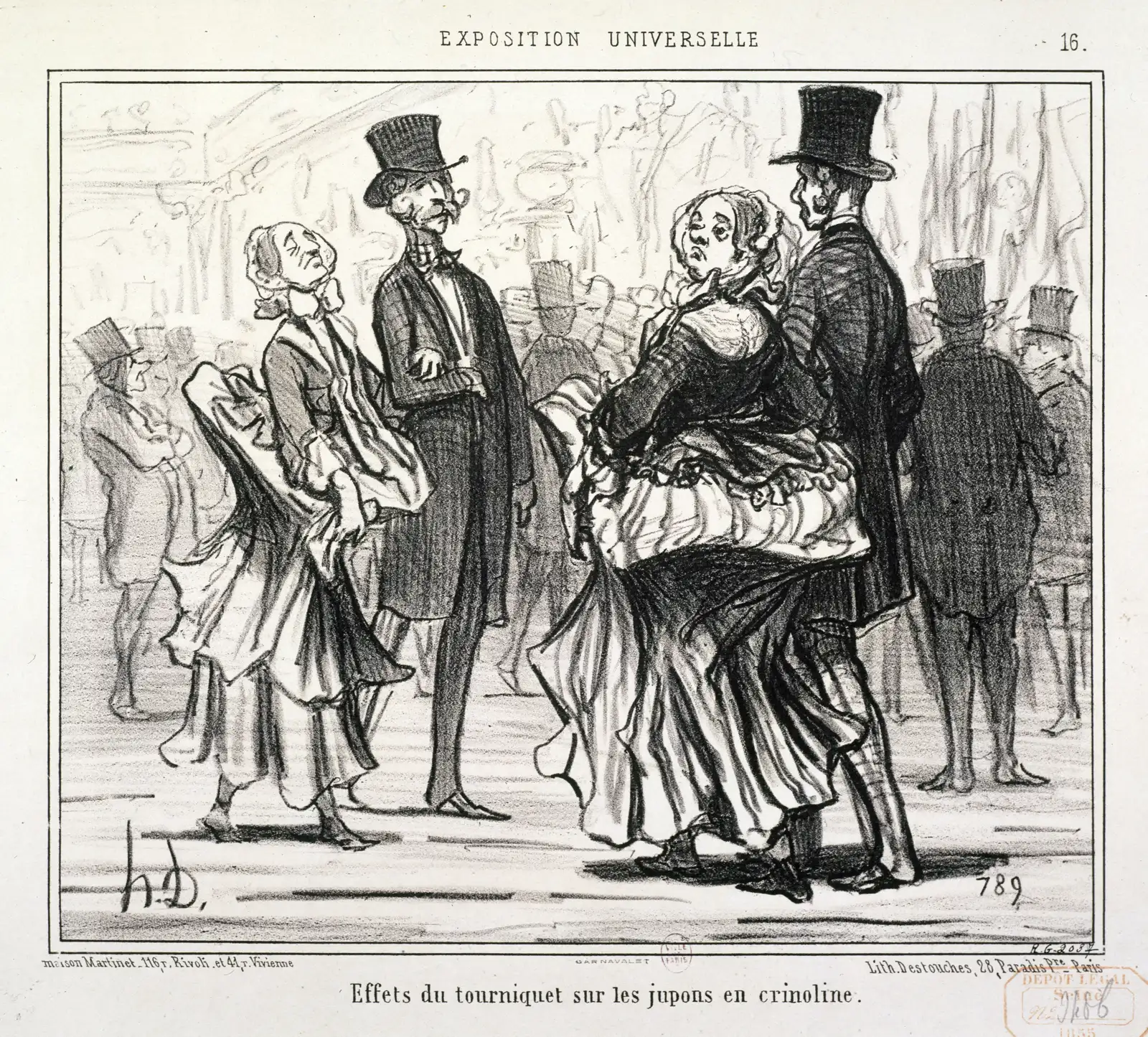
"Effets du tourniquet sur les jupons en crinoline" by Honoré Daumier — https://commons.wikimedia.org/wiki/File:Effets_du_tourniquet_sur_les_jupons_en_crinoline._N%C2%B016,_G.2037(3).jpg — CC0 1.0 (https://creativecommons.org/publicdomain/zero/1.0/)

