


Picture credit
"Stirrup Ring" by Unknown maker — https://commons.wikimedia.org/wiki/File:Stirrup_Ring_MET_DP701987.jpg — CC0 1.0 (https://creativecommons.org/publicdomain/zero/1.0/)
By Tailor, Weaver, Jeweler, Dyer Published
Build card
This card as data: victorian-hair-jewelry-build-card.csv (CSV) · file notes (JSON): where the values come from, version and license
Data: Mark Campbell, Self-Instructor in the Art of Hair Work (1867), Project Gutenberg eBook #38658 (public domain); Alexanna Speight, The Lock of Hair (1871), public domain (facts restated); Rijksmuseum, Amsterdam, collection data (CC0): BK-NM-1120; Wellcome Collection catalogue data (CC0): Museum No A642443, image L0036167; Walters Art Museum catalogue data (CC0): 57.2059, 38.567, 2008.5.8; Art Institute of Chicago collection data (CC0): 1958.410; The Metropolitan Museum of Art Open Access data (CC0): 32.134.2
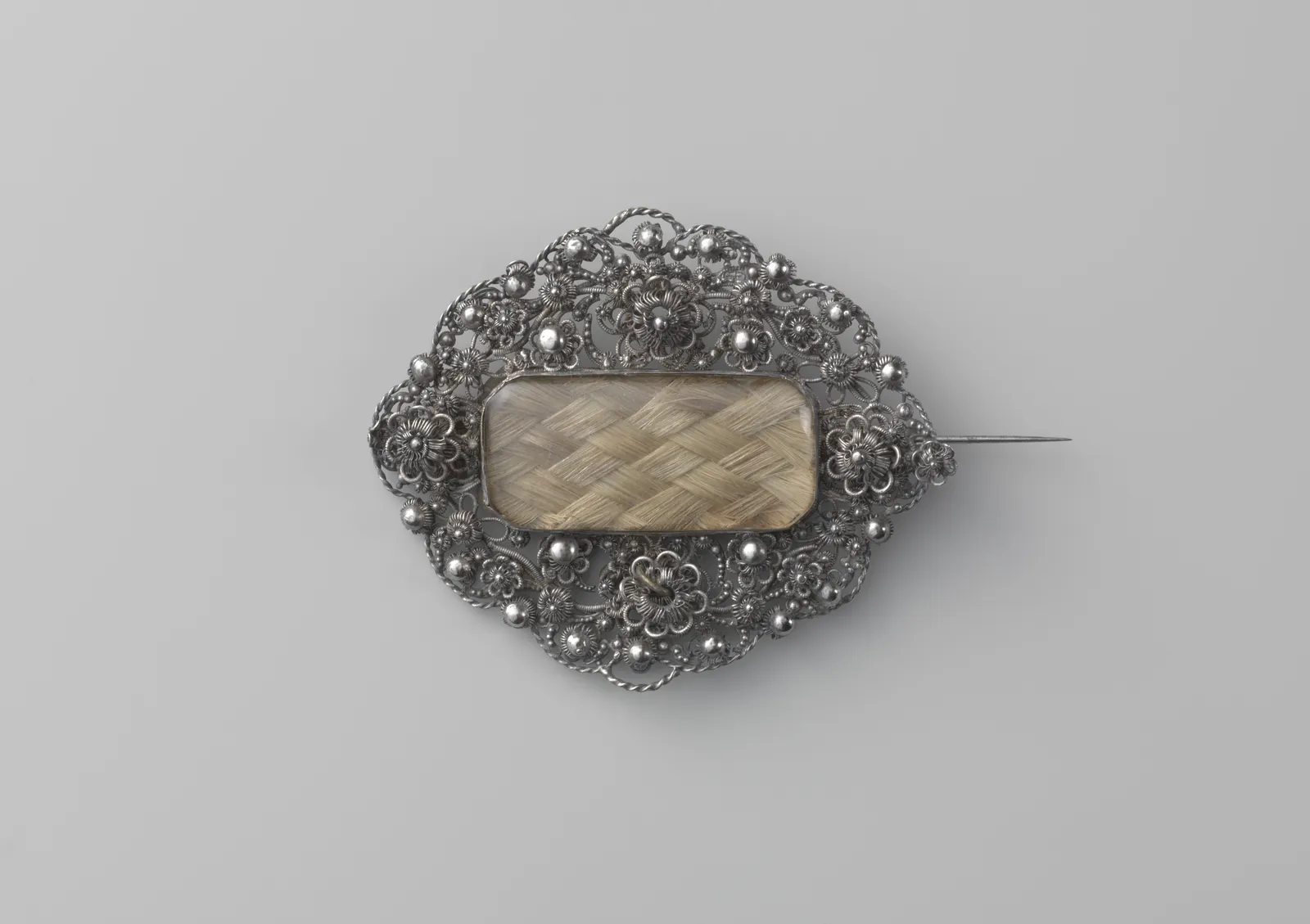
A silver brooch with braided hair under glass and a filigree border, Netherlands, about 1843 (Rijksmuseum, BK-NM-1120).
"Broche met haar van de dichteres Petronella Moens" by Unknown maker — https://commons.wikimedia.org/wiki/File:Broche_met_haar_van_de_dichteres_Petronella_Moens,_BK-NM-1120.jpg — CC0 1.0 (https://creativecommons.org/publicdomain/zero/1.0/)
Bobbins hang in a fringe around a small round table, each one tied to a strand of hair. That is the braiding table in Mark Campbell's Self-Instructor in the Art of Hair Work (1867), whose patterns turn hair into chains, rings and bracelets [1]. The braider lifted the strands across the table in a set order, around a mold at the center, while a weight below drew the braid down through a hole [1]. Not all hairwork needed a table: Alexanna Speight's The Lock of Hair (1871) lays hair flat on a palette and sets it on a tablet for a brooch or locket [2].
The brooch above holds hair laid flat under glass. The Rijksmuseum dates it to about 1843 and records braided hair under a rectangular piece of glass; its title names the hair as that of the poet Petronella Moens [3]. Neither manual describes a surviving piece. So each object here is described from its own museum record or, for one bracelet, its Commons file page.
Campbell's table was a round cover on a stand, turning on a cap "for the convenience of the braider" [1]. Each strand, a counted bundle of hairs, was tied to a bobbin and laid across the cover over marked numbers [1]. A mold of wire or wood was tied at the center, and under the table a weight fastened to the strands' joined ends drew the braid down through a central hole as it grew [1]. Too heavy a weight makes the braid loose and too light a weight leaves it rough, Campbell warns [1].
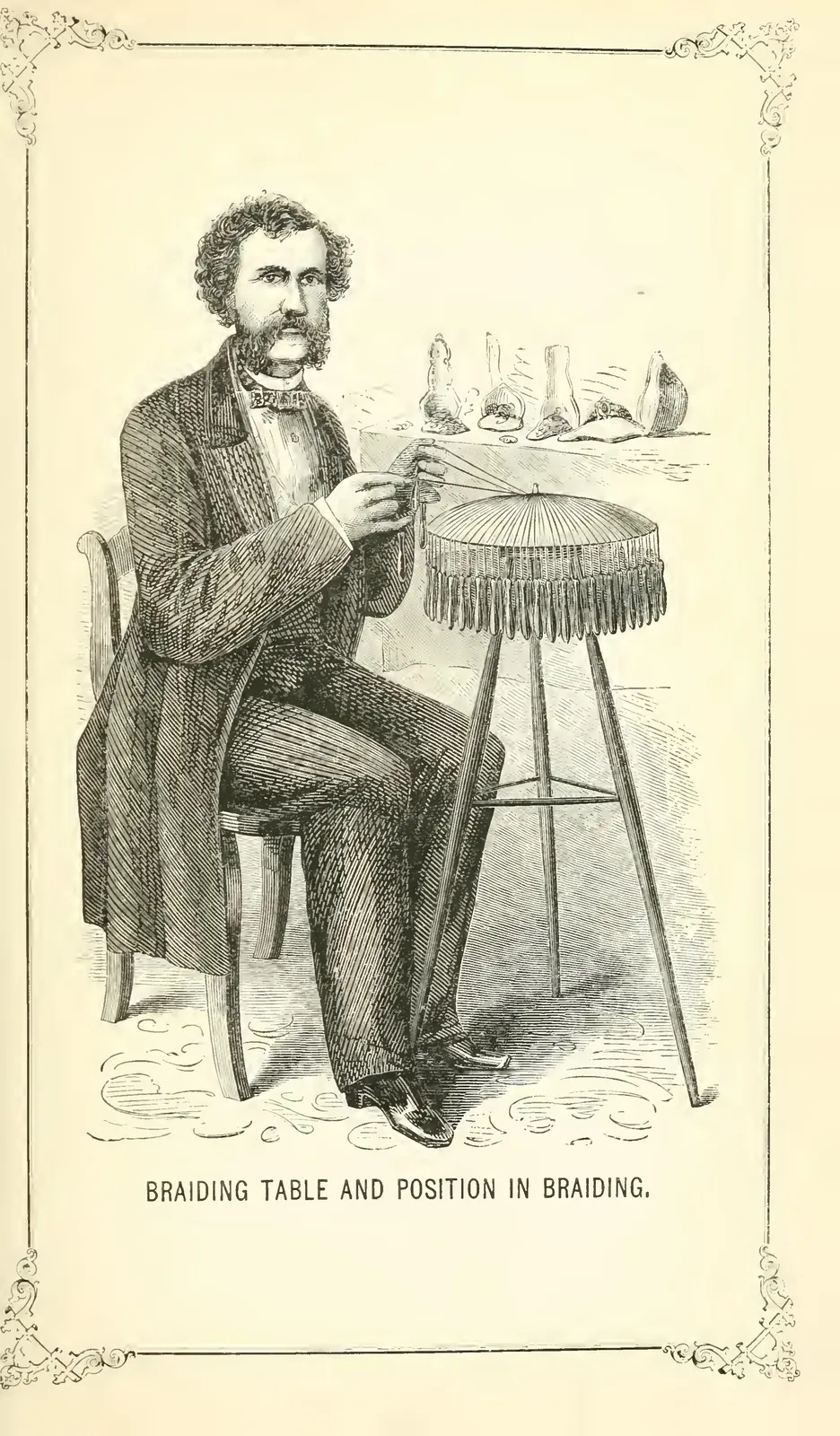
"Braiding Table and Position in Braiding," a plate in Campbell's 1867 manual: bobbins hang around the edge of a round table on a stand.
"Braiding Table and Position in Braiding, from Mark Campbell, Self-Instructor in the Art of Hair Work (1867)" by Unknown engraver, Public domain
"Braiding Table and Position in Braiding, from Mark Campbell, Self-Instructor in the Art of Hair Work (1867)" by Unknown engraver — https://commons.wikimedia.org/wiki/File:Self-instructor_in_the_art_of_hair_work,_dressing_hair,_making_curls,_switches,_braids,_and_hair_jewelry_of_every_description_(IA_selfinstructorin00camp).pdf — Public domain (plate in Mark Campbell's Self-Instructor in the Art of Hair Work, published New York and Chicago 1867, engraver not named; US: published before 1931 (file page tag PD-US-expired); EU: anonymous engraving published more than 70 years ago, file page also tags PD-old-100-expired; the compiler's death year is not verified); modified: page 129 of the 288-page PDF taken out as a single image, the whole page at 400 dpi; not cropped; colours not altered
The first pattern in the manual, the square chain braid, takes 16 strands of 80 hairs, four at each of four stations, A to D [1]. His text gives one round:
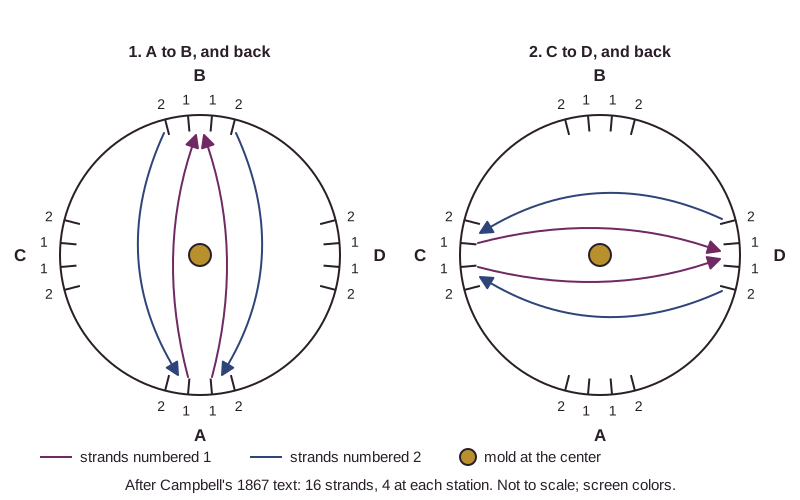
Wider than a phone screen: swipe sideways along the diagram, or open it full size.
One round of Campbell's square chain braid from above: the 1s cross from A to B, the 2s return, then C and D trade. Drawn from his text; screen colors.
Diagram: Tailor, Weaver, Jeweler, Dyer, CC BY 4.0
"One round of Campbell's square chain braid, top view" by Tailor, Weaver, Jeweler, Dyer, from https://tailorweaverjewelerdyer.com/jewelry/victorian-hair-jewelry/. Licensed under CC BY 4.0: https://creativecommons.org/licenses/by/4.0/
Data: Moves as described by Mark Campbell, Self-Instructor in the Art of Hair Work (1867), p. 9, Project Gutenberg eBook #38658 (public domain); drawn for this page
In Campbell's directions, a finished braid comes off the weights, is boiled on its mold, dried in a hot oven and slipped onto a cord, elastic if wanted [1]. Anything to be worn as jewelry should then be mounted in gold, he says [1].
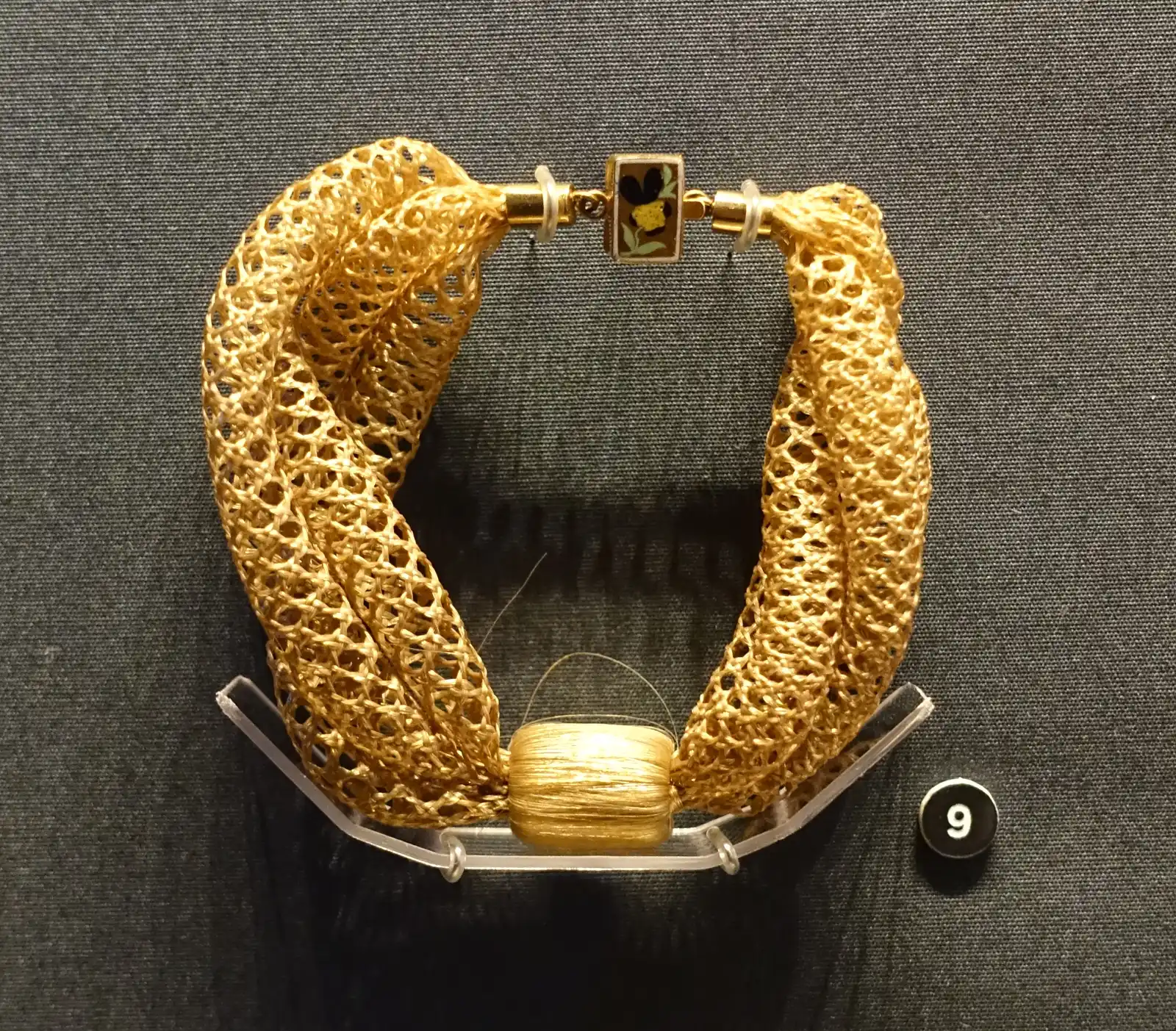
Two open, hollow braids twisted into a bracelet with an enamel clasp. The Commons file page records them as human hair, in the Nordiska museet, Stockholm, with a clasp made in Karlstad in 1863; not checked with the museum.
"Bracelet, Nordiska museet, Stockholm (photograph DSC09720)" by Daderot — https://commons.wikimedia.org/wiki/File:Bracelet,_clasp_made_in_Karlstad,_1863,_hair_from_three_siblings,_human_hair,_gold,_enamel_-_Nordiska_museet_-_Stockholm,_Sweden_-_DSC09720.JPG — CC0 1.0 (https://creativecommons.org/publicdomain/zero/1.0/)
Speight spreads a cleaned lock on a palette with a knife, curls it with heated irons, fixes each curl with gum and leaves it under a weight for about an hour [2]. Three curls, one turned left and two right, make the Prince of Wales' feather, gummed to an ivory or opal tablet and finished with gold work and pearls [2].
Speight's basket plait weaves strips of gold-beaters' skin, each covered with hair, over and under one another; the plait is pressed flat, cut to shape and set in a brooch [2]. The braid under the Rijksmuseum brooch's glass looks like such a plait, though its record does not say how it was made [3]. Campbell adds hair flowers, cut into leaves and buds once treated with gum tragacanth [1].
The brooch below, catalogued by the Wellcome Collection under the subjects Victorian and British, shows locks laid flat under glass; its record gives no date [4].
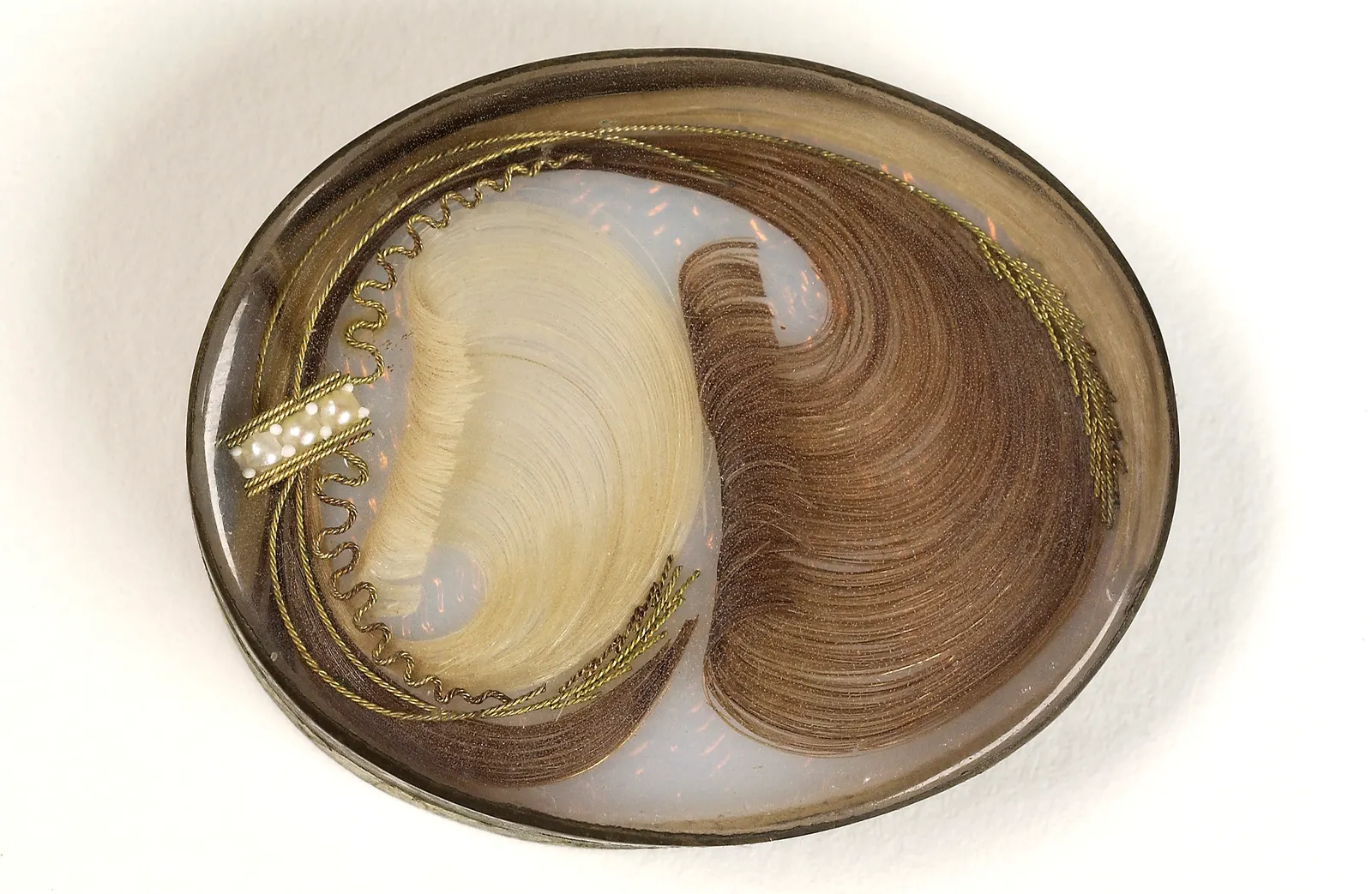
Two locks laid flat in curved plumes under glass, in a brooch the Wellcome Collection catalogues as a mourning brooch with the hair of a deceased relative (A642443).
"Mourning brooche containing the hair of a deceased relative" by Wellcome Collection — https://commons.wikimedia.org/wiki/File:Mourning_brooche_containing_the_hair_of_a_deceased_relative._Wellcome_L0036167.jpg — CC BY 4.0 (https://creativecommons.org/licenses/by/4.0/)
This site reads jewelry from the back, since a setting often tells more about when and by whom a piece was made than the front does. A sealed hair brooch makes that hard. In the general construction drawn below, the hair lies on its tablet between the glass and a solid back, the metal wall is pushed over the glass edge, and the hinge, pin and catch sit outside.
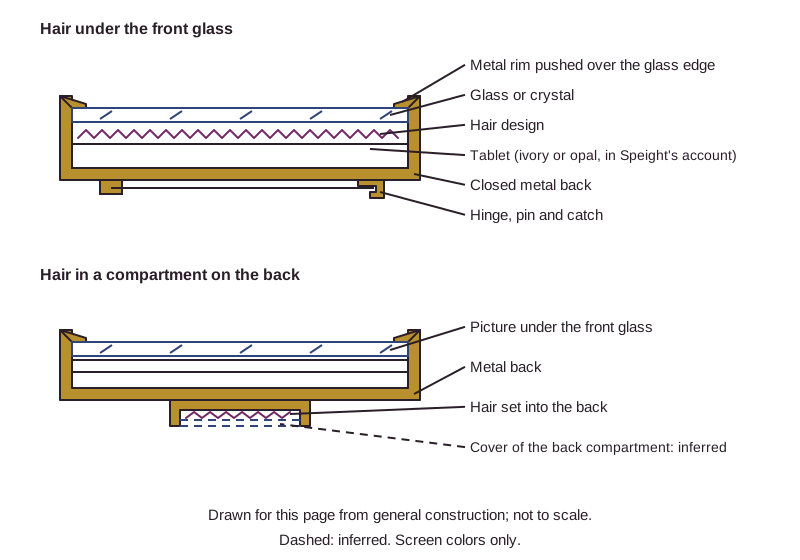
Wider than a phone screen: swipe sideways along the diagram, or open it full size.
A hair brooch in section, drawn from general construction: glass, hair, tablet and closed back; below, a back with its own hair compartment. Dashed: inferred.
Diagram: Tailor, Weaver, Jeweler, Dyer, CC BY 4.0
"A hair brooch in section, front and back" by Tailor, Weaver, Jeweler, Dyer, from https://tailorweaverjewelerdyer.com/jewelry/victorian-hair-jewelry/. Licensed under CC BY 4.0: https://creativecommons.org/licenses/by/4.0/
Data: Drawn for this page from general construction; tablet as described by Alexanna Speight, The Lock of Hair (1871), public domain; hair on the back as recorded by the Art Institute of Chicago (1958.410, CC0) and the Walters Art Museum (38.567)
Some backs hold hair too. The Walters Art Museum describes a brooch of 1840–1849 with a small oval frame holding a strand of hair, set into its engraved reverse [5]. The Art Institute of Chicago lists a 1790 miniature by James Peale with human hair on the back [6]. Neither record says whether that compartment is glazed, so the drawing marks its cover as inferred.
The back can also carry a name. The Walters records H.M. Corbin inscribed on the back of each shell cameo in a necklace of the 1860s, catalogued as a cameo pendant [7], a different construction covered in cameo jewelry. A closed-back ring keeps what lies behind its stone out of sight in the same way, and the ring settings entry shows the colored foil that Cellini's account places there.
Speight alleges that the hair in a commissioned piece was not always the customer's own. The 1871 preface says it appeared "not to suit the purpose of professional hair workers to work up, in all cases, the materials entrusted to them," so the book teaches readers to do the work themselves [2]. Campbell's preface makes a similar promise: people who braid a dead relative's hair with their own hands can know it is "the actual hair" of the person they lost [1].
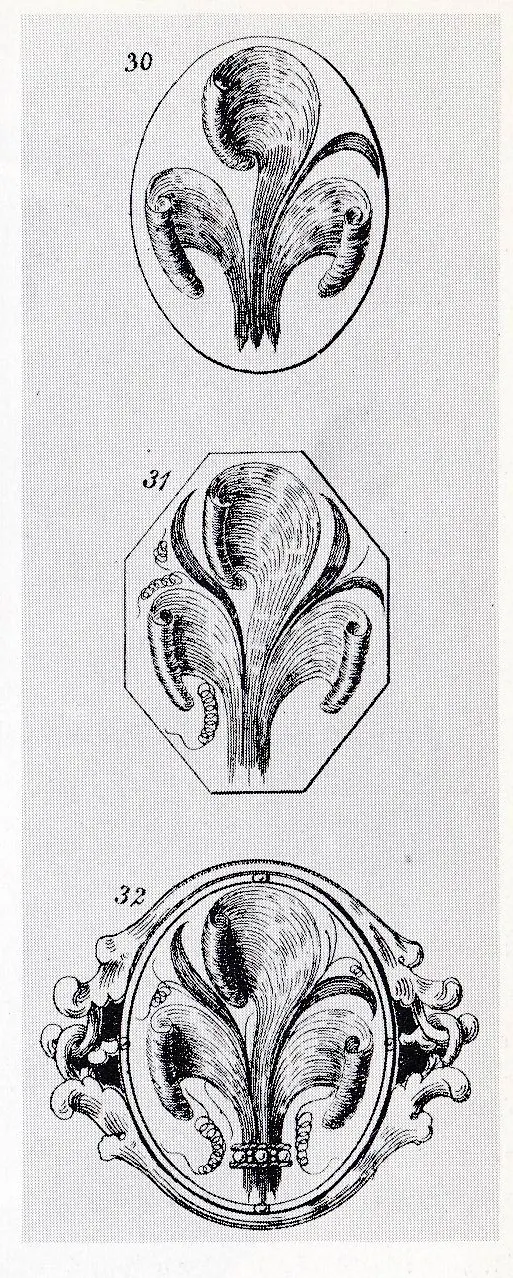
A plate from Speight's 1871 book: the three-curl feather in an oval (30), with coiled sprays added (31), and set in a brooch mount (32).
"Plate from The Lock of Hair (1871): Prince of Wales' feather designs" by Unknown engraver, Public domain
"Plate from The Lock of Hair (1871): Prince of Wales' feather designs" by Unknown engraver — https://commons.wikimedia.org/wiki/File:Prince_of_wales_Locke.jpg — Public domain (engraver not named, published in London in 1871 in Alexanna Speight's The Lock of Hair; US: published before 1931; EU: anonymous work published more than 70 years ago (the author's death year is not verified); file page template PD-Art (PD-old-70))
Campbell, who also sold hair goods, writes that nearly all the hair retailed in the United States was imported from Europe [1]. This page does not try to tell one person's hair from another's.
The period sources name mourning as one use of hair jewelry, not the only one. Speight's closing page hopes the book will preserve "a memento of friendships cemented in youth" and call to mind locks "that death has long claimed for his own" [2]. Campbell calls hair jewelry beautiful "either as an ornament or memento" [1].
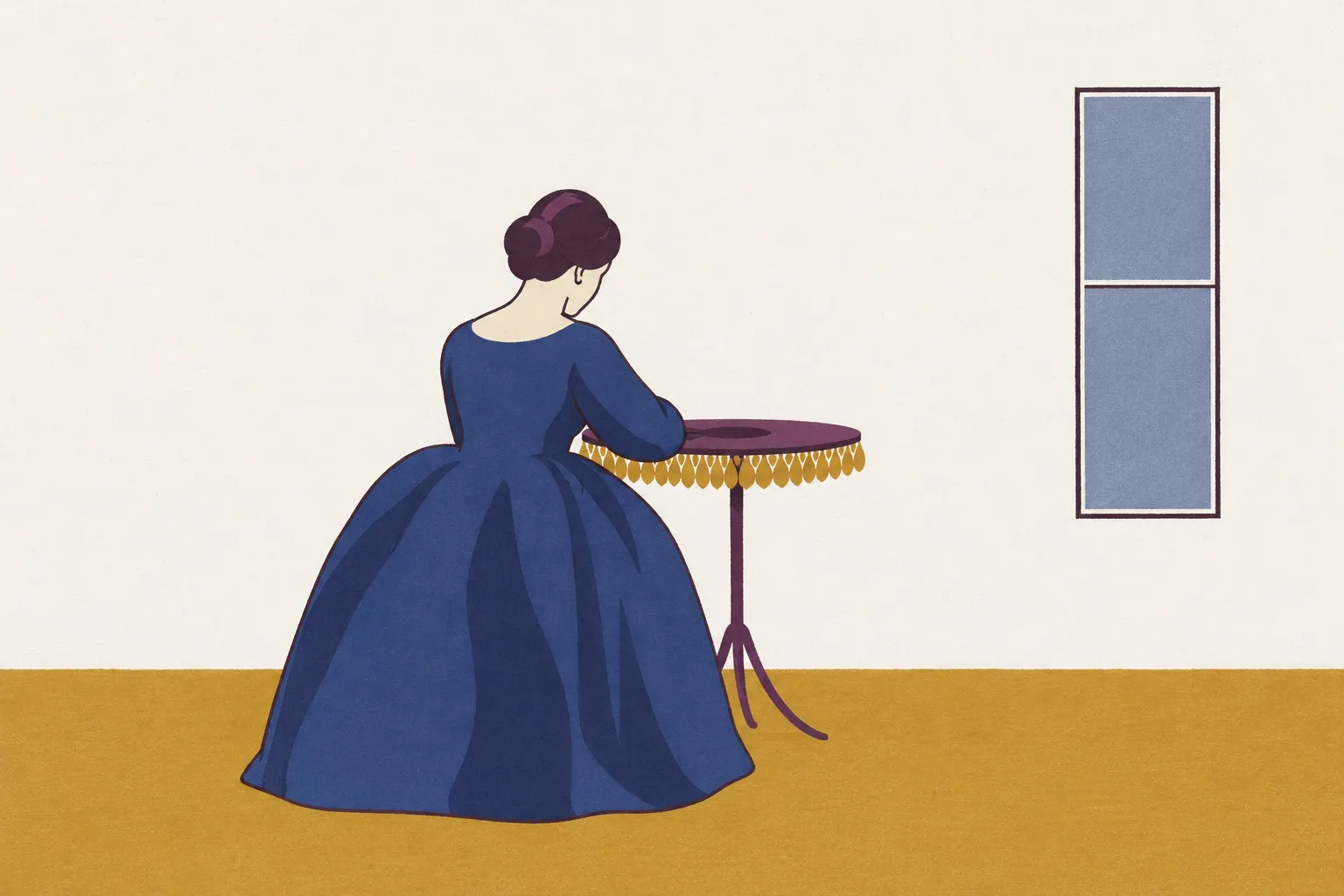
A woman, seen from behind, braids hair at a round table with bobbins hanging from its edge.
Illustration: Tailor, Weaver, Jeweler, Dyer. Generated schematic image — not a photograph or historical record. Reuse terms: may be shared with this full caption and a link to the source page; not licensed under CC BY.
Speight adds that hair designs were usually mounted in the black enamelled gold used for mourning, and suggests plain or burnished gold instead [2]. The Met's memorial brooch of about 1795 is "watercolor and hair pigment on ivory," painted with an urn on a plinth lettered with a June 1795 date [8]. The Walters dates a snake-shaped bracelet of human hair to about 1840–1850 and reads the snake as a sign of eternity and commitment [9].
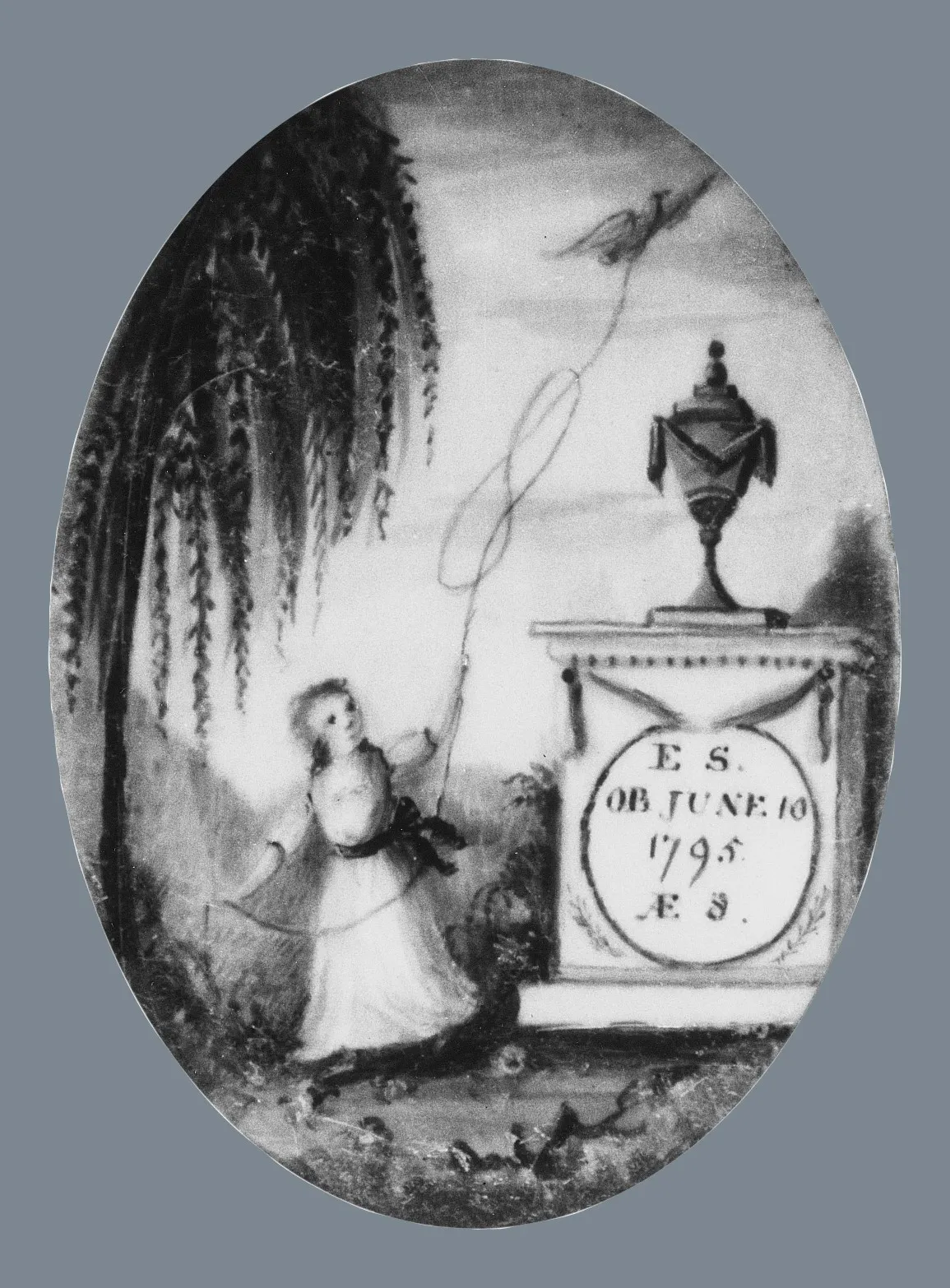
A memorial brooch, United States, about 1795: watercolor and hair pigment on ivory in a gold locket (The Met, 32.134.2). Only the painted ivory is shown.
"Memorial Brooch" by Unknown maker — https://commons.wikimedia.org/wiki/File:Memorial_Brooch_MET_ap32.134.2.jpg — CC0 1.0 (https://creativecommons.org/publicdomain/zero/1.0/)
Tailor, Weaver, Jeweler, Dyer. “Victorian Hair Jewelry: Braided on a Table, or Laid Flat.” Published 27 October 2026. https://tailorweaverjewelerdyer.com/jewelry/victorian-hair-jewelry/. Accessed: add the date you read it.
Facts here carry numbered links to the sources listed above. How entries are checked: Weighing the Evidence: How This Site Checks Facts. Every substantive change is dated on Corrections. Spotted a mistake or have a better source? Contact and Correspondence.
"Stirrup Ring" by Unknown maker — https://commons.wikimedia.org/wiki/File:Stirrup_Ring_MET_DP701987.jpg — CC0 1.0 (https://creativecommons.org/publicdomain/zero/1.0/)
"Cameo" by George W. Jamison; William Rose — https://commons.wikimedia.org/wiki/File:Cameo_MET_DP167073.jpg — CC0 1.0 (https://creativecommons.org/publicdomain/zero/1.0/)

