


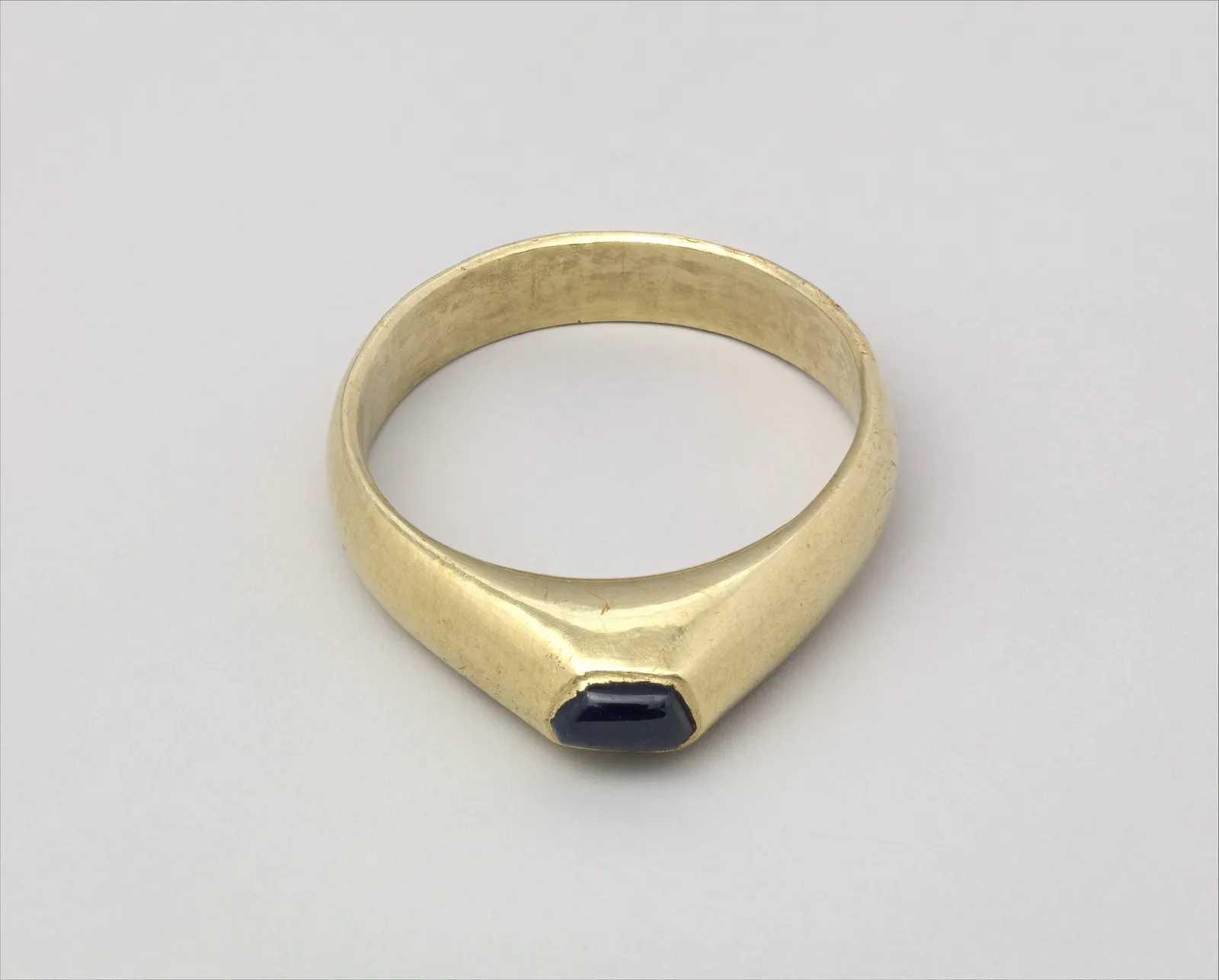
Picture credit
"Stirrup Ring" by Unknown maker — https://commons.wikimedia.org/wiki/File:Stirrup_Ring_MET_DP701987.jpg — CC0 1.0 (https://creativecommons.org/publicdomain/zero/1.0/)
By Tailor, Weaver, Jeweler, Dyer Published
Build card
This card as data: cameo-build-card.csv (CSV) · file notes (JSON): where the values come from, version and license
Data: The Metropolitan Museum of Art Open Access data (CC0): 2000.562, 1982.60.392; Walters Art Museum catalogue data (CC0): 42.1193, 42.210, 2008.5.8, 48.2387; Art Institute of Chicago collection data (CC0): 1992.297, 1962.450; Yale Center for British Art collection data (CC0): B2001.2.361; Josiah Wedgwood, Catalogue of Cameos, Intaglios, Medals, Bas-Reliefs, Busts and Small Statues, sixth edition (Etruria, 1787), public domain (facts restated); R. E. Raspe, A Descriptive Catalogue of a General Collection of Ancient and Modern Engraved Gems, cast by James Tassie (London, 1791), public domain (facts restated)
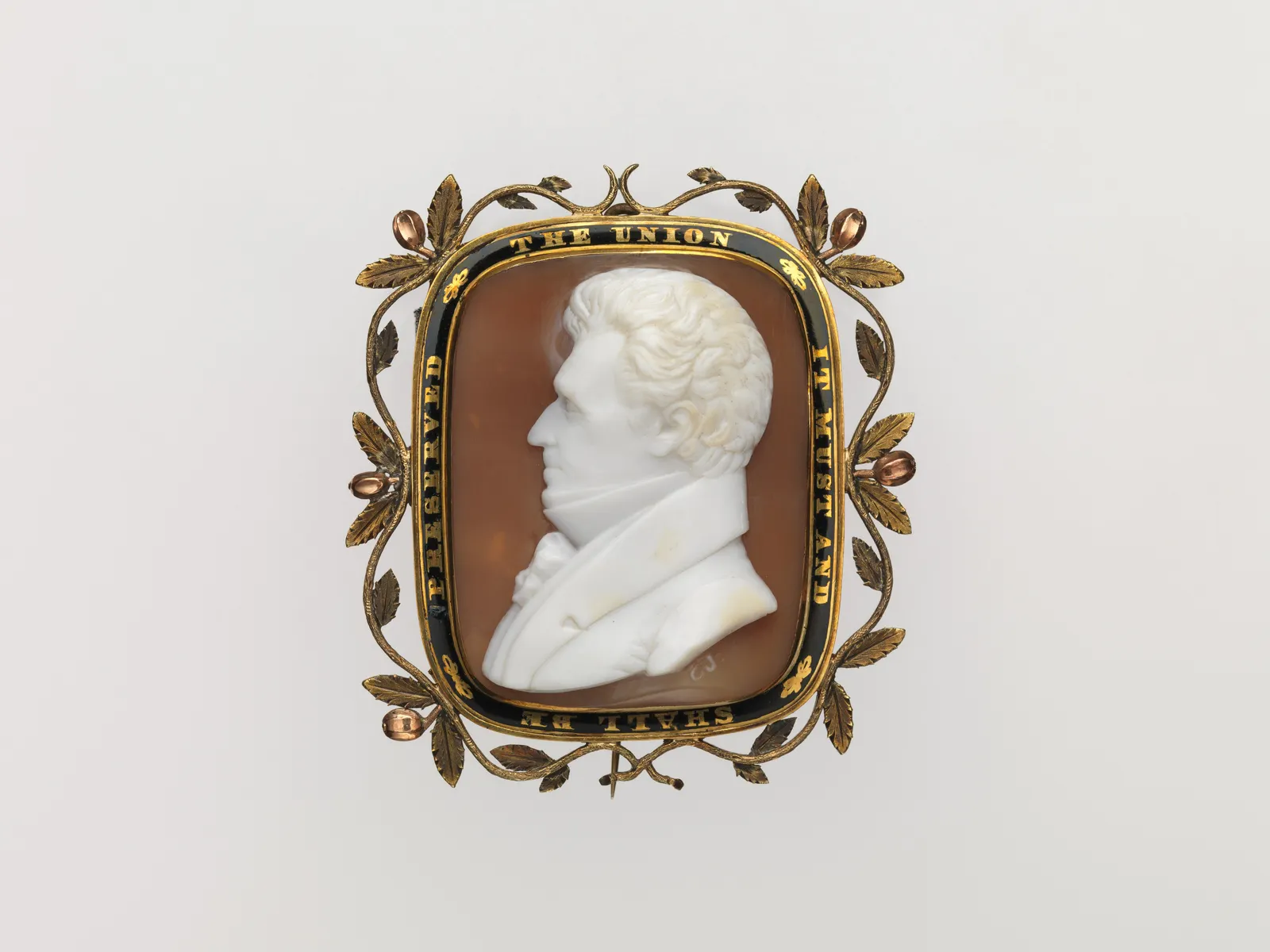
A shell cameo brooch, American, about 1835: a white profile portrait on a brown ground, framed in gold with a black enamel band lettered THE UNION IT MUST AND SHALL BE PRESERVED (The Met, 2000.562).
"Cameo" by George W. Jamison; William Rose — https://commons.wikimedia.org/wiki/File:Cameo_MET_DP167073.jpg — CC0 1.0 (https://creativecommons.org/publicdomain/zero/1.0/)
On a shell cameo of about 1835, a white profile rises from a brown ground [1]. The Metropolitan Museum of Art records the brooch as helmet-conch shell, gold, and enamel; the gold and enamel are its frame, so the portrait and the ground are one piece of shell in two colors [1]. A carved cameo works that way: the figure is left standing in relief, and in layered material the ground beneath it can be another color [2][3]. Josiah Wedgwood's jasper cameos, listed in his catalogue of 1787, put white figures on colored grounds by another route, with models and moulds [4].
A cameo's figure stands above its ground. Wedgwood's catalogue calls such work "raised figures" [4]. In layered stone, figure and ground can also differ in color. The Art Institute of Chicago describes its Roman cameo of Tiberius, dated 14–37, as cut from a stone banded brown and white, so the emperor shows up against the dark ground; its record names the stone as sardonyx [2].
Shell gives the same result. The Walters Art Museum catalogues a battle-scene cameo of about 1550–1575 simply as "carved shell" [3], and on The Met's brooch the white portrait stands on a brown ground of the same helmet-conch shell [1]. By 1791 at least one shell cameo had been cast as a copy: Rudolf Erich Raspe's catalogue of James Tassie's casts lists "A Shell Cameo" from Tassie's own collection, no. 4348 [5].
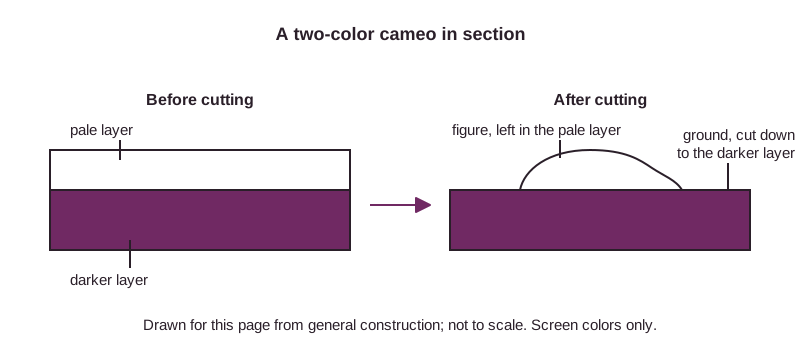
Wider than a phone screen: swipe sideways along the diagram, or open it full size.
A two-color cameo in section, drawn from general construction: before cutting, a pale layer on a darker one; after, the figure stands in the pale layer and the ground is cut down to the darker one. Not to scale; screen colors.
Diagram: Tailor, Weaver, Jeweler, Dyer, CC BY 4.0
"A two-color cameo in section, before and after cutting" by Tailor, Weaver, Jeweler, Dyer, from https://tailorweaverjewelerdyer.com/jewelry/cameo/. Licensed under CC BY 4.0: https://creativecommons.org/licenses/by/4.0/
Data: Drawn for this page from general construction; the two-layer principle as described by the Art Institute of Chicago for cameo 1992.297
In the drawing the cut stops where the two layers meet, so the figure's outline is also the edge of the pale layer.
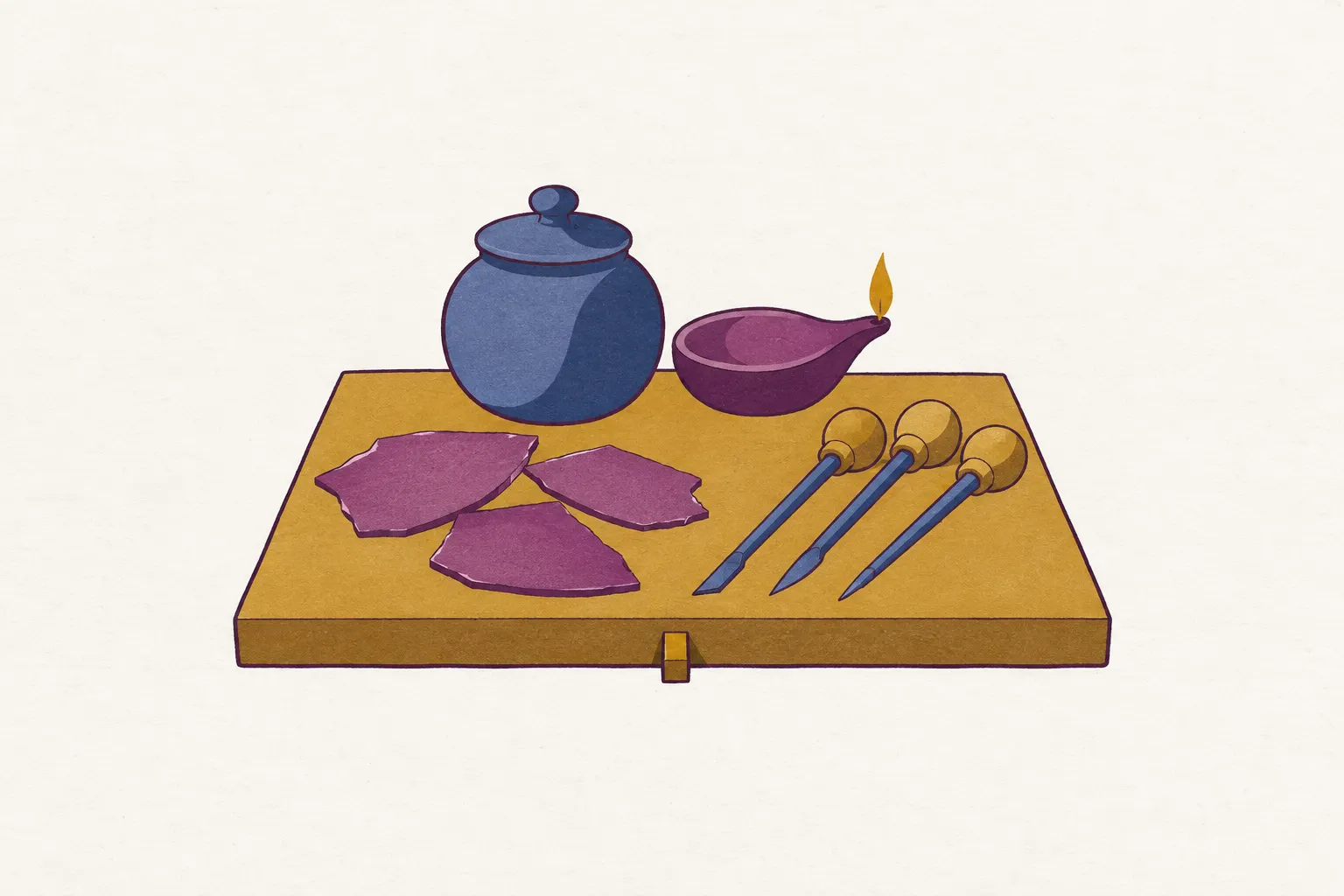
A cameo carver's bench with shell blanks and gravers, before any figure is cut.
Illustration: Tailor, Weaver, Jeweler, Dyer. Generated schematic image — not a photograph or historical record. Reuse terms: may be shared with this full caption and a link to the source page; not licensed under CC BY.
The records read for this page name shell, layered stone, two kinds of Wedgwood ware and glass paste. The Met's satyr head, probably Italian and of the late 18th or early 19th century, is sardonyx in a gold mount [6]. The Walters records a cameo of 1870 after Ingres's La Source as onyx, "white on black" [7].
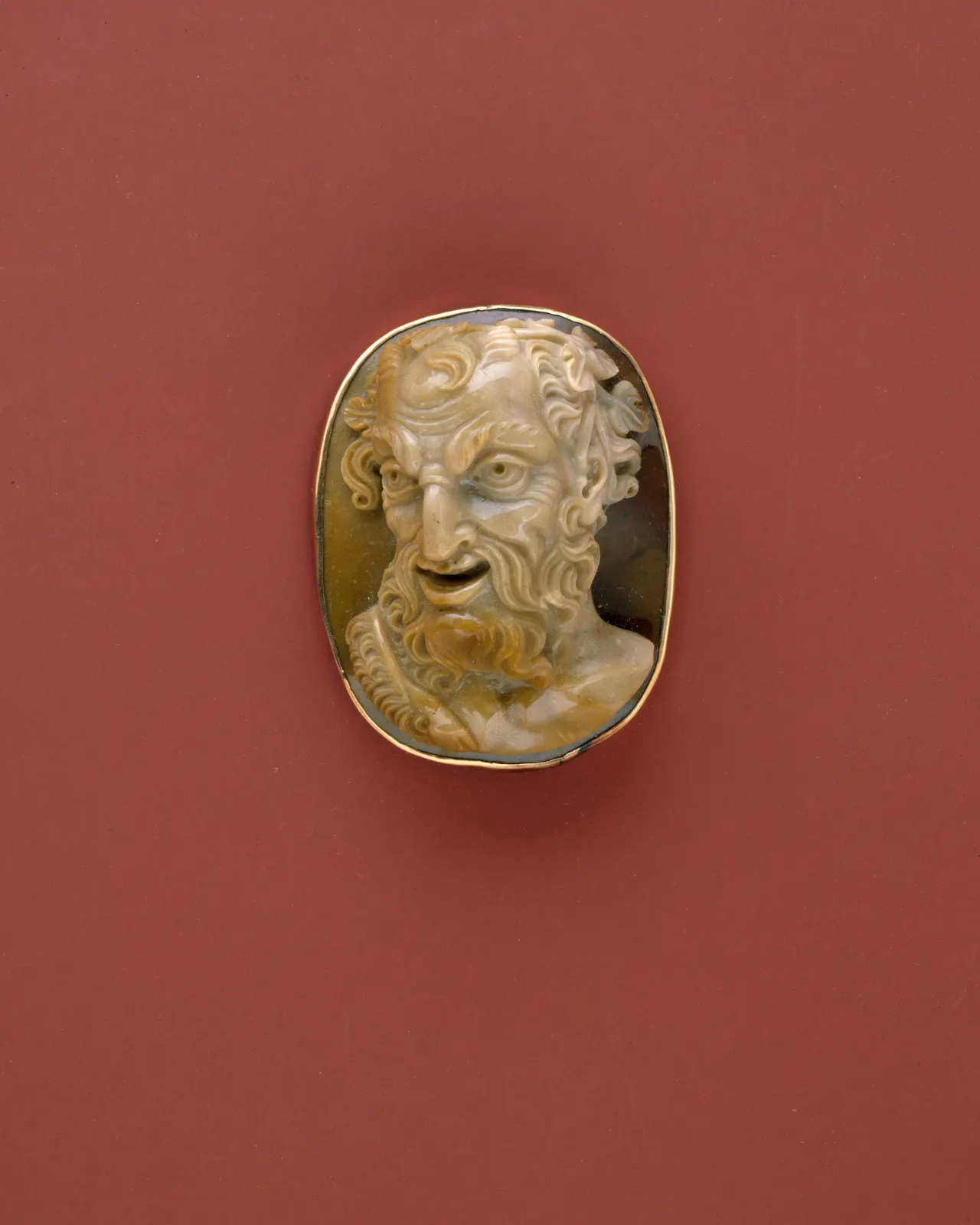
A satyr's head in sardonyx, probably Italian, late 18th or early 19th century, in a gold rim: the pale head stands in high relief on a darker ground (The Met, 1982.60.392).
"Cameo with the Head of a Satyr" by Unknown maker — https://commons.wikimedia.org/wiki/File:Cameo_with_the_Head_of_a_Satyr_MET_DT7188.jpg — CC0 1.0 (https://creativecommons.org/publicdomain/zero/1.0/)
| Material, as recorded | How made, per the source | Example | Date |
|---|---|---|---|
| Helmet-conch shell, gold, and enamel | Not recorded | The Met 2000.562 [1] | circa 1835 |
| Carved shell | Carved, as recorded | Walters 42.1193 [3] | ca. 1550–1575 |
| Sardonyx with gold mount | Not recorded | The Met 1982.60.392 [6] | late 18th or early 19th century |
| Onyx, white on black | Not recorded | Walters 42.210 [7] | 1870 |
| Helmut-conch shell (so spelled), seed pearls, gold | Not recorded | Walters 2008.5.8 [8] | 1860–1869 |
| Stoneware (jasperware) | Models and moulds, per Wedgwood's 1787 catalogue [4] | Art Institute of Chicago 1962.450 [9] | Late 18th century |
| Black basalt ware | Not recorded | Walters 48.2387 [10] | late 18th century |
| Glass paste | Wax model, then moulded and cast, per Raspe 1791 [5] | Yale Center for British Art B2001.2.361 [11] | 1780 |
Not from a layered stone. The sixth edition of Wedgwood's catalogue, printed at Etruria in 1787, calls jasper "a white porcelain bisqué" that takes color "through its whole substance," so that "the ground may be made of any colour throughout, without paint or enamel, and the raised figures, of a pure white" (p. 2) [4]. Its cameos, it says, are "accurately taken from antique gems" and from the finest models modern artists could supply (p. 3) [4].
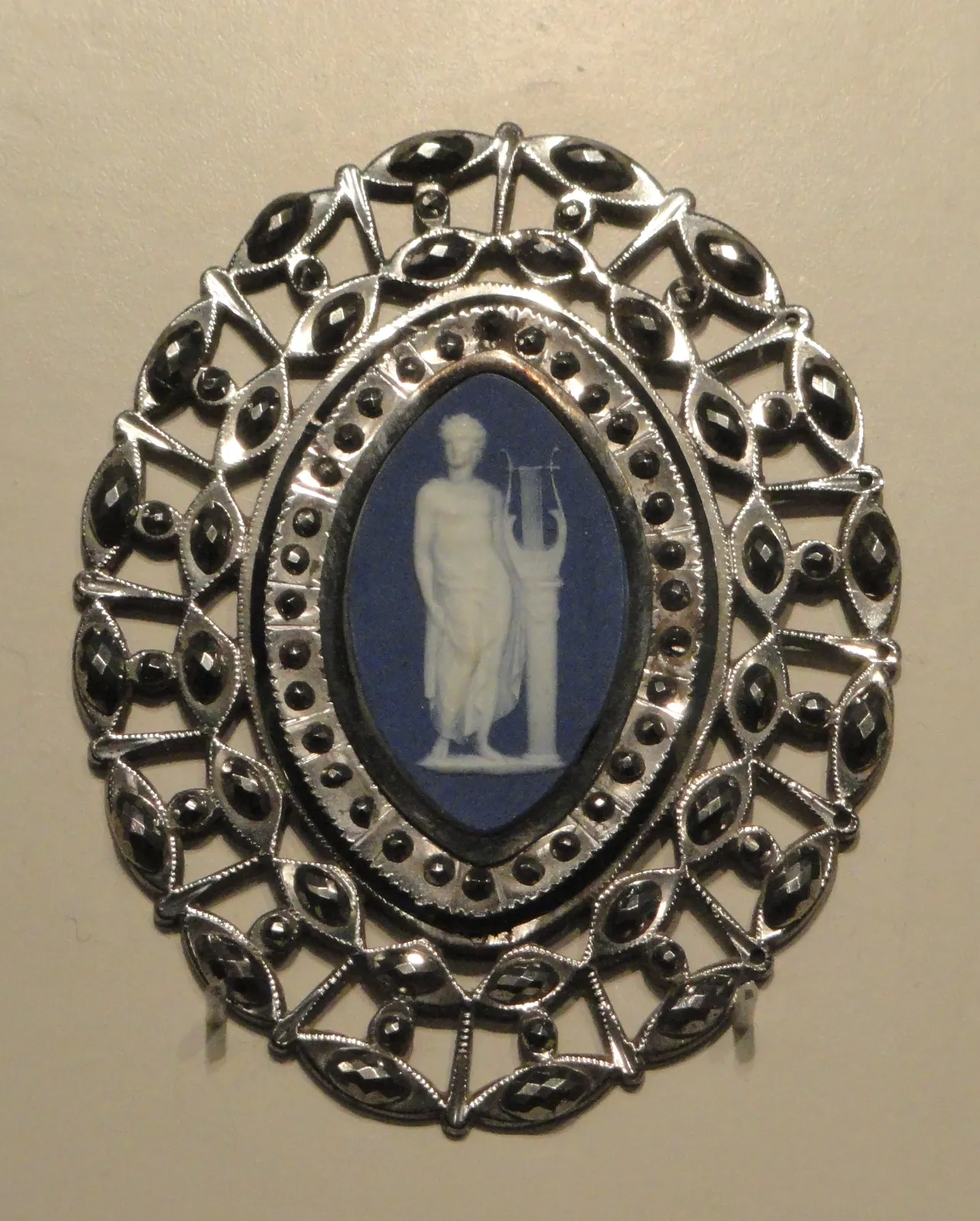
A white Apollo with a lyre on a blue ground, in an openwork frame set with faceted studs. The Art Institute of Chicago records it as Wedgwood jasperware in a cut steel frame, 1775/80 (1912.1239).
"Apollo, Art Institute of Chicago 1912.1239 (photograph DSC09827)" by Daderot — https://commons.wikimedia.org/wiki/File:Apollo,_1775-1780,_Wedgwood_Pottery,_Burslem,_solid_jasper_with_cut_steel_frame_-_Art_Institute_of_Chicago_-_DSC09827.JPG — CC0 1.0 (https://creativecommons.org/publicdomain/zero/1.0/)
For portraits "in bas relief, in the jasper with coloured grounds," the catalogue asks for models or moulds, with clay models "a fifth part larger than the figure required" (p. 56) [4]. Its closing pages, on ornamental wares generally, say that where a mould is used it "performs but a small part of the work," and undercutting and retouching "with the modelling tools" follow (p. 72) [4]. The 1787 edition falls within the years of women's dress worn in layers, about 1770–1800.
James Tassie got the look of a cameo from glass paste. Raspe's catalogue says Tassie modeled portraits "in Wax, and afterwards moulds and casts in Paste," which "entirely resemble Cameos," and it puts his casts of ancient and modern gems at "above 15,000 articles" (p. lx) [5].
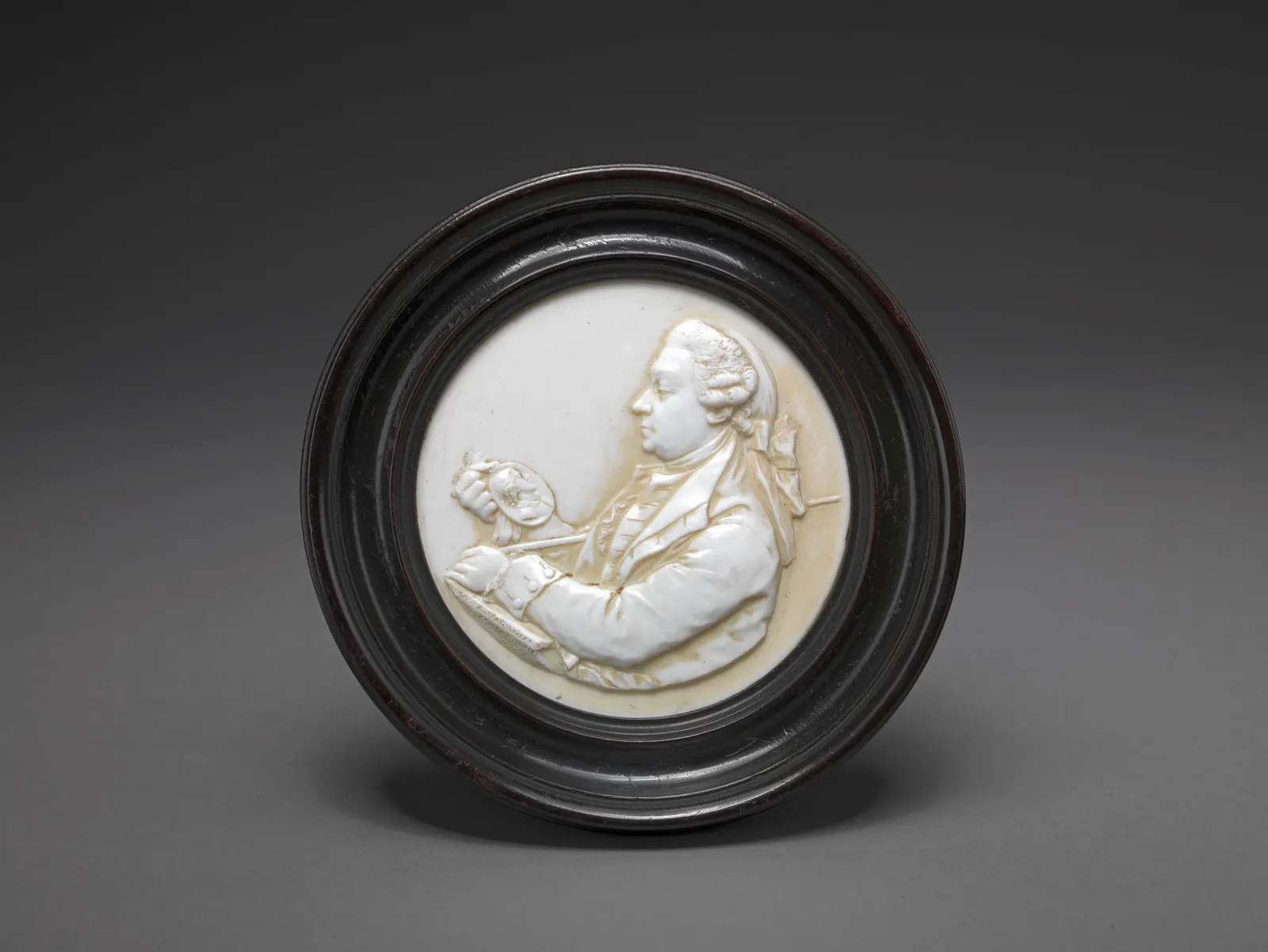
David Garrick by James Tassie, 1780, glass paste, in a round dark frame (Yale Center for British Art, B2001.2.361). Figure and ground are the same white.
"David Garrick" by James Tassie — https://commons.wikimedia.org/wiki/File:James_Tassie_-_David_Garrick_-_B2001.2.361_-_Yale_Center_for_British_Art.jpg — CC0 1.0 (https://creativecommons.org/publicdomain/zero/1.0/)
Two colors were the hard part to copy. Colored cameos, Raspe writes, "can never shew well" when taken in wax, sulphur, plaster or glass "of only one colour," and different glasses "do not well unite into different strata." Yet he says Mr. Reiffenstein, at Rome, made colored impressions that "can hardly be distinguished from the originals" (p. lvi) [5]. Tassie's Garrick is white on white [11].
An intaglio reverses the cut. Its design is sunk below a flat surface instead of rising from it. Wedgwood's catalogue describes jasper intaglios with "the intaglio part black, and the flat surface blue and highly polished," made to imitate black and blue onyx and "equally ornamental for rings as for seals" (p. 22) [4].
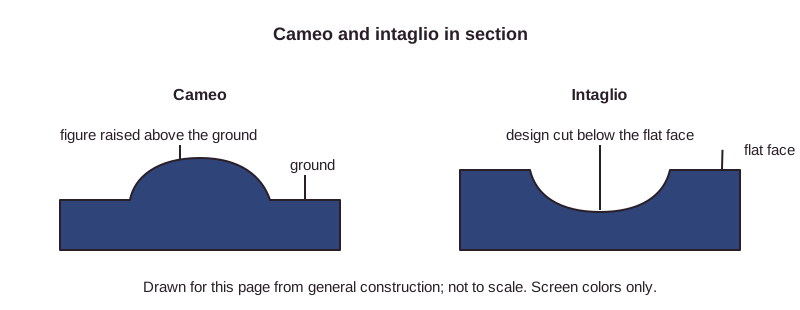
Wider than a phone screen: swipe sideways along the diagram, or open it full size.
Cameo and intaglio in section, drawn from general construction: the cameo's figure stands above its ground, and the intaglio's design is cut below the flat face. Not to scale; screen colors.
Diagram: Tailor, Weaver, Jeweler, Dyer, CC BY 4.0
"Cameo and intaglio in section" by Tailor, Weaver, Jeweler, Dyer, from https://tailorweaverjewelerdyer.com/jewelry/cameo/. Licensed under CC BY 4.0: https://creativecommons.org/licenses/by/4.0/
Data: Drawn for this page from general construction; the contrast as described in Josiah Wedgwood's catalogue, sixth edition (Etruria, 1787), pp. 2 and 22 (public domain)
| Feature | Cameo | Intaglio |
|---|---|---|
| Where the design lies | Raised above its ground | Cut below a flat surface |
| In Wedgwood's 1787 catalogue | Raised white figures on a ground colored throughout, p. 2 [4] | A black intaglio part under a flat, polished blue surface, p. 22 [4] |
| Uses the catalogue names | Rings, lockets, bracelets, snuff boxes, watch keys and chains, buttons, p. 3 [4] | Rings and seals, p. 22 [4] |
| Example on this page | The Met's shell cameo brooch, about 1835 [1] | The Met's Roman garnet ring, 1st century BC–1st century AD [12] |
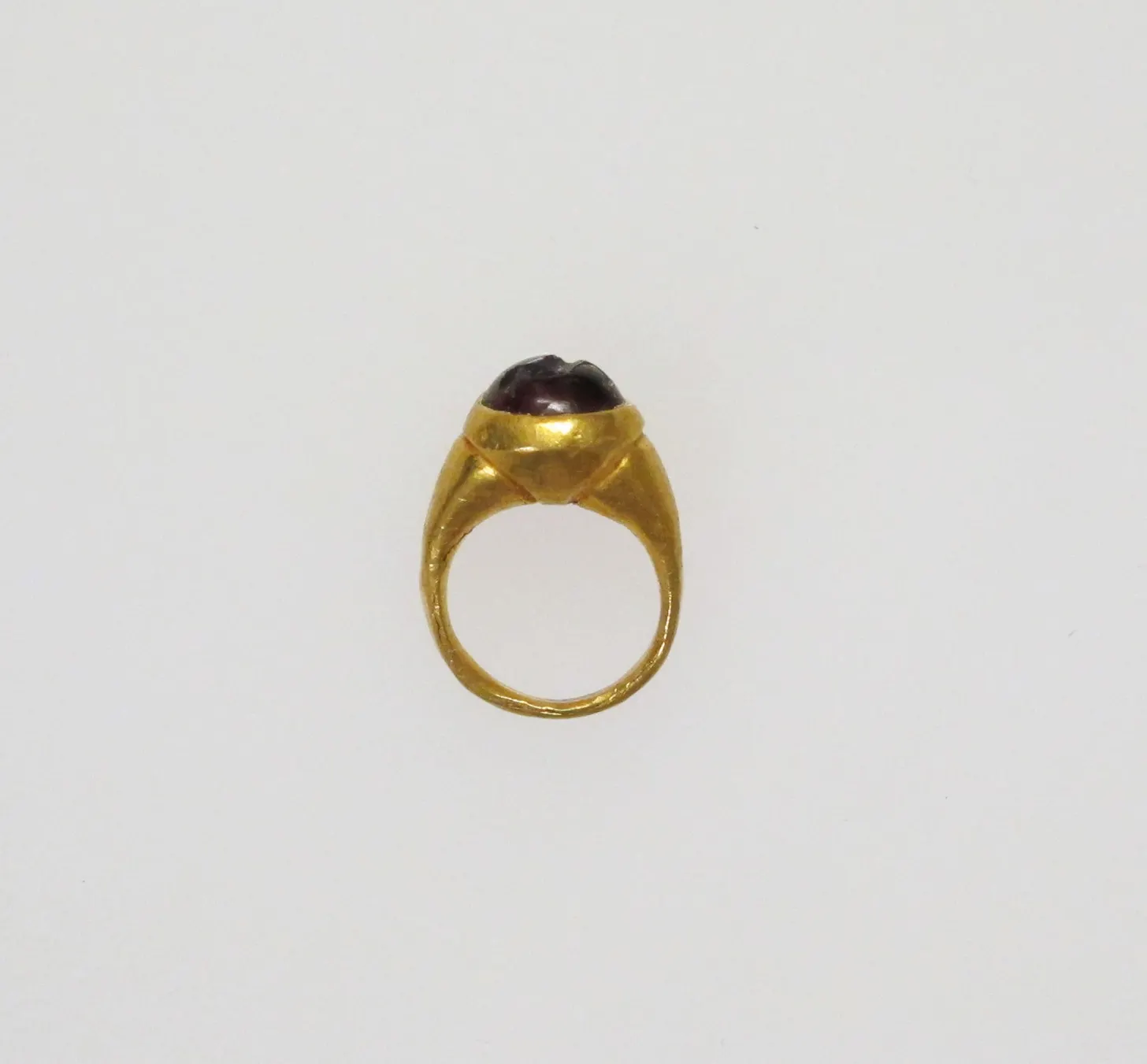
A Roman gold ring with a garnet, 1st century BC–1st century AD. The Met records an intaglio of a bird; from the side, the cut shows only as a notch in the stone (1992.263.10).
"Ring with intaglio of a bird" by Unknown maker — https://commons.wikimedia.org/wiki/File:Ring_with_intaglio_of_a_bird_MET_SF199226310.jpg — CC0 1.0 (https://creativecommons.org/publicdomain/zero/1.0/)
Wedgwood's catalogue says its cameos "are set in gold and steel mountings" (p. 3) [4]. Raspe says London jewelers "perhaps" first made Tassie's pastes fashionable "by setting them in rings, seals, bracelets, necklaces, and other trinkets" (p. lx) [5]. On The Met's brooch a gold rim holds the shell inside the lettered enamel band, and a border of gold leaves runs around the outside [1].
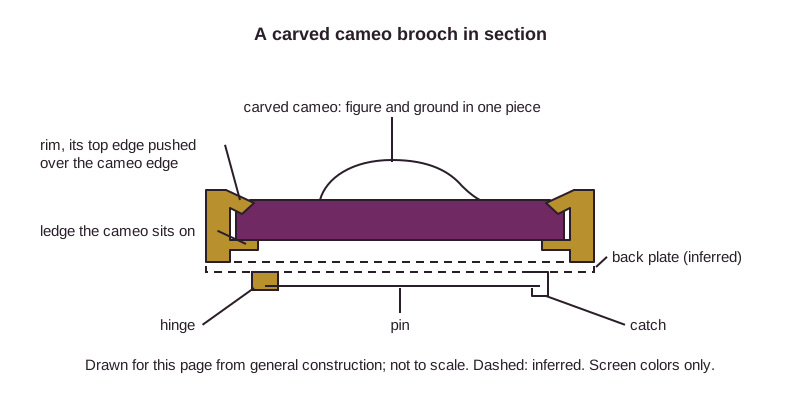
Wider than a phone screen: swipe sideways along the diagram, or open it full size.
A carved cameo brooch in section, drawn from general construction: the cameo sits on a ledge, the rim's top edge is pushed over its edge, and hinge, pin and catch sit on the back. Dashed: inferred. Not to scale; screen colors.
Diagram: Tailor, Weaver, Jeweler, Dyer, CC BY 4.0
"A carved cameo brooch in section" by Tailor, Weaver, Jeweler, Dyer, from https://tailorweaverjewelerdyer.com/jewelry/cameo/. Licensed under CC BY 4.0: https://creativecommons.org/licenses/by/4.0/
Data: Drawn for this page from general construction
In the drawing, as in a bezel setting on a ring, the rim's top edge leans over the edge of what it holds. The records read for this page do not say whether these brooches are closed behind the cameo, so the drawing marks the back plate inferred.
Since a setting often tells more than the front does about when and by whom a piece was made, this site reads jewelry from the back. The Walters records the name H.M. Corbin inscribed on the back of each of three shell cameos in a necklace of 1860–1869, catalogued as a cameo pendant [8]. It also records a maker's mark, "Wedgwood & Bentley," on the reverse of a black basalt cameo lettered Addison [10].
Tailor, Weaver, Jeweler, Dyer. “Cameo Jewelry: In Shell Cameos, Figure and Ground Are One.” Published 27 October 2026. https://tailorweaverjewelerdyer.com/jewelry/cameo/. Accessed: add the date you read it.
Facts here carry numbered links to the sources listed above. How entries are checked: Weighing the Evidence: How This Site Checks Facts. Every substantive change is dated on Corrections. Spotted a mistake or have a better source? Contact and Correspondence.
"Stirrup Ring" by Unknown maker — https://commons.wikimedia.org/wiki/File:Stirrup_Ring_MET_DP701987.jpg — CC0 1.0 (https://creativecommons.org/publicdomain/zero/1.0/)
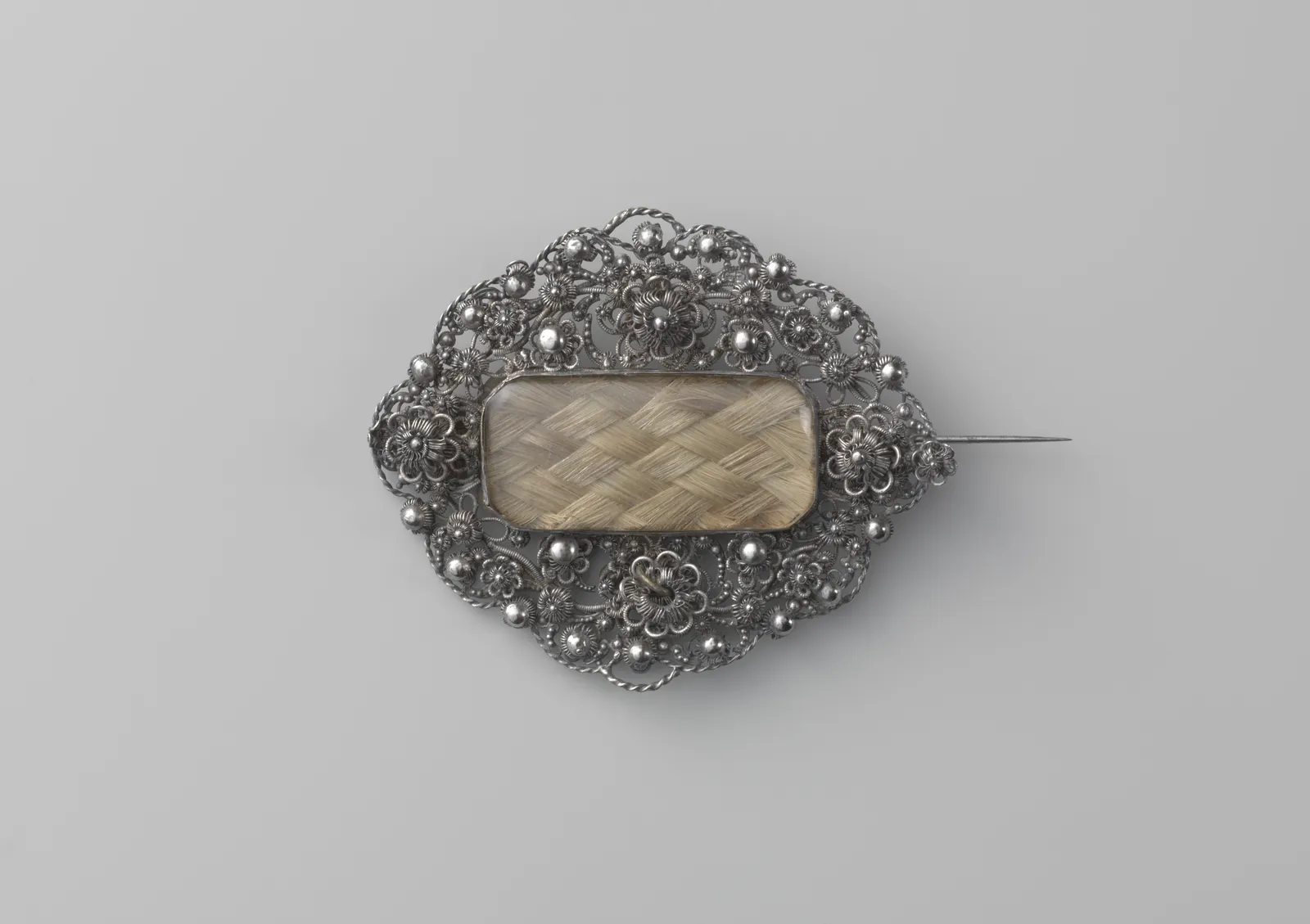
"Broche met haar van de dichteres Petronella Moens" by Unknown maker — https://commons.wikimedia.org/wiki/File:Broche_met_haar_van_de_dichteres_Petronella_Moens,_BK-NM-1120.jpg — CC0 1.0 (https://creativecommons.org/publicdomain/zero/1.0/)

