Ring Settings: Cellini's Closed Backs Hid Colored Foil
By Tailor, Weaver, Jeweler, DyerPublished
Index summary This index cuts open six ring settings, from bezel to gypsy, in cross-sections drawn for this page from general construction and Cellini's account, with one museum ring in two photographs.
Setting
What holds the stone
Back
Example on this page
Bezel
A metal wall pushed over the stone's widest edge (the girdle) all round
Open or closed
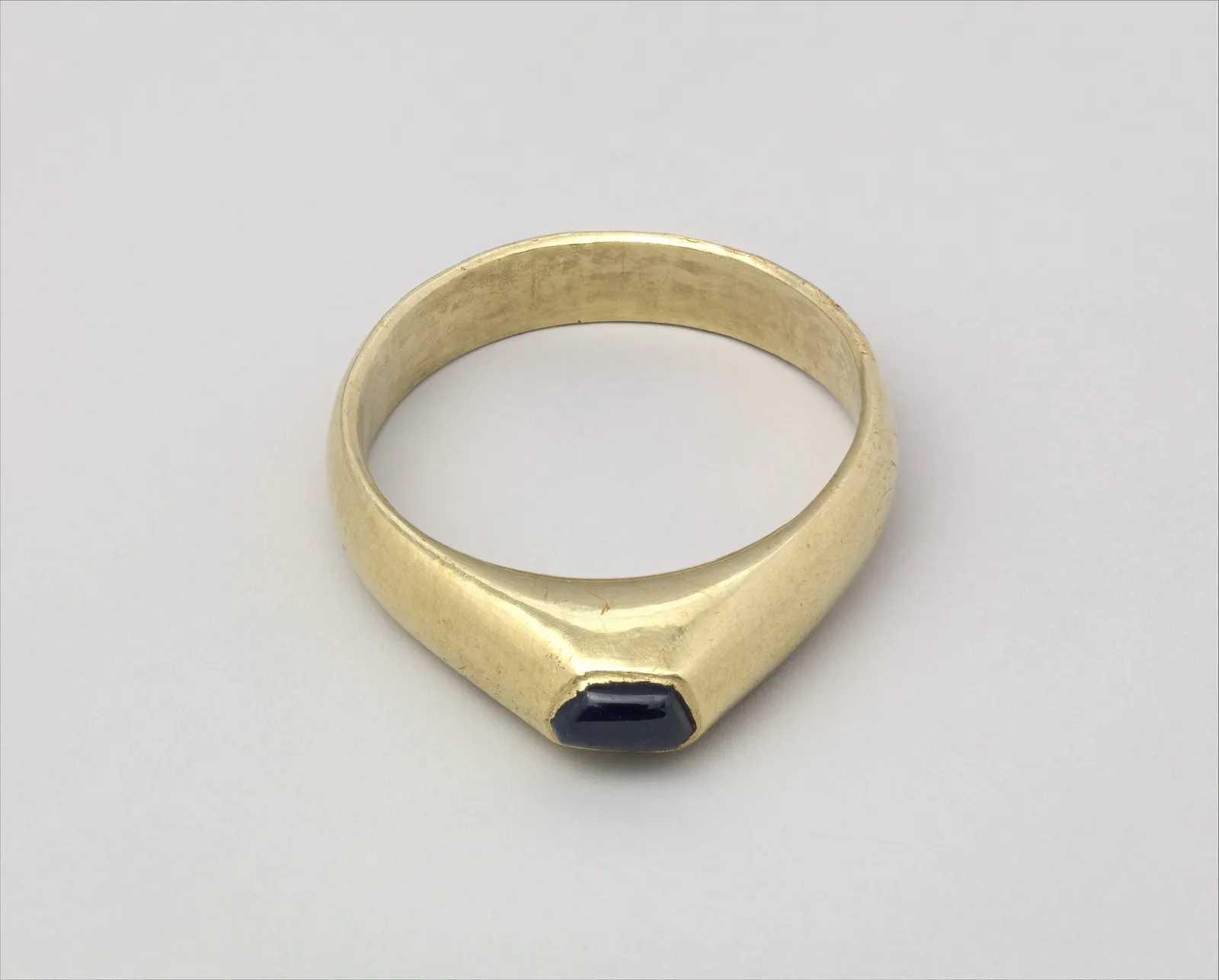
The Met 2015.697 stirrup ring, two photographs
Prong
Notched claws with their tips bent over the stone
Open between the prongs
Cross-section
Closed back
A bezel or box wall pushed over the girdle
Solid metal; in Cellini's account, colored foil behind the stone
Cross-section
Pavé
Small metal beads raised between close-set stones
Drawn with a hole below each stone
Cross-section
Channel
Two grooved walls with their tops pushed over the stones
Drawn open below
Cross-section
Gypsy
The rim of a hole in the band, pushed over the girdle
A jeweler holds a ruby on a point of black wax and tries it over red foil. The goldsmith Benvenuto Cellini describes that step in his treatise on goldsmithing, first printed in Florence in 1568 [1]. He called for four or five ruby foils, some "of so deep a glow that they seem quite dark," others with "scarce any red in them at all" [1]. The chosen foil went into the gold box behind the ruby, called the bezel in the 1898 English translation, where "no air passes behind" [1].
From the front, nobody could see that foil. This page draws six ring settings in section, back as well as front. In each section drawn here, some metal passes over the stone's widest edge, the girdle, so the stone cannot lift out; what differs is how much metal does the work and what lies behind the stone.
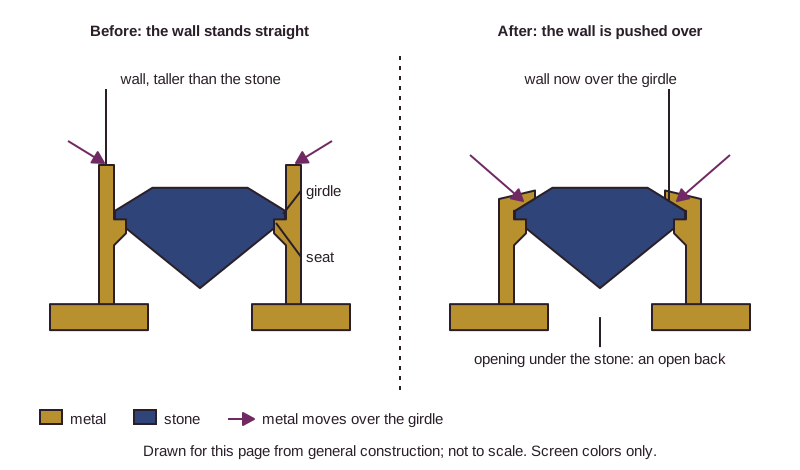
What is a bezel setting?
Wider than a phone screen: swipe sideways along the diagram, or open it full size.
A bezel before and after its wall is pushed over the girdle; this one is open behind. Drawn from general construction; screen colors.
Data: Drawn for this page from general construction; not copied from any maker's drawing
Picture a thin collar of metal standing around a stone. The stone rests on a ledge inside, the seat, and the top of the collar is pushed inward until it lies over the girdle all round. Cellini's word, translated as bezel, covers the whole box a stone is fitted into, "whether in a pendant, a ring, or what not" [1].
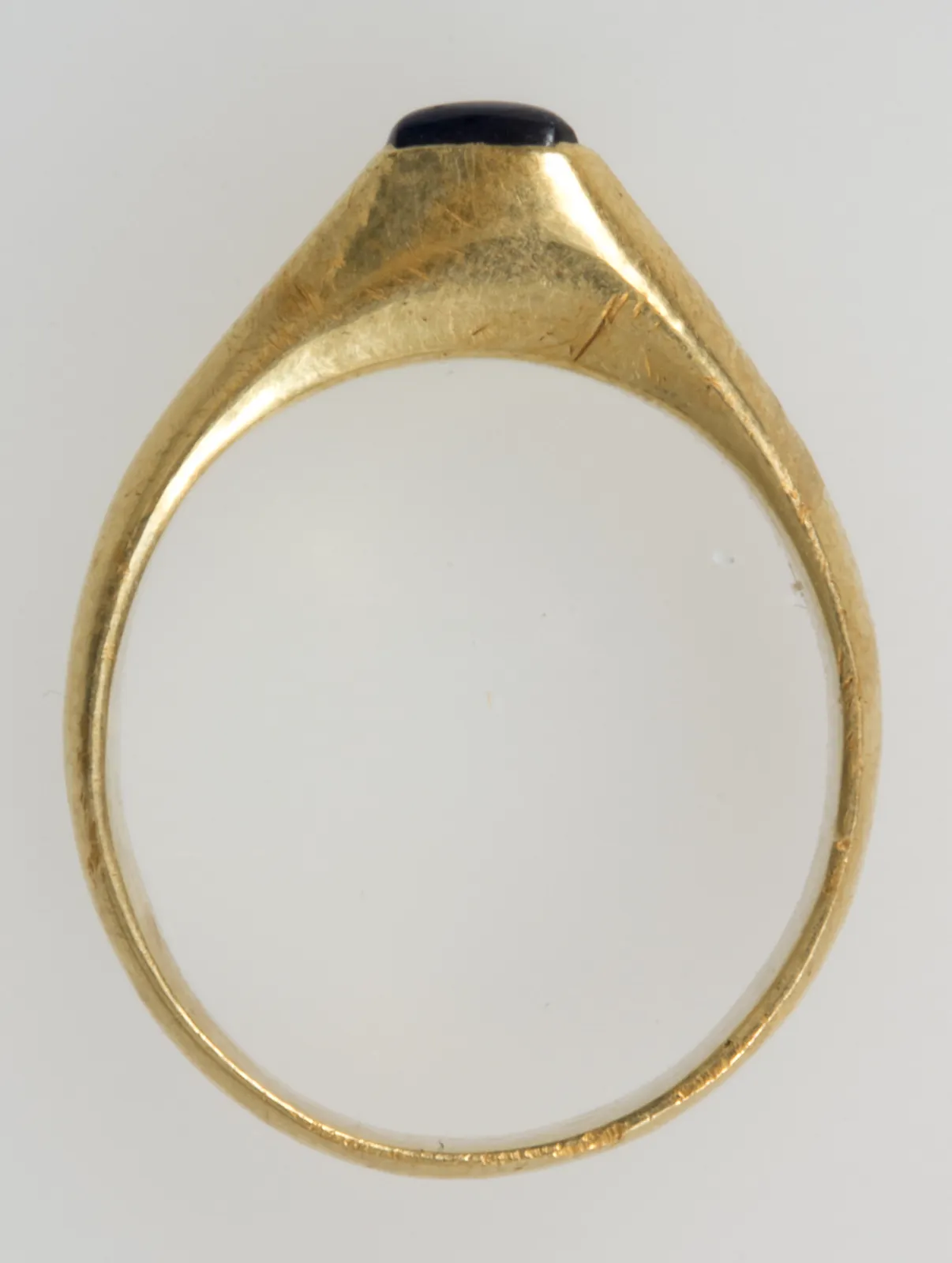
The same ring from the side (The Met, 2015.697): the hoop thickens into a tapering block with the stone at its top.
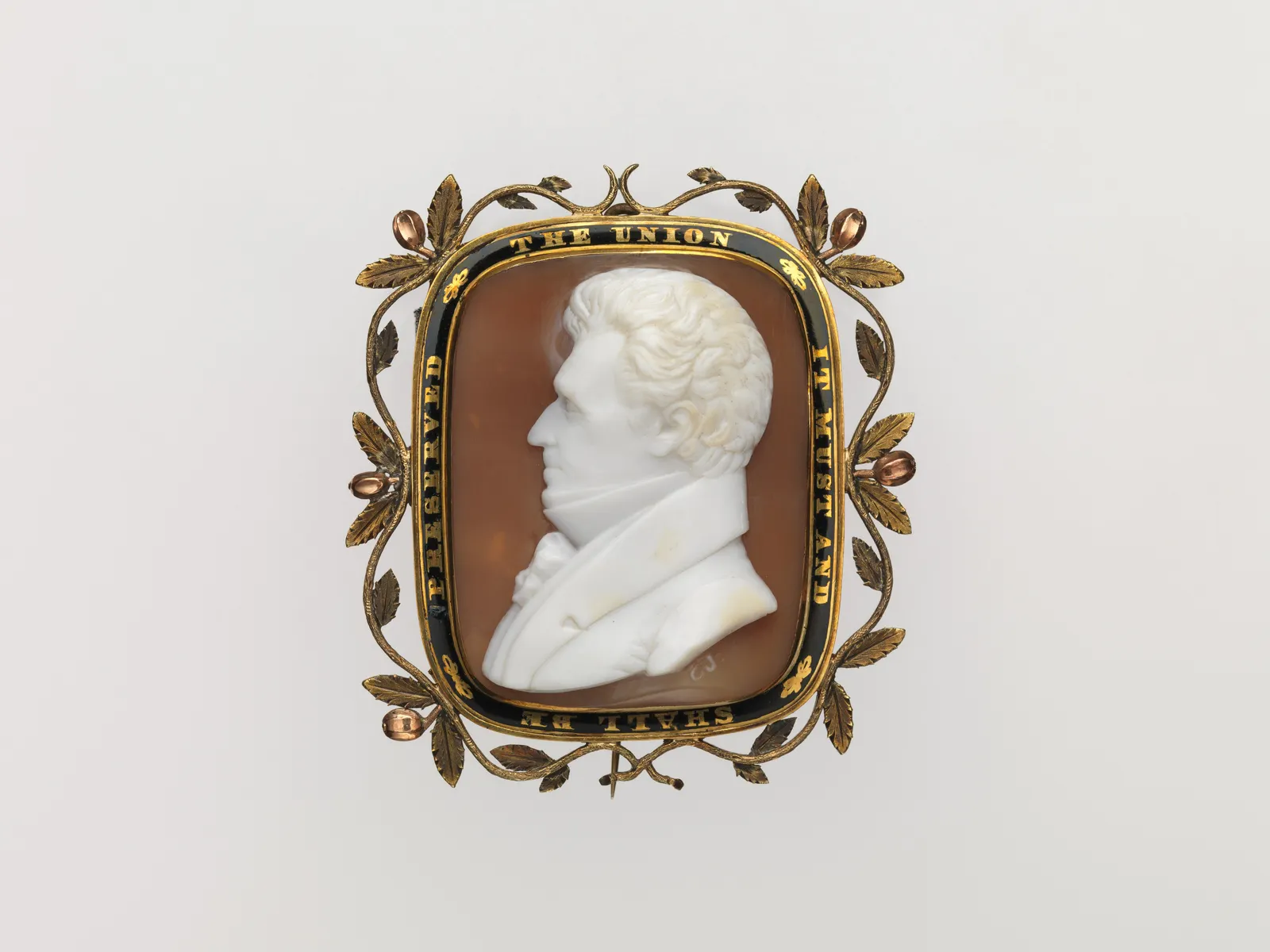
The stirrup ring shows such a rim from outside, but its record says nothing about what is underneath [2], and the wall alone cannot tell you. The Walters Art Museum describes a 16th-century gold ring with a table-cut diamond in a box bezel raised above the hoop [3]. A carved stone can sit in a bezel too: the Walters records a Roman sardonyx cameo set in a 17th-century gold ring with an oval bezel [4]; see what cameos are made of.
How do prongs differ from a bezel?
Wider than a phone screen: swipe sideways along the diagram, or open it full size.
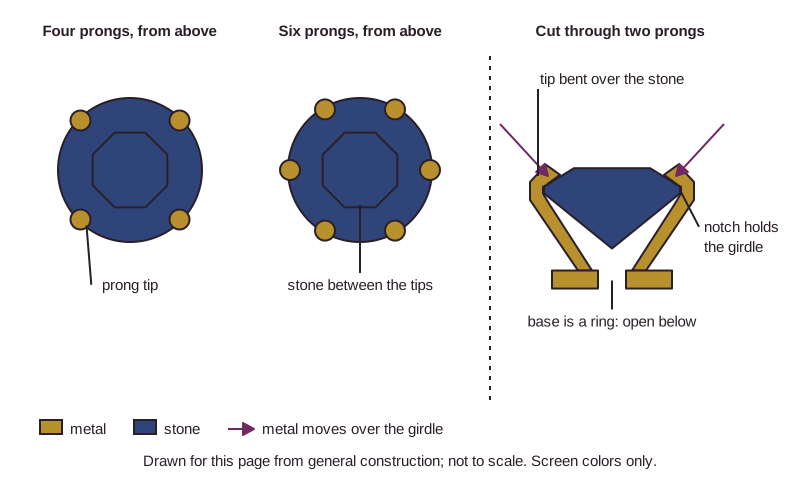
Four and six prongs from above, and a cut through two: each prong is notched for the girdle and bent over it. Drawn from general construction; screen colors.
Data: Drawn for this page from general construction; not copied from any maker's drawing
Swap the continuous wall for a few separate claws and you have a prong setting. Each prong is notched where the girdle sits and bent over the stone at its tip, so metal touches the edge only at the prongs, four or six in the drawings here, and the back stays open between them.
Cellini set one great diamond this way, "quite free (à jour) between four claws," on the morse, the large clasp he made for the cope of Pope Clement [1]. Some jewelers wanted him to tint the stone's base and back facets instead [1]. Each prong works like a small clamp, and the stone stays put because the clamps press from opposite sides.
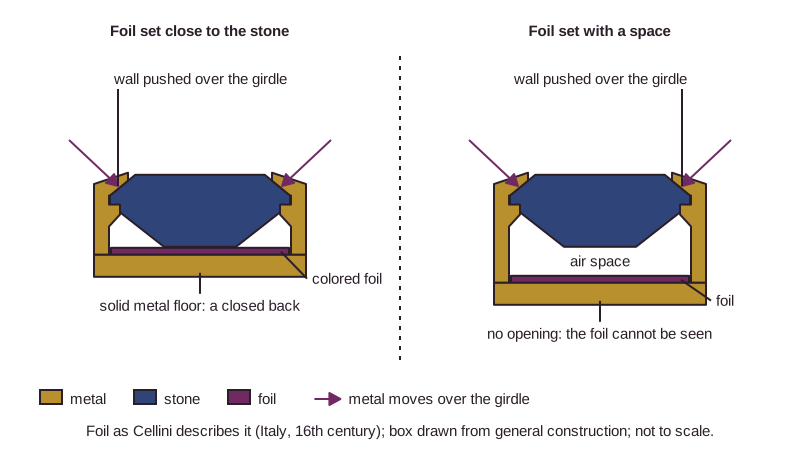
What did a closed back hide?
Wider than a phone screen: swipe sideways along the diagram, or open it full size.
Foil behind the stone in a closed box, set close (left) or with a space (right), as Cellini describes. Box drawn from general construction; screen colors.
Data: Foil placement as described by Benvenuto Cellini, trans. C. R. Ashbee (1898), ch. V, Project Gutenberg eBook #72995 (public domain); box drawn for this page from general construction
Turn a closed-back ring over and you see metal where the point of the stone would be. Whatever lies between the stone and that solid floor stays out of sight. In Cellini's account, it was foil.
In his account, the jeweler tried the ruby over each foil until he found the one that gave the stone "most value" [1]. He then placed the chosen foil in the setting, close to the stone or with a space between, because the effect changes once no air passes behind [1]. Emeralds and sapphires got the same care, and Cellini names yellow, red, blue and green foils, each a different mixture of gold, silver and copper [1].
Nothing on the front gave the backing away. Cellini once put a scrap of silk dyed with kermes behind a ruby instead of a foil. When other jewelers asked which foil he had used, he said none, and in the end he opened the bezel and took the stone out in front of them [1].
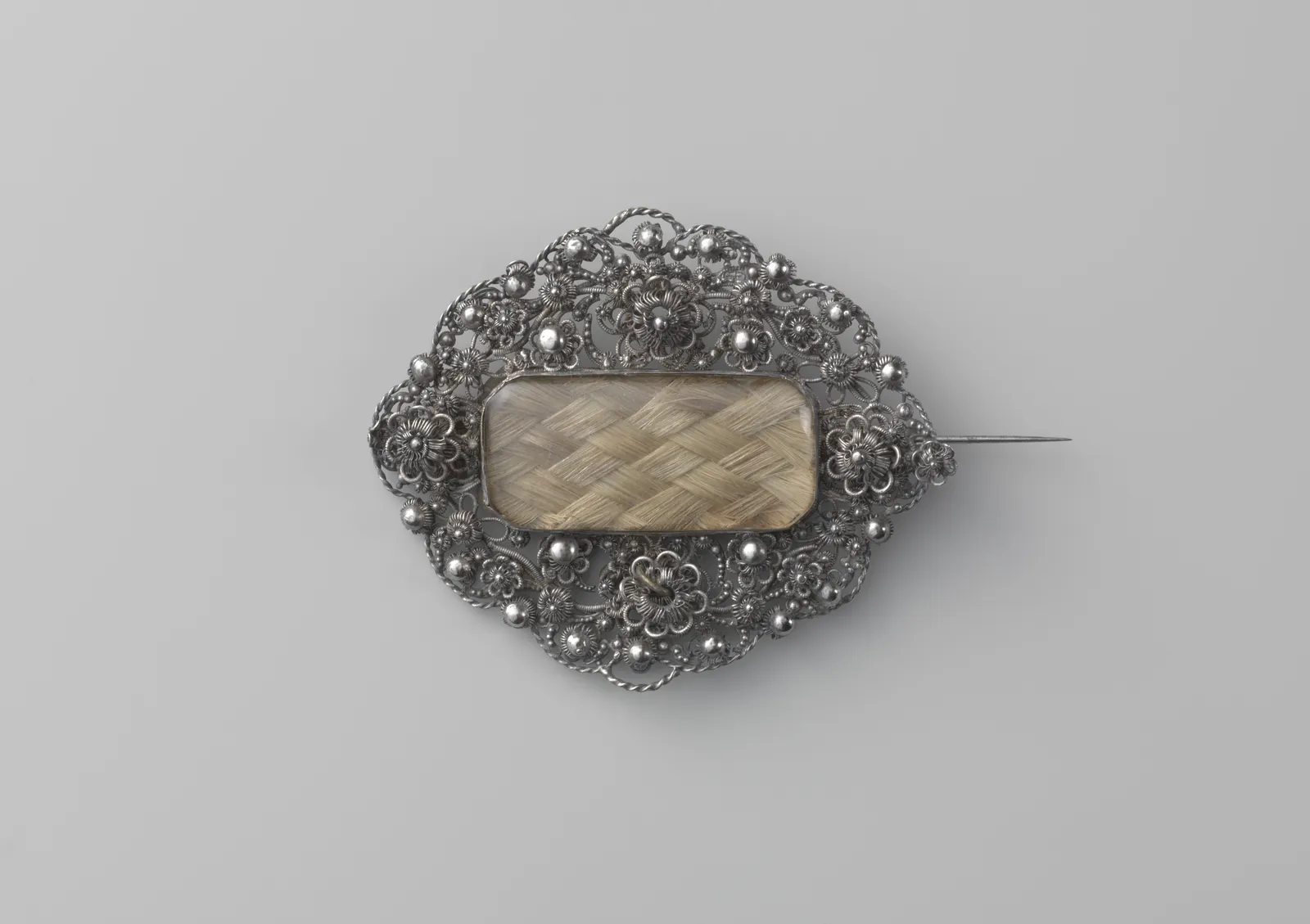
This site reads jewelry from the back, since a setting often tells more about when and by whom a piece was made than the stone on the front, and a closed back is the hard case. The Walters lists silver foil among the materials of a gilded bronze ring with rock crystal, dated 1480 to 1500, without saying where the foil sits [5]. It also describes a mourning brooch of about 1850 with a braid of brown hair beneath crystal [6]; see Victorian hair jewelry. Cloth keeps evidence on its back as well: types of weave shows a twill's diagonal running the opposite way once the cloth is turned over.
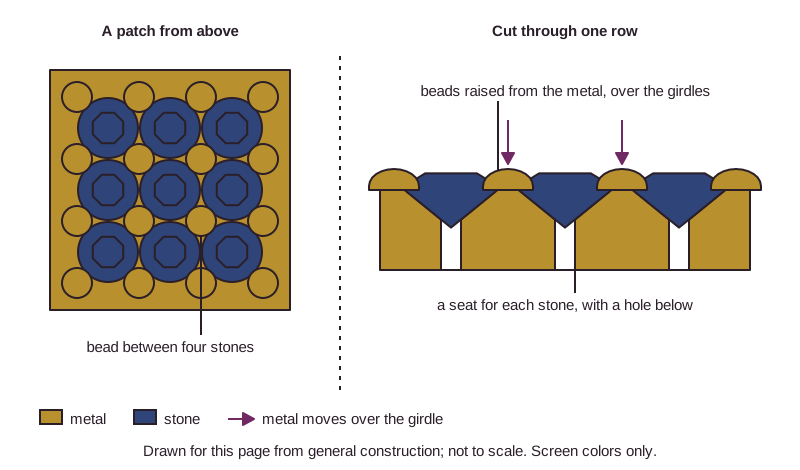
What is a pavé setting?
Wider than a phone screen: swipe sideways along the diagram, or open it full size.
Pavé from above and in section: beads raised between the stones hold their edges, with a hole below each stone. Drawn from general construction; screen colors.
Data: Drawn for this page from general construction; not copied from any maker's drawing
Up close, a surface paved with small stones shows tiny knobs of metal between them. Each stone sits in its own seat, and beads raised from the surrounding metal are pushed over the girdles, so one bead can hold several stones.
The Walters catalogues an 18th-century ring of gold, diamonds and silver, titled "Ring with Cluster of Stones," whose diamonds it describes as pavé set, clustered close enough to hide the metal [7].
Illustration
A jeweler's bench: a steel graver, a hand lens and an unset ring band in a wooden clamp.
Illustration: Tailor, Weaver, Jeweler, Dyer. Generated schematic image — not a photograph or historical record. Reuse terms: may be shared with this full caption and a link to the source page; not licensed under CC BY.
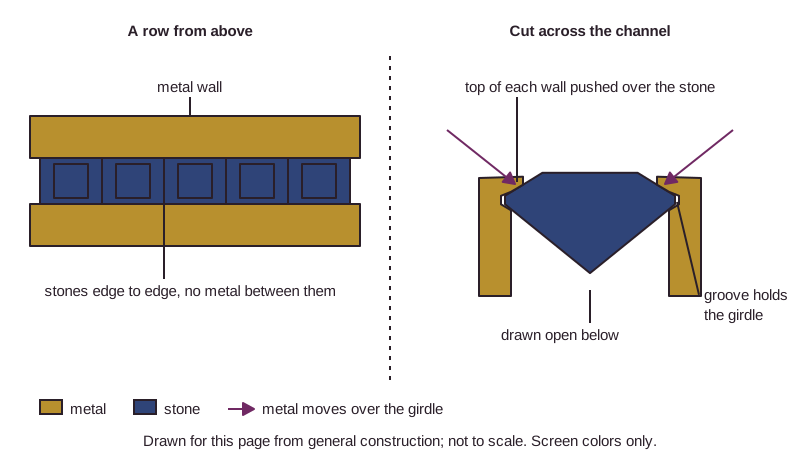
What is a channel setting?
Wider than a phone screen: swipe sideways along the diagram, or open it full size.
A channel from above and in section: two grooved walls hold a row of stones, with no metal between them. Drawn from general construction; screen colors.
Data: Drawn for this page from general construction; not copied from any maker's drawing
In a channel setting, stones line up in a track between two parallel walls, each grooved for the girdles, with the tops of the walls pushed over the stones. From above, no metal separates one stone from the next. No dated museum record naming a channel setting was read for this page, so no date is given here.
What is a gypsy setting?
Wider than a phone screen: swipe sideways along the diagram, or open it full size.
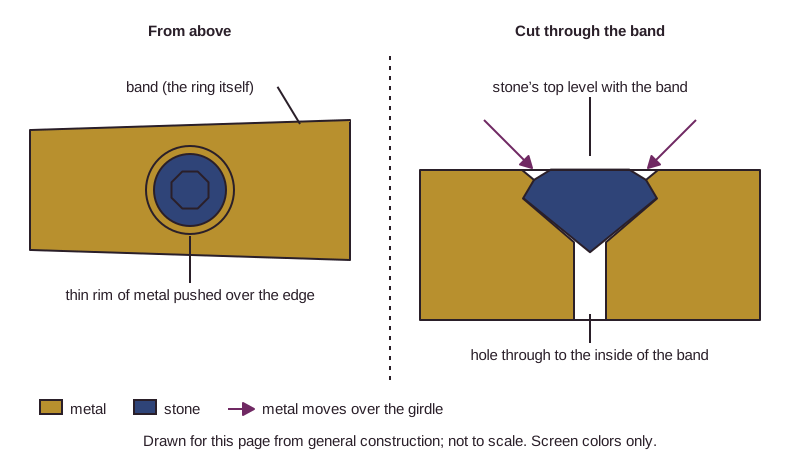
A gypsy setting from above and in section: the stone sits level with the band, held by the rim of its hole. Drawn from general construction; screen colors.
Data: Drawn for this page from general construction; not copied from any maker's drawing
A gypsy setting sinks the stone into the band itself. A hole is cut into a thick part of the ring, the stone drops in until its top is level with the metal, and the rim of the hole is pushed over the girdle. As with the channel setting, no dated museum record naming a gypsy setting was read for this page.
1Benvenuto Cellini. The Treatises of Benvenuto Cellini on Goldsmithing and Sculpture. Translated by C. R. Ashbee. London: Edward Arnold, 1898, introduction and chs. V–VII. Project Gutenberg eBook #72995. https://www.gutenberg.org/ebooks/72995(full text)
2The Metropolitan Museum of Art. "Stirrup Ring," British, late 13th or early 14th century, gold and sapphire, 2015.697 (The Cloisters Collection, 2015). Catalogue data row on the Wikimedia Commons file page. https://commons.wikimedia.org/wiki/File:Stirrup_Ring_MET_DP701987.jpg(collection record (catalogue data, CC0))
3Walters Art Museum. "Diamond Ring," 16th century (Renaissance), gold, enamel, diamond, 44.313. https://purl.thewalters.org/art/44.313(collection record (catalogue data, CC0); catalogue description paraphrased)
4Walters Art Museum. "Cameo with a Man Reading from a Scroll Set in a Ring," gem 1st–2nd century CE, ring 17th century, sardonyx, mount gold, 42.1344. https://purl.thewalters.org/art/42.1344(collection record (catalogue data, CC0); catalogue description paraphrased)
5Walters Art Museum. "Ecclesiastical 'Passport' Ring," 1480–1500 (Renaissance), gilded bronze, rock crystal, silver foil, 54.432. https://purl.thewalters.org/art/54.432(collection record (catalogue data, CC0))
6Walters Art Museum. "Mourning Brooch," ca. 1850, gold, crystal, hair, 57.2060. https://purl.thewalters.org/art/57.2060(collection record (catalogue data, CC0); catalogue description paraphrased)
7Walters Art Museum. "Ring with Cluster of Stones," 18th century, gold, diamond, silver, 57.1757. https://purl.thewalters.org/art/57.1757(collection record (catalogue data, CC0); catalogue description paraphrased)